We're loading the complete profile of this person of interest including their biography, achievements, and contributions.
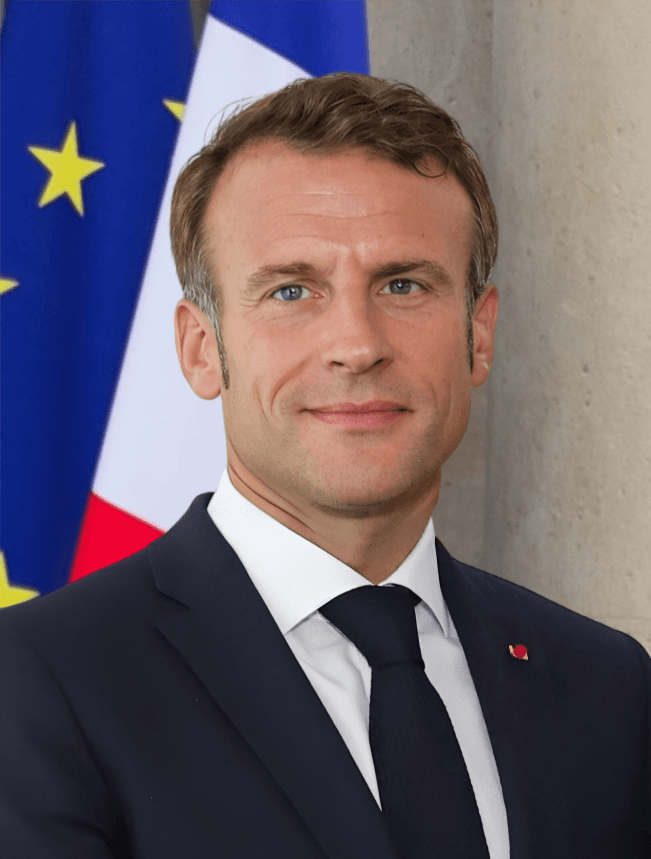
President of France
Public Views
Experience
Documented career positions
Emmanuel Jean-Michel Frédéric Macron is a French politician who has served as the President of France since May 14, 2017. Born on December 21, 1977, in Amiens, France, to Jean-Michel Macron, a professor of neurology, and Françoise Nogues, a physician, Macron pursued a path of elite academic and professional achievement before ascending to the highest office in the French Republic. Macron’s education was marked by his attendance at prestigious institutions. After attending the Lycée La Providence in Amiens, he completed his secondary education at the Lycée Henri-IV in Paris. He went on to study philosophy at the University of Paris Nanterre, obtaining a DEA degree, and subsequently attended the Paris Institute of Political Studies (Sciences Po). He completed his formal education at the École Nationale d'Administration (ENA), graduating in 2004. Upon graduation, he joined the Inspectorate General of Finances (IGF), a senior civil service corps, serving as an inspector from 2004 to 2008. In 2008, Macron transitioned to the private sector, joining the investment bank Rothschild & Cie. His tenure there was marked by his work on high-profile mergers and acquisitions, including the prominent Nestle-Pfizer deal. This period in the private sector concluded in 2012 when he returned to public service. He served as the deputy secretary-general of the Élysée under President François Hollande before being appointed Minister of Economy, Industry and Digital Affairs in 2014. During his ministerial tenure, he championed the "Loi Macron," a package of reforms aimed at liberalizing the French economy by deregulating certain sectors, which underscored his centrist, pro-market economic philosophy. In April 2016, Macron resigned from the government to launch his own political movement, En Marche!, which he described as neither left nor right. Leveraging this new platform, he contested the 2017 presidential election. In a historic victory, he defeated National Front candidate Marine Le Pen in the second round of voting, becoming the youngest president in French history at the age of 39. His administration focused on ambitious labor and tax reforms, though he faced significant domestic pushback, most notably during the "Yellow Vests" (Gilets Jaunes) protest movement that began in 2018. Macron’s presidency has been characterized by a strong commitment to European integration and a proactive foreign policy. During his first term, he navigated the complexities of the COVID-19 pandemic and sought to position France as a central leader within the European Union. In 2022, he sought re-election and successfully defeated Marine Le Pen once again, becoming the first French president to win a second consecutive term since Jacques Chirac in 2002. His second term has been marked by contentious efforts to reform the French pension system, which was enacted in 2023 despite widespread public protests and parliamentary instability. Regarding his personal life, Macron married Brigitte Trogneux, his former drama teacher, in 2007. Their relationship has been a subject of significant public and media interest throughout his political career. As a political figure, Macron is frequently associated with pragmatism and a technocratic approach to governance. His legacy remains a subject of ongoing debate; supporters highlight his efforts to modernize the French economy, strengthen European sovereignty, and address climate change, while critics often point to perceived elitism, the social tensions arising from his reform agenda, and the fragmentation of the traditional political landscape in France. As of March 2026, he continues to navigate the challenges of governing a polarized French electorate while managing the complex international and domestic responsibilities of his office.
Youngest President in French history (elected at age 39) and the first French President in 20 years to win re-election (2022)
The primary architect of 'European Strategic Autonomy,' successfully pushing the EU to pool debt for post-pandemic recovery and heavily invest in domestic defense manufacturing
Passed highly controversial, deeply unpopular pension reforms (raising the retirement age from 62 to 64) via executive decree, stabilizing the French fiscal trajectory
His decision to call snap legislative elections in 2024 was viewed as a catastrophic strategic blunder that crippled his domestic agenda and empowered both the far-left coalition and the far-right National Rally
His presidency has been defined by massive, frequently violent street protests, including the 'Yellow Vests' (Gilets Jaunes) and nationwide strikes over his pension reforms, cementing his reputation among the working class as the 'President of the Rich'
Criticized internationally early in the Ukraine war for his persistent, ultimately fruitless attempts to negotiate directly with Vladimir Putin
News articles featuring Emmanuel Macron
Graduated from the École Nationale d'Administration in 2004.
Joined the Inspectorate General of Finance as a civil servant in 2004.
Appointed Deputy Secretary-General of the Élysée Palace in 2012.
Appointed Minister of Economics, Industry, and Digital Affairs in 2014.
Championed the 'Macron Law' in 2015, aimed at economic liberalization and growth.
Founded the political movement 'En Marche!' in 2016, which later became the Renaissance party.
Elected as the 25th President of France in 2017, becoming the youngest president in French history.
Assumed the role of Co-Prince of Andorra in 2017, an office held ex-officio by the French president.
Secured a legislative majority for his party, La République En Marche!, in the 2017 French legislative election.
Re-elected as President of France in 2022, becoming the first French president to win a second term since 2002.
Oversaw the passage of pension reform legislation in 2023, increasing the retirement age from 62 to 64.
Awarded the Olympic Order in gold in 2024 in recognition of his support for the Paris 2024 Olympic Games.
In 2018, the 'Benalla affair' erupted after footage emerged of Alexandre Benalla, a top security aide to President Macron, assaulting a protester while impersonating a police officer. The scandal led to major political fallout, with accusations that the Élysée Palace attempted to cover up the incident and failed to report the illegal actions to the authorities.
Starting in late 2018, Macron's presidency faced the 'Yellow Vests' (Gilets Jaunes) protests, a prolonged and often violent movement sparked by proposed fuel taxes and deeper economic grievances. Critics accused Macron of being disconnected from the struggles of ordinary citizens and perceived his leadership style as arrogant and elite-focused.
In January 2022, Macron faced intense criticism and backlash from political opponents for stating in an interview that his strategy for dealing with unvaccinated people was to 'piss them off' (emmerder) by restricting their access to public life. The remarks were condemned as vulgar and unworthy of the presidential office.
In 2022, the 'Uber Files' leak revealed that while serving as Minister of Economy (2014–2016), Macron had engaged in multiple undisclosed meetings and communications to assist Uber in its lobbying efforts to bypass French regulations. Critics accused him of prioritizing private corporate interests over public policy and the domestic taxi industry.
During his 2022 re-election campaign, Macron faced scrutiny over the government's extensive use of private consulting firms, particularly McKinsey, for public policy projects. Allegations of favoritism and questions regarding the firm's tax practices led to a judicial investigation into campaign financing, though Macron was not personally accused of wrongdoing.
In 2023, Macron’s government faced widespread national strikes and protests after passing legislation to raise the retirement age from 62 to 64. The decision to invoke Article 49.3 of the Constitution to bypass a parliamentary vote on the measure was denounced by opposition lawmakers and protesters as an undemocratic move.