We're loading the full news article for you. This includes the article content, images, author information, and related articles.
Former DP claims the state has secretly offloaded a 15% stake in the telco giant at a “throwaway” price of KES 34 per share, warning that the country is eating its own future.
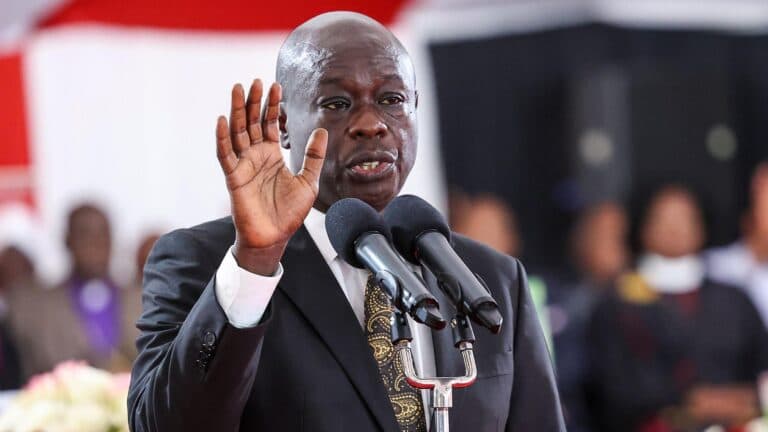
NAIROBI — In his most blistering attack since leaving office, former Deputy President Rigathi Gachagua has accused the government of committing “economic treason” by selling off a significant chunk of Safaricom, the jewel of Kenya’s corporate crown.
Speaking to a packed congregation at Christian Dominion Ministries in Kasarani on Sunday, Gachagua did not mince words. He painted a picture of an administration so desperate for cash that it is auctioning the family silver to pay for lunch.
“We are in a place where Ruto is selling everything that is working,” Gachagua declared, his voice echoing off the church walls. “Kenya Pipeline is gone. The ports are gone. And now, they have sold Safaricom.”
Breaking down complex economics into a parable for the mwananchi, Gachagua likened the sale to a farmer destroying his only source of livelihood.
“It is like having a high-yielding cow in your home,” he explained, switching to an impassioned mix of English and Swahili. “Hio ngombe ndio inatoa maziwa watoto wanakunywa (That cow provides the milk your children drink). But you sell it to buy food for just one day. Once you eat that food, you have no cow left to milk. What will you feed them tomorrow?”
The metaphor strikes a nerve in a country where Safaricom is not just a company but a lifeline—powering everything from morning bus fares to evening school fees via M-PESA.
Gachagua alleged that the government has quietly offloaded a 15% stake to foreign investors, slashing the state’s shareholding from 35% to just 20%. But his sharpest criticism was reserved for the price tag.
“Safaricom generates KES 18 billion to KES 20 billion for the Treasury every year,” he noted. “Why sell a golden goose for peanuts? Who is buying these shares at half-price?”
The government, however, tells a different story. Treasury Cabinet Secretary John Mbadi has previously defended the move, describing the proceeds—estimated at KES 240.5 billion ($1.6 billion)—as essential “seed capital” for the new National Infrastructure Fund.
According to the Treasury, the sale is a strategic realignment to reduce debt servicing costs, which currently consume over 60% of tax revenue. Officials insist the state retains a 20% stake and sufficient voting power to protect national interests, including M-PESA’s critical financial infrastructure.
Yet, for many Kenyans watching the shilling fluctuate and taxes rise, the logic of selling a profitable asset to pay off debts feels like digging a new hole to fill an old one.
Beyond the economics, the speech signaled a deepening political realignment. Gachagua, now firmly entrenched in the opposition, hinted at a joint strategy with Wiper Leader Kalonzo Musyoka to “liberate Nairobi” from the ruling UDA party.
“We must liberate this country,” Gachagua concluded, framing the asset sales not just as bad policy, but as a moral failure. “If we stay silent, we will wake up one day to find even the soil we stand on has been sold.”
Keep the conversation in one place—threads here stay linked to the story and in the forums.
Sign in to start a discussion
Start a conversation about this story and keep it linked here.
Other hot threads
E-sports and Gaming Community in Kenya
Active 9 months ago
The Role of Technology in Modern Agriculture (AgriTech)
Active 9 months ago
Popular Recreational Activities Across Counties
Active 9 months ago
Investing in Youth Sports Development Programs
Active 9 months ago
Key figures and persons of interest featured in this article