We're loading the full news article for you. This includes the article content, images, author information, and related articles.
NASA shares a stunning ISS photo of "fish-shaped" clouds over Patagonia, explaining the rare atmospheric physics behind the lenticular formation.
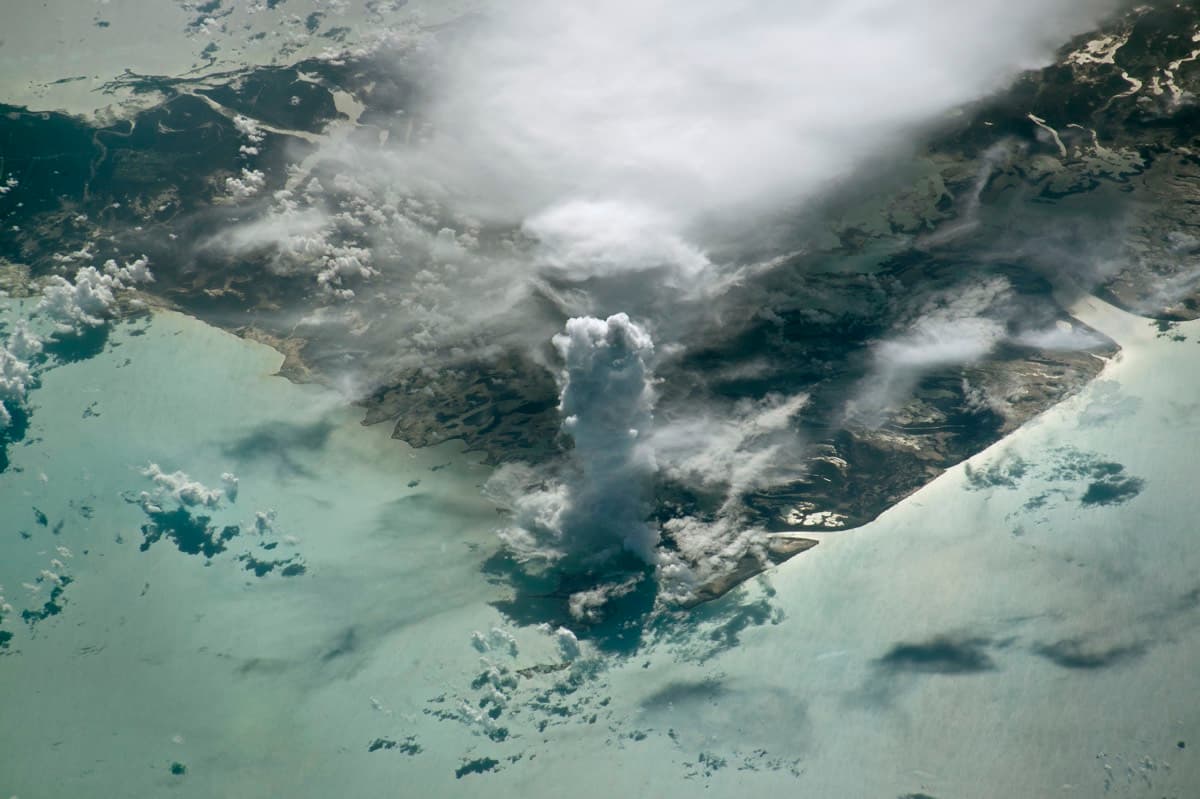
Nature has a way of mimicking art, but rarely on this scale. An astronaut aboard the International Space Station (ISS) has captured a stunning image of "fish-shaped" clouds swimming through the atmosphere over Lago Argentino in Patagonia, leaving scientists buzzing with theories about their origin.
The photograph, snapped in late December 2025, shows a school of elongated, teal-tinted clouds hovering above the glacial lake. To the untrained eye, they look like giant koi fish suspended in the air. To NASA experts, however, they are a textbook—albeit spectacular—example of atmospheric physics at work in one of the world's most turbulent weather corridors.
NASA scientists believe these are likely lenticular clouds, formed by strong winds hitting the Andes Mountains. "It’s a classic case of lee waves," explained Maria Hakuba from NASA's Jet Propulsion Laboratory. "When stable air is forced up over a mountain range, it creates a wave pattern on the other side. The air cools at the crest, condensing into clouds that appear stationary, even as the wind rushes through them."
However, the unique "fish" shape is due to a combination of wind shear and turbulence. Strong winds stretched the clouds horizontally, while shadows cast on the landscape below gave them depth and form. "It’s a perfect storm of moisture, topography, and light," added Hazem Mahmoud from NASA's Langley Research Center.
While lenticular clouds are common in mountainous regions like Mt. Kilimanjaro or Mt. Kenya, this specific formation is rare due to the clarity and the "schooling" effect. "Together, these clouds tell a story of the interaction between the Andes' dynamic topography and the moisture from the lake," Mahmoud noted.
For the astronaut looking down from 400 kilometers up, it was a lucky snap. For us on Earth, it is a reminder that the atmosphere is a fluid ocean, constantly painting masterpieces that vanish as quickly as they form.
Keep the conversation in one place—threads here stay linked to the story and in the forums.
Sign in to start a discussion
Start a conversation about this story and keep it linked here.
Other hot threads
E-sports and Gaming Community in Kenya
Active 9 months ago
The Role of Technology in Modern Agriculture (AgriTech)
Active 9 months ago
Popular Recreational Activities Across Counties
Active 9 months ago
Investing in Youth Sports Development Programs
Active 9 months ago