We're loading the full news article for you. This includes the article content, images, author information, and related articles.
President William Ruto’s five-day development tour of Western Kenya seeks to secure 2.6 million votes, testing his influence against a rising opposition.
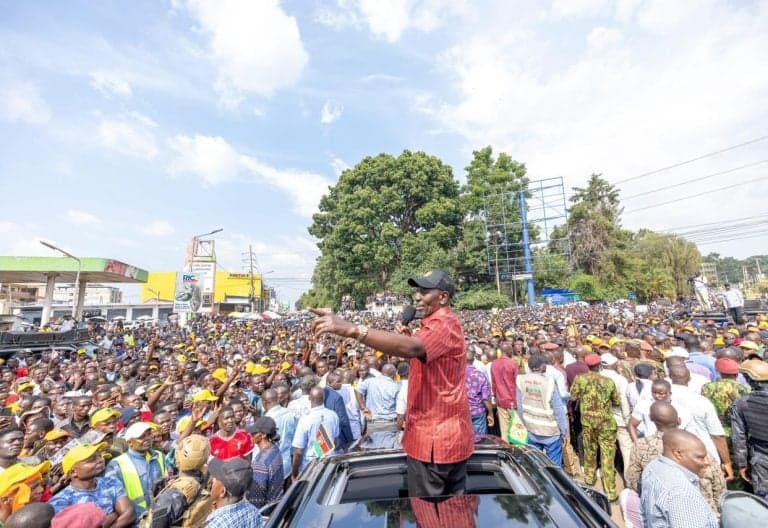
President William Ruto’s motorcade stirred thick, red dust across Kakamega County on Monday morning, marking the start of a pivotal five-day development tour that serves as a high-stakes campaign for the soul of Western Kenya. Stepping out to a mix of formal welcomes and wary, expectant crowds, the President signaled that his administration is moving beyond national policy to the aggressive, localized implementation of infrastructure projects designed to fracture a historically stubborn opposition stronghold.
This political maneuvering is not merely about road construction or market sheds it is an existential scramble for 2.6 million votes ahead of the 2027 General Election. With traditional power structures in the region in flux—marked by the decline of older political heavyweights and the emergence of youth-led movements—Ruto is wagering that tangible, state-funded development can serve as a potent wedge to peel away support from opposition bastions. The gamble is high: he is betting that the promise of economic modernization will override deep-seated grievances about the cost of living and historical political marginalization.
The centerpiece of the President’s visit is an array of capital-intensive projects that the government argues will unlock the region’s economic potential. This strategy, often described by political analysts as "developmental patronage," relies on the visible delivery of services to create a political dividend. During this week-long tour, the administration has showcased several flagship initiatives aimed at transforming the local economic landscape:
Economists at the University of Nairobi argue that while these projects are objectively necessary for regional growth, their timing is distinctly tactical. By flooding the region with project launches, the administration creates a narrative of progress that its local point-men—Prime Cabinet Secretary Musalia Mudavadi, National Assembly Speaker Moses Wetang`ula, and Cabinet Secretary Wycliffe Oparanya—can use to campaign for the 2027 re-election bid. The goal is to convince a skeptical electorate that their path to prosperity lies in alignment with the central government rather than opposition agitation.
However, the political soil in Western Kenya is far from fertile for this unified pro-government strategy. The traditional gatekeepers—Mudavadi and Wetang`ula—are facing a crisis of legitimacy. For years, they were viewed as the definitive voices of the Luhya community. Yet, their integration into the Kenya Kwanza administration has left them vulnerable to accusations of political sycophancy, particularly as the cost of living remains stubbornly high.
Standing in sharp opposition to this establishment-backed alignment is the "Tawe" movement, led by Trans Nzoia Governor George Natembeya. This movement has evolved from a regional slogan into a potent socio-political identity that rejects the transactional nature of previous political alliances. Natembeya and his allies, including a cadre of younger, digitally savvy politicians, are framing the 2027 contest as a choice between a "new, reformist renaissance" and the "old, failed brokerage" of the past. Their message resonates with a youth population that feels increasingly disconnected from the political maneuvers of the senior elite.
The divide is stark. While the pro-government faction attempts to solidify support through state resources, the opposition-aligned grouping is doubling down on grassroots mobilization. They are painting the current development tour not as an act of service, but as a desperate attempt to purchase loyalty in a region that has historically stood firm against such overtures.
The strategic importance of Western Kenya in the 2027 electoral map cannot be overstated. With 2.6 million registered voters, the region is a decisive bloc that can tip the balance in a tight national race. For President Ruto, securing a majority of these votes is not just a bonus it is a necessity to cushion his support base, especially as he navigates shifting loyalties in other key regions like Mount Kenya.
Yet, the political reality is messy. Internal divisions within the Orange Democratic Movement (ODM) and the broader opposition are creating a fragmented landscape where local leaders are hedging their bets. Some are openly courting government resources, while others are maintaining a cautious, performative opposition. This ambiguity has turned the region into a volatile laboratory of political influence, where the electorate is increasingly aware of their leverage.
Ultimately, the President’s five-day tour is a test of whether state-driven infrastructure development can conquer the deep-rooted political culture of a region that has long viewed itself as the kingmaker of Kenyan politics. As the convoys move from market to market, the question remains: will the residents of Western Kenya trade their political independence for the promise of bitumen roads and modern housing, or will the "Tawe" sentiment prove that some allegiances are not for sale?
Keep the conversation in one place—threads here stay linked to the story and in the forums.
Sign in to start a discussion
Start a conversation about this story and keep it linked here.
Other hot threads
E-sports and Gaming Community in Kenya
Active 10 months ago
The Role of Technology in Modern Agriculture (AgriTech)
Active 10 months ago
Popular Recreational Activities Across Counties
Active 10 months ago
Investing in Youth Sports Development Programs
Active 10 months ago
Key figures and persons of interest featured in this article