We're loading the full news article for you. This includes the article content, images, author information, and related articles.
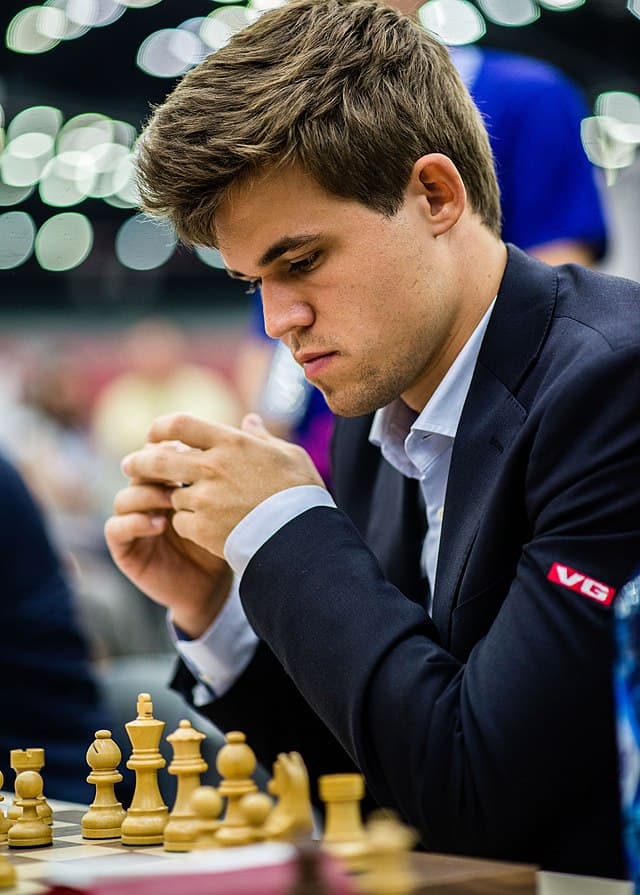
Magnus Carlsen has added a new kind of crown to his collection, winning the inaugural FIDE Freestyle Chess World Championship at Weissenhaus after defeating Fabiano Caruana 2.5–1.5 in the final.
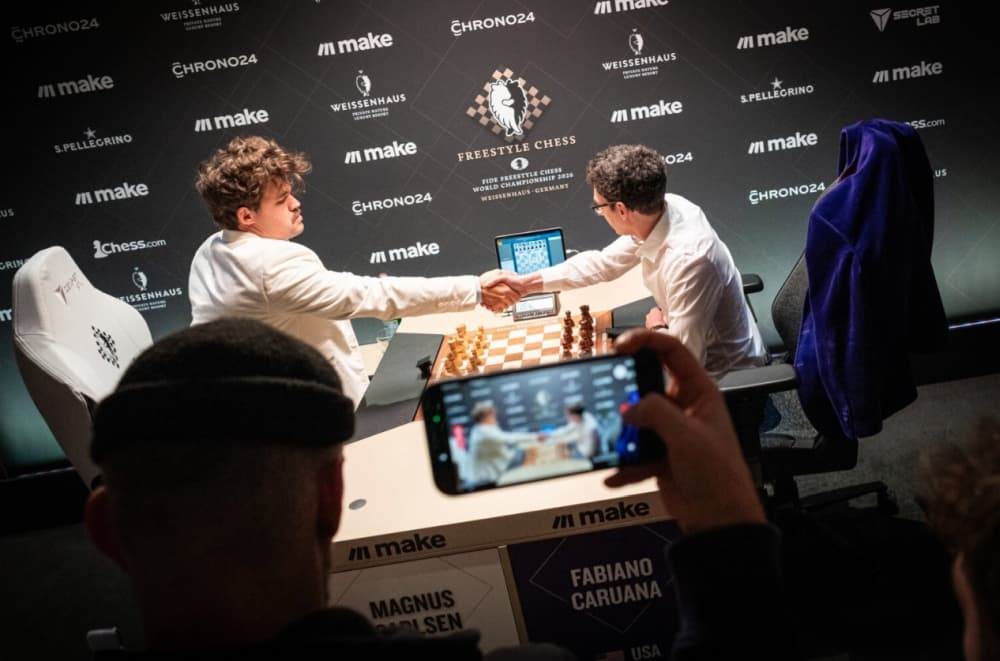
WEISSENHAUS, GERMANY — February 15, 2026: Magnus Carlsen has added a new kind of crown to his collection, winning the inaugural FIDE Freestyle Chess World Championship at Weissenhaus after defeating Fabiano Caruana 2.5–1.5 in the final.
It was not a victory built on a single opening novelty or a prepared line—because in freestyle chess (the FIDE-branded form of Chess960), the starting position changes, and the familiar “map” of opening theory largely disappears. The championship’s structure reinforced that philosophy: an eight-player round-robin in rapid (10+5) determined the top four, then a knockout decided the title through four classical-speed games (25+10) per match.
Carlsen finished first in the round-robin on 4.5/7, then navigated the knockout bracket to face Caruana—his old rival from the 2018 classical world championship match.
The final is best understood as three acts.
Act I: balance.
Game one was quiet and symmetrical, with neither side landing a decisive punch.
Act II: Caruana’s pressure without payoff.
Game two suggested Caruana might seize control—he obtained strong chances, but the conversion window narrowed and Carlsen defended through complications and time pressure.
Act III: the game that should have ended the match—until it didn’t.
Game three delivered the defining narrative: Carlsen’s position deteriorated sharply after an error (reported as 15…Bxh4?), and by multiple accounts Caruana reached a “completely winning” position—only to let it slip.
What followed is the core Carlsen skill that freestyle chess magnifies: when the board becomes unfamiliar and “best play” is hard to see, Carlsen is often the first to find practical play—moves that force concrete decisions, accelerate time trouble, and convert evaluation into psychology. In game three, the turnaround was not slow; it was sudden, as Carlsen generated threats so quickly that resignation arrived only a few moves later.
With that shock win, a draw in game four was enough to seal the title.
Freestyle chess is often marketed as “chess without openings.” That’s oversimplified. It is better described as chess with the comfort removed.
In classical chess, the early phase can be partly outsourced to memory and team preparation. In freestyle, the early phase becomes a live test of:
Orientation under uncertainty
Players must build a plan without familiar landmarks. Carlsen’s edge has long been his ability to find stable principles fast—king safety, piece coordination, pawn levers—then improve his position incrementally until the opponent runs out of easy moves.
Error management (not error avoidance)
At elite level, everyone blunders occasionally—especially in unusual positions and faster time controls. The separator is what happens next. Carlsen’s career has repeatedly shown a rare capacity to continue playing resourcefully after mistakes, keeping the game alive long enough for the opponent to face hard choices. Game three of this final was a textbook example.
Endgame confidence as a pressure weapon
Freestyle chess often reaches “non-standard” endgames where patterns are less rehearsed. Carlsen’s endgame reputation changes opponent behavior: rivals often feel they must convert earlier advantages quickly—ironically increasing the chance of overpressing, miscalculating, or choosing an imprecise simplification.
Time, nerves, and stamina
This event landed right after major high-intensity chess commitments for Carlsen (including elite speed play in London days earlier, per contemporary reporting), making the win partly a story of stamina and recovery under fatigue.
This championship was also a governance and ecosystem story: it marked a formal collaboration between FIDE and the Freestyle Chess organizers, turning what had been a high-profile circuit concept into an official world-title pathway.
It also sharpened an uncomfortable truth for everyone else: even in a format designed to reduce “home prep,” the world’s best generalist still tends to win. That raises a serious analytical question: if you can’t neutralize Carlsen by removing openings, what exactly is left?
The answer is not one thing; it is a cluster:
superior decision-making under incomplete information,
emotional control after errors,
an instinct for complications when “clean chess” favors the opponent,
and a ruthless sense of when a position is defendable in practice, not just on an engine bar.
If the question is “Will there be another world champion?”—of course. If the question is “Will there be another Carlsen-shaped career?”—that is far harder.
Carlsen’s long-running anomaly is not only peak strength; it is durability across formats and the repeated ability to win when conditions change—classical, rapid, blitz, now freestyle.
To produce a comparable figure, the next generation would likely need four things at once:
Early pattern exposure (massive volume, but guided well)
Online chess increases volume; it does not guarantee judgment. The rare players turn volume into refined intuition.
A coaching environment that trains adaptability, not just lines
Freestyle success hints at training that prioritizes evaluation, planning, and endgame technique over memorization.
Psychological coaching as a competitive skill
Carlsen’s hallmark is how rarely he collapses after a mistake—and how often opponents do. That is teachable to a point, but not easily.
A life structure that sustains excellence
This is where the “even as a parent” lens becomes real: greatness depends on routines, recovery, relationships, and emotional stability. The public sees the trophy; the private life determines whether the level is repeatable for years.
The sharper question is not “Who is the next Carlsen?” It is: what combination of talent, environment, and temperament creates someone who can keep winning after the world adapts to them? Freestyle chess makes that challenge even harder, because it rewards the player who can build order out of chaos—again and again.
Carlsen’s win will likely accelerate two trends:
Freestyle chess as a serious title ecosystem, not a novelty. A world championship backed by FIDE and an elite broadcast-and-sponsor structure changes incentives for top players to invest in the format.
Training shifts toward universals: calculation, endgames, resilience, and decision-making under uncertainty—skills that also translate directly to parenting and leadership: how you respond after a mistake, how you keep thinking under pressure, and how you recover without drama.
Carlsen won because the decisive skill in freestyle chess is the ability to stay coherent when the position stops feeling familiar. In Weissenhaus, when the final briefly turned against him, coherence became a weapon—and it broke the match open.
Keep the conversation in one place—threads here stay linked to the story and in the forums.
Sign in to start a discussion
Start a conversation about this story and keep it linked here.
Other hot threads
E-sports and Gaming Community in Kenya
Active 9 months ago
The Role of Technology in Modern Agriculture (AgriTech)
Active 9 months ago
Popular Recreational Activities Across Counties
Active 9 months ago
Investing in Youth Sports Development Programs
Active 9 months ago
Key figures and persons of interest featured in this article