We're loading the full news article for you. This includes the article content, images, author information, and related articles.
A routine departure turns into a fight for survival as ground equipment erupts in flames at São Paulo’s busiest hub. For Kenyan travelers and aviation bosses, it is a chilling reminder: safety depends as much on the baggage loader as the pilot.
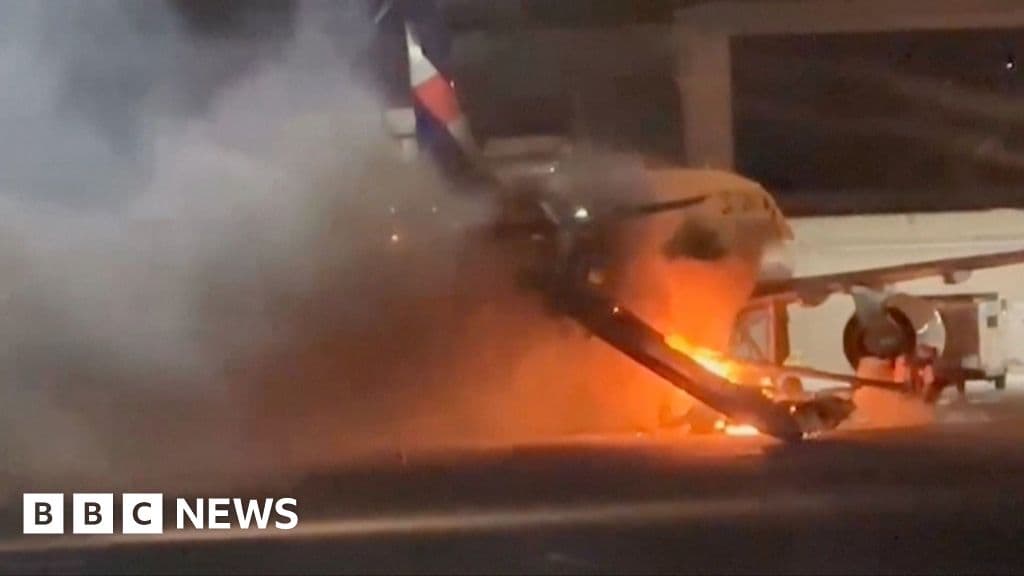
For 169 passengers aboard LATAM Airlines flight LA3418, the nightmare began not in the air, but while their feet were still firmly on the ground. As the Airbus A320 prepared for departure from São Paulo’s Guarulhos International Airport (GRU) late Thursday, a routine baggage loading operation descended into chaos, forcing a frantic emergency evacuation that has sent ripples through the global aviation community.
Thick, acrid smoke rapidly filled the cabin, obscuring the aisle lights and triggering the primal instinct to flee. Outside, tongues of fire licked the belly of the aircraft, originating from a baggage conveyor belt that had spontaneously combusted just inches from the fuselage.
"Leave everything!" is the command no traveler wants to hear, but it was the only order that mattered as flight attendants deployed the inflatable emergency slides. Footage verified by Streamline News captures the terrifying efficiency of the escape: passengers tumbling down the yellow chutes, stumbling onto the tarmac, and sprinting away from the smoking jet under the glare of airport floodlights.
According to a statement from LATAM Airlines, the fire did not start within the aircraft’s systems but was caused by "external equipment" belonging to a third-party ground handling company. The blaze, which ignited just before the scheduled flight to Porto Alegre, was swiftly contained by airport fire crews, but not before it had surrounded the plane in a choking gray haze.
Remarkably, no serious injuries were reported. "The situation was quickly brought under control," the airline noted, emphasizing that their crew’s training prevented a tragedy. However, the psychological toll on those onboard—and the operational disruption to Brazil’s busiest airport—was immediate.
While this drama unfolded 8,000 kilometers away in South America, the lessons for Nairobi are urgent and uncomfortable. Jomo Kenyatta International Airport (JKIA), the regional aviation hub, relies heavily on similar ground handling ecosystems where third-party contractors manage everything from fueling to baggage.
Local aviation safety analysts warn that the "outsourcing of risk" is a growing concern globally. When a third-party loader catches fire, it threatens a distinct asset: the aircraft itself. An Airbus A320, similar to the one involved in the Brazil incident, is valued at approximately $100 million (approx. KES 13 billion). A fire spreading to the fuel tanks could have turned a $100 million asset—and nearly 200 lives—into ash in minutes.
Kenyan travelers should note the critical safety takeaways from the São Paulo miracle:
The incident at Guarulhos highlights a vulnerability often overlooked by the flying public: the tarmac is an industrial workspace teeming with combustible fuels and heavy machinery. In Nairobi, ground handling companies like NAS and Tradewinds operate under strict regulations, yet the Brazil incident serves as a stress test for protocols worldwide.
"If a baggage loader catches fire at JKIA, the response time of our fire engines determines the future of the airline involved," notes a Nairobi-based commercial pilot who requested anonymity. "We train for engine fires in the air, but a fire on the ground during boarding is a logistical nightmare because the doors are open and the panic is immediate."
As investigations continue in Brazil to determine why the loader ignited, the 169 survivors are undoubtedly counting their blessings. For the rest of the world, the image of that smoking plane is a stark prompt to pay attention to the safety briefing—even before the wheels leave the ground.
Keep the conversation in one place—threads here stay linked to the story and in the forums.
Sign in to start a discussion
Start a conversation about this story and keep it linked here.
Other hot threads
E-sports and Gaming Community in Kenya
Active 9 months ago
The Role of Technology in Modern Agriculture (AgriTech)
Active 9 months ago
Popular Recreational Activities Across Counties
Active 9 months ago
Investing in Youth Sports Development Programs
Active 9 months ago
Key figures and persons of interest featured in this article