We're loading the full news article for you. This includes the article content, images, author information, and related articles.
A juvenile humpback whale, stranded for days off the German coast, successfully reached open water, highlighting both nature`s resilience and human effort.

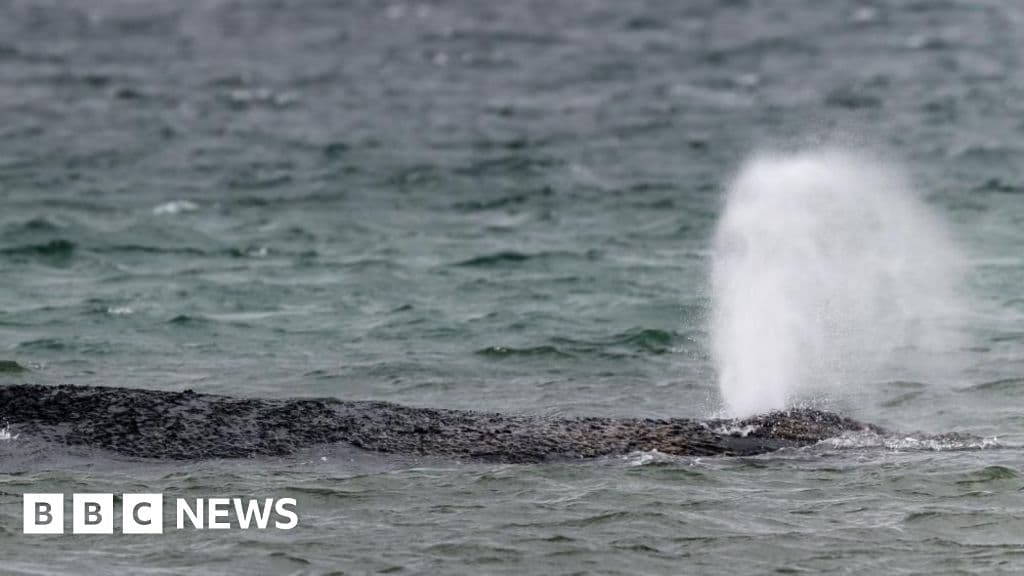
The silence of the Baltic dawn on Friday morning was broken by a rare, resonant success in Niendorf, Germany. After four agonizing days of being trapped on a sandbank, a 40-foot humpback whale finally surged through a man-made channel and into the deeper waters of Lübeck Bay. This moment of salvation, captured by onlookers who had held their breath for the creature’s survival since Monday, marks the culmination of an extraordinary, race-against-time engineering and wildlife rescue operation.
For marine biologists and the local Niendorf community, the whale’s release is not merely a local headline—it is a critical case study in the vulnerability of apex marine life in rapidly changing environments. The animal, a juvenile male estimated to weigh approximately 26,000 pounds (roughly 11,800 kilograms), faced a perilous intersection of human activity and natural disorientation. While the creature has reached open water, its journey is far from over, as it faces the daunting challenge of navigating the Baltic Sea, an environment inherently unsuited to its biology.
The rescue strategy shifted dramatically on Thursday afternoon when conventional methods—including the use of boats to generate waves to coax the animal—failed to dislodge the massive mammal. With the animal’s condition deteriorating and its health compromised by skin infections and residual netting, experts from the Institute of Terrestrial and Aquatic Wildlife in Germany recognized that time was running out.
The decision to deploy heavy machinery was controversial but necessary. Rescuers assembled an excavator on the beach to dredge a literal lifeline through the sandbank, angling it toward deeper water. The objective was to create a channel that could provide enough depth for the whale to generate the necessary propulsion to clear the shallows. The operation was a delicate balance of marine science and heavy civil engineering:
Humpback whales (Megaptera novaeangliae) are cosmopolitan travelers, typically found in oceans far more expansive and saline than the brackish, shallow Baltic Sea. Marine experts believe this individual likely took a wrong turn, potentially lured by the abundance of fish or disrupted by navigation errors linked to environmental stressors. In the open ocean, humpbacks rely on complex echolocation and magnetoreception, tools that are often rendered ineffective in the shallow, noise-polluted topography of the Baltic.
The whale’s health remains a point of significant concern. Marine conservationists note that the animal’s skin infection and previous entanglements in fishing nets are red flags indicating a prolonged struggle. While its successful exit from the Niendorf sandbank is a victory, the creature remains in a fragile state, attempting to find its way through the Danish Straits toward the North Sea and, ultimately, the Atlantic Ocean.
While the Baltic operation captured international attention, marine mammal strandings are an increasing concern across the globe, including in Kenya. Along the Kenyan coast, where species such as the humpback migrate through the Indian Ocean, conservationists at the Watamu Marine National Park report similar, albeit geographically distinct, challenges. Organizations like the Kenya Marine Mammal Research and Conservation (KMMREC) and the Kenya Wildlife Service (KWS) have been building a rigorous reporting network to respond to such incidents.
Data from marine conservation groups suggests that anthropogenic pressures—including marine traffic, plastic pollution, and overexploitation—are contributing to an uptick in strandings worldwide. In Kenya, recent years have seen increased collaboration between local fishermen, trained marine rangers, and scientists to provide safer intervention protocols. The German rescue mirrors the community-driven ethos often seen in Watamu, where the survival of a stranded whale relies not just on government resources, but on the vigilance of local coastal residents who act as the first line of defense.
Experts emphasize that whether in the Indian Ocean or the Baltic, these incidents serve as a proxy for the health of our seas. The increase in these events suggests that marine corridors are becoming more hazardous, forcing animals into areas they would naturally avoid. In Germany, the whale’s survival is being monitored by coast guard vessels, but the responsibility for such animals remains a collective, global concern.
As the whale navigates the bay, the rescue is effectively in a transition phase. Because the animal could not be tagged due to its medical condition, tracking its progress remains dependent on public sightings and maritime authorities. The success of this rescue is a testament to the power of targeted, non-invasive intervention, but it also underscores the limits of human capability when nature loses its way. The humpback is now back in its element, yet the long road to the North Sea holds dangers that no excavator can clear. For now, the world watches and waits, hoping this weary wanderer finds the path home.
Keep the conversation in one place—threads here stay linked to the story and in the forums.
Sign in to start a discussion
Start a conversation about this story and keep it linked here.
Other hot threads
E-sports and Gaming Community in Kenya
Active 10 months ago
The Role of Technology in Modern Agriculture (AgriTech)
Active 10 months ago
Popular Recreational Activities Across Counties
Active 10 months ago
Investing in Youth Sports Development Programs
Active 10 months ago