We're loading the full news article for you. This includes the article content, images, author information, and related articles.
AGES 2026 opened in Cape Town to shift Africa’s sustainability agenda from pledges to investable projects, spotlighting green finance and the blue economy.
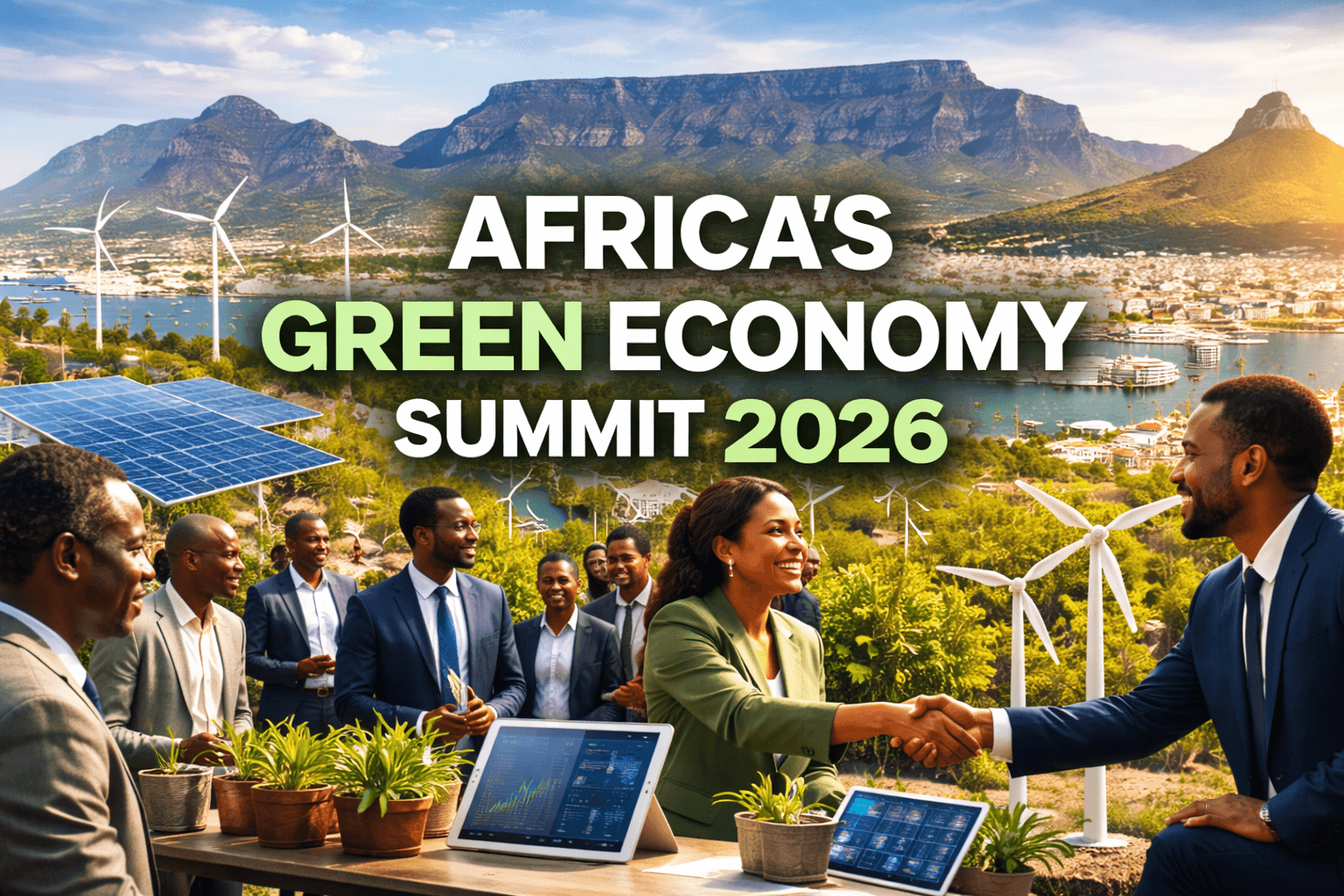
CAPE TOWN, South Africa — February 25, 2026.
Africa’s green transition has long been defined by ambition—bold targets, sweeping commitments, and global pledges. But in Cape Town this week, that narrative is being deliberately rewritten.
The Africa’s Green Economy Summit (AGES) 2026 has opened with a sharper mandate: turn sustainability into structured, investable opportunity.
Under the theme “From Ambition to Action: Scaling Opportunities in Africa’s Green and Blue Solutions,” the summit brings together policymakers, institutional investors, development financiers, and entrepreneurs in what is increasingly becoming one of the continent’s most consequential economic forums.
The message is clear: Africa’s climate conversation is no longer about why—it is about how fast, how scalable, and how bankable.
At the heart of AGES 2026 is a strategic reframing.
Africa’s environmental pressures—climate vulnerability, resource constraints, and infrastructure gaps—are being repositioned not as liabilities, but as entry points for economic expansion.
This is not theoretical positioning.
Global estimates continue to show that the green economy could unlock up to $10 trillion in business opportunities over the next decade, spanning renewable energy, sustainable agriculture, green infrastructure, and circular systems. For Africa, with its demographic trajectory and resource base, the stakes are even higher—potentially supporting up to 300 million jobs in the long term.
Yet the gap has never been ambition.
It has been execution.
As summit moderator Lerato Mbele noted during the opening session:
“Ambition lights the path, but it does not pave it… This summit is where vision meets capital, and where ideas are structured into real, investable projects.”
The emphasis across sessions is therefore deliberate: pipeline over promises.
A central pillar of this year’s agenda is the blue economy—a sector often referenced, but still underleveraged at scale.
Current estimates indicate that Africa’s oceans, lakes, and coastal ecosystems already contribute nearly $300 billion annually to GDP, supporting over 46 million livelihoods across fisheries, tourism, logistics, and maritime trade.
But the real story lies in its unrealized value.
From sustainable aquaculture and marine conservation financing to port modernization and ocean-based renewable energy, the blue economy is increasingly being positioned as a frontier for institutional investment.
AGES 2026 is actively pushing this shift—from extraction to structured, sustainable monetization of natural capital.
If capital is to flow at scale, policy must move with it.
This alignment sits at the core of discussions led by government representatives, including South Africa’s Deputy Minister of Forestry, Fisheries and Environment, Naren Singh, who framed sustainability as a systemic balance:
“Our transition must balance three imperatives—the health of our planet, the prosperity of our people, and the creation of shared value. Investing in natural capital is investing in the resilience of our economies.”
This reflects a broader continental reality.
Africa does not lack projects. It lacks bankable structures—clear regulatory frameworks, de-risking mechanisms, and financing models that align public and private interests.
AGES is positioning itself as the bridge.
Unlike traditional summits, AGES 2026 is structured as an active deal-making environment.
Over the course of the gathering, participants are engaging in:
Live project pitches from green and climate-tech entrepreneurs
Curated investor matchmaking sessions
High-level policy dialogues focused on unlocking green finance
Cross-sector collaboration forums spanning energy, agriculture, infrastructure, and water
The objective is not visibility—it is velocity.
Projects showcased here are expected to move beyond presentation into funding pipelines, partnerships, and execution frameworks.
Africa’s green transition is entering a critical phase.
Global capital is increasingly climate-aligned, but also more selective. Investors are prioritizing clarity, scalability, and returns alongside impact.
At the same time, Africa’s structural pressures—urbanization, energy demand, food security, and climate vulnerability—are accelerating.
This convergence creates a narrow window:
Act, and the continent positions itself as a global hub for green growth
Delay, and capital flows elsewhere
AGES 2026 reflects an understanding that the window is open—but not indefinitely.
The summit signals a deeper shift in how Africa is positioning itself globally.
No longer as a passive recipient of climate finance, but as an active architect of investable, scalable solutions.
This is a transition from:
Sustainability as compliance → Sustainability as competitive advantage
Climate risk → Climate-driven opportunity
Policy ambition → Execution frameworks
Africa’s green economy is no longer a future narrative.
It is a present market.
AGES 2026 is where that market begins to take shape—with structure, with capital, and with intent.
Distributed by APO Group on behalf of VUKA Group. Enhanced analysis and editorial by Streamline.
Keep the conversation in one place—threads here stay linked to the story and in the forums.
Sign in to start a discussion
Start a conversation about this story and keep it linked here.
Other hot threads
E-sports and Gaming Community in Kenya
Active 9 months ago
The Role of Technology in Modern Agriculture (AgriTech)
Active 9 months ago
Popular Recreational Activities Across Counties
Active 9 months ago
Investing in Youth Sports Development Programs
Active 9 months ago