We're loading the complete profile of this person of interest including their biography, achievements, and contributions.
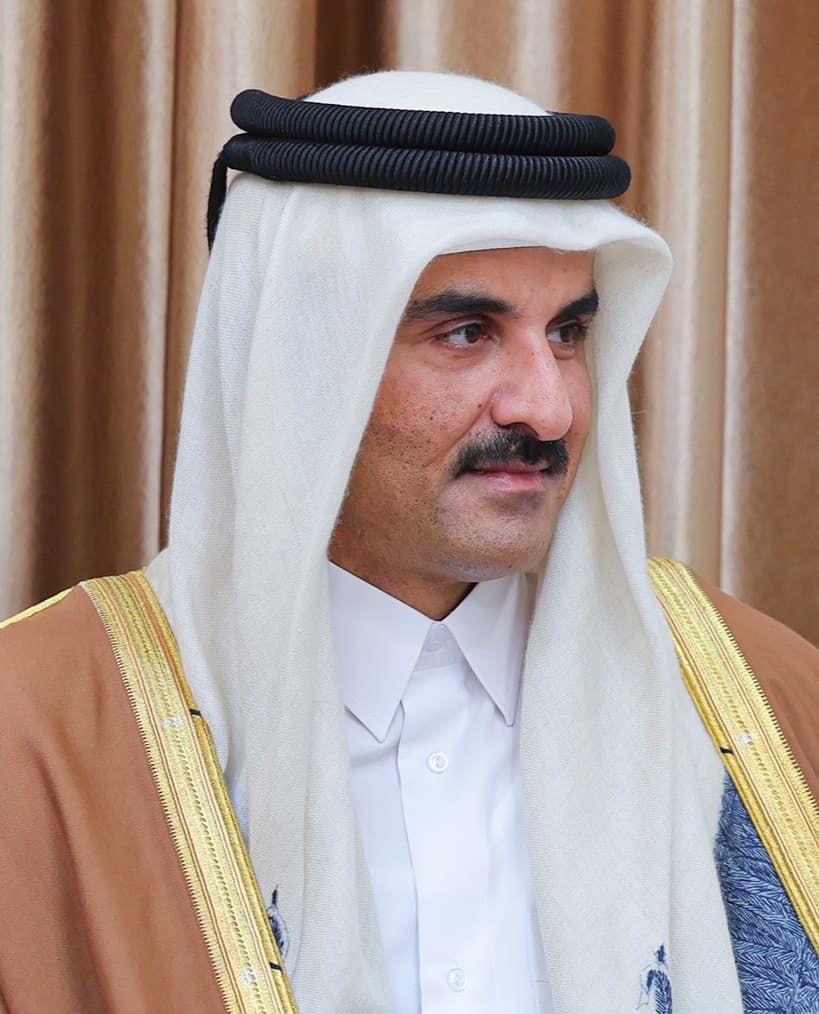
Emir of Qatar
Public Views
Experience
Documented career positions
Sheikh Tamim bin Hamad Al Thani (born June 3, 1980) is the Emir of Qatar and the head of the Al Thani royal family. He has served as the sovereign of the nation since June 25, 2013, following the abdication of his father, Sheikh Hamad bin Khalifa Al Thani. As the leader of Qatar, Sheikh Tamim has overseen significant economic diversification efforts, expanded the nation's influence in global diplomacy, and presided over high-profile international events, most notably the 2022 FIFA World Cup. Born in Doha, Qatar, Sheikh Tamim is the fourth son of Sheikh Hamad bin Khalifa Al Thani and the second son of Sheikha Moza bint Nasser. His early life was characterized by a rigorous education, both locally and internationally, designed to prepare him for the responsibilities of the state. He attended Sherborne School in Dorset, United Kingdom, and later the Harrow School, also in the United Kingdom, where he completed his A-levels. Following his secondary education, he enrolled at the Royal Military Academy Sandhurst in the United Kingdom, graduating in 1998. This training provided him with the military and strategic grounding considered essential for a future ruler. Sheikh Tamim’s formal ascent to power began well before his accession to the throne. On August 5, 2003, he was appointed as the Crown Prince of Qatar after his elder brother, Sheikh Jassim bin Hamad Al Thani, renounced his claim to the title. During his decade as Crown Prince, Sheikh Tamim was groomed for governance, taking on increasing responsibilities in security, military affairs, and public policy. He was instrumental in managing the Qatar 2022 Supreme Committee for Delivery and Legacy, which oversaw the planning and infrastructure development for the World Cup, a pivotal project that redefined Qatar’s international profile. On June 25, 2013, in a televised address to the nation, Sheikh Hamad bin Khalifa Al Thani announced he would step down and hand power to his son. At 33 years old, Sheikh Tamim became the youngest monarch in the Gulf Cooperation Council (GCC) and the youngest sovereign in the world at the time. His early years as Emir were defined by a focus on domestic modernization and the acceleration of the "Qatar National Vision 2030," a comprehensive development plan aimed at transitioning the nation from a hydrocarbon-based economy to a knowledge-based economy through investments in technology, healthcare, and education. Under his leadership, Qatar faced a significant geopolitical crisis in June 2017, when a coalition of nations—led by Saudi Arabia, the United Arab Emirates, Bahrain, and Egypt—severed diplomatic and economic ties, citing allegations of support for extremist groups. The blockade, which included the closure of land, air, and sea borders, forced Qatar to adapt rapidly. Sheikh Tamim’s administration navigated the crisis by strengthening self-sufficiency, diversifying trade routes, and maintaining a steadfast diplomatic stance. The blockade concluded in January 2021 with the Al-Ula Declaration, which restored full diplomatic relations among the Gulf nations. Internationally, Sheikh Tamim has positioned Qatar as a vital mediator in global conflicts. The country has facilitated dialogues between various international parties, including roles in the negotiations between the United States and the Taliban that led to the 2020 Doha Agreement. Domestically, the crowning achievement of his tenure was the successful hosting of the 2022 FIFA World Cup, which served as a landmark moment for the region. The tournament was widely viewed as a display of Qatar's organizational capacity and its ability to bridge cultural divides, despite intense international scrutiny regarding human rights and labor practices. Sheikh Tamim is married and has multiple children. He is known for maintaining a relatively private personal life, though he is publicly associated with interests in sports, particularly football and tennis, and has long been a patron of the Qatar National Sport Day. He remains a central figure in regional geopolitics, with a legacy currently being defined by his efforts to balance traditional Gulf alliances with a distinct, independent foreign policy and a long-term strategy for domestic socio-economic transformation.
Successfully navigated and broke the devastating 2017-2021 diplomatic and economic blockade imposed by Saudi Arabia, the UAE, Bahrain, and Egypt, emerging with a stronger, more independent national economy
Hosted the historic 2022 FIFA World Cup, utilizing an estimated $220 billion in infrastructure spending to execute the ultimate display of global 'sportswashing'
Faces relentless, severe global condemnation for hosting the political headquarters of Hamas in Doha and providing the organization with hundreds of millions of dollars in annual funding, which Israel and the US argue directly enabled the October 7 attacks
The 2022 World Cup was universally overshadowed by horrific human rights abuses, with international organizations estimating thousands of migrant workers died due to the brutal Kafala system and extreme heat during stadium construction
Accused by European authorities of massive political bribery in the 'Qatargate' scandal, where European Parliament officials were allegedly paid millions to influence EU policy in favor of Doha
News articles featuring Sheikh Tamim bin Hamad
Established Qatar as the indispensable global hostage negotiator, successfully brokering complex deals between the US and the Taliban, and Israel and Hamas
Massively expanded Qatar's LNG production capabilities (North Field East), securing decades of energy dominance
Born in Doha, Qatar on June 3, 1980.
Graduated from Sherborne School in the United Kingdom in 1997.
Graduated from the Royal Military Academy Sandhurst in 1998.
Elected as a member of the International Olympic Committee (IOC) in 2002.
Appointed as the Heir Apparent of Qatar on August 5, 2003.
Appointed Deputy Commander-in-Chief of the Qatar Armed Forces in 2003.
Founded Oryx Qatar Sports Investments in 2005, which later acquired Paris Saint-Germain F.C.
Chaired the organizing committee of the 15th Asian Games held in Doha in 2006.
Voted 'the best sport personality in the Arab world' by Al Ahram newspaper in 2006.
Assumed duties as the Emir of Qatar on June 25, 2013, following his father's abdication.
Appointed as the Commander-in-Chief of the Qatar Armed Forces in 2013.
Spearheaded Qatar's successful bid to host the 2022 FIFA World Cup.
Launched the Sheikh Tamim bin Hamad Al-Thani Anti-Corruption Excellence (ACE) Award in 2016 in partnership with the United Nations.
In 2017, Saudi Arabia, the UAE, Bahrain, and Egypt severed diplomatic ties with Qatar, accusing Sheikh Tamim's government of supporting extremist groups and aligning with Iran, a crisis sparked by an alleged hack of the Qatar News Agency. The diplomatic and economic blockade lasted until 2021, when the Al-Ula Declaration was signed, restoring diplomatic relations among the Gulf Cooperation Council states.
Under his administration, Qatar faced widespread international criticism and scrutiny regarding human rights abuses and the treatment of migrant workers during the construction projects for the 2022 FIFA World Cup. While the Qatari government introduced significant labor reforms, including the dismantling of the kafala system, in response to pressure, international human rights organizations have continued to call for stricter enforcement and better protections for workers.
Since assuming power, Sheikh Tamim has faced ongoing allegations from various regional neighbors and international observers regarding Qatar's support for Islamist movements, including the Muslim Brotherhood and Hamas. The Qatari government has consistently rejected these accusations, maintaining that its foreign policy is aimed at mediating regional conflicts and engaging with a broad spectrum of political actors.
In 2021, the Pandora Papers investigation, conducted by the International Consortium of Investigative Journalists (ICIJ), revealed that members of Sheikh Tamim's family, including his mother Sheikha Moza bint Nasser, held millions of dollars in offshore properties in the United Kingdom. While the reports did not allege direct illegality by the Emir, they drew criticism regarding the lack of transparency surrounding the ruling family's financial activities.
The government under Sheikh Tamim has faced persistent criticism from international rights organizations, such as Amnesty International and Reporters Without Borders, regarding the suppression of free speech and independent journalism in Qatar. Critics have frequently cited the restricted environment for dissent and the prosecution of activists and poets as evidence of ongoing challenges to civil liberties within the country.