We're loading the complete profile of this person of interest including their biography, achievements, and contributions.
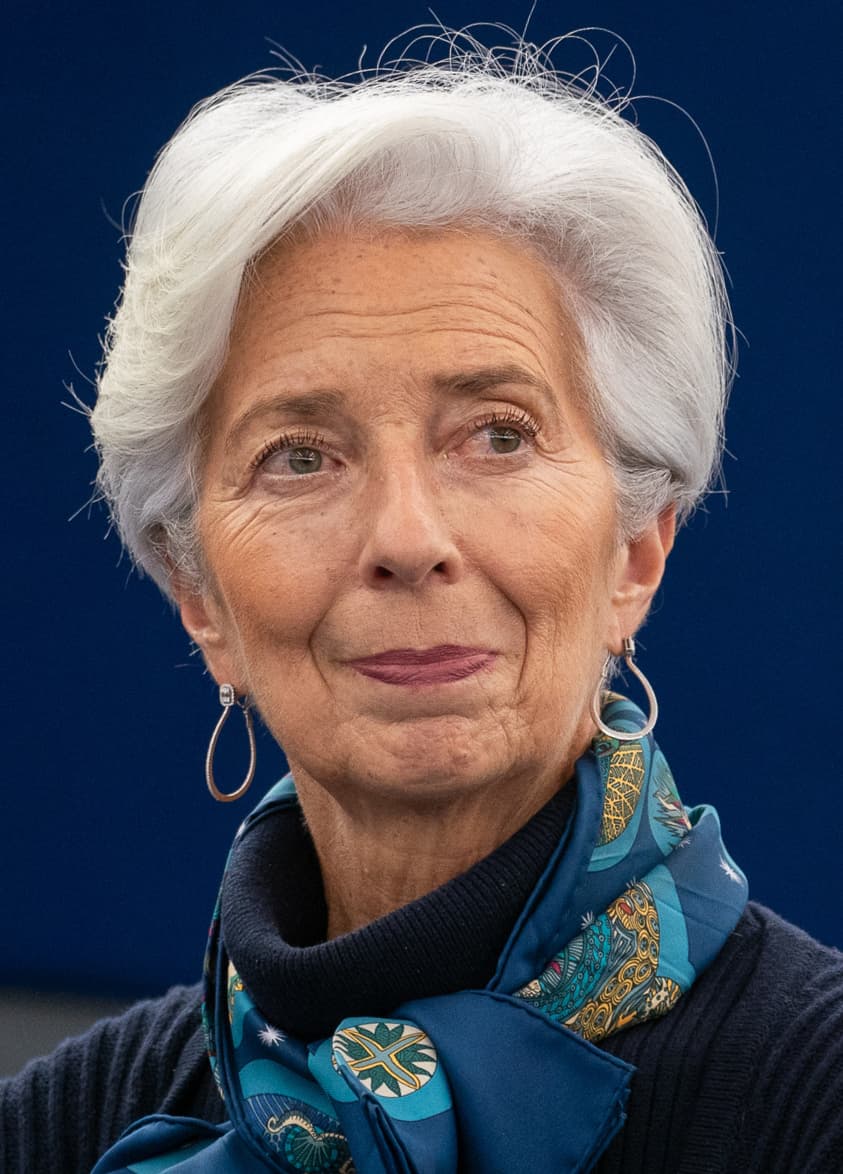
President of the European Central Bank
Public Views
Experience
Documented career positions
Christine Madeleine Odette Lagarde is a prominent French politician, lawyer, and economist who has served as the President of the European Central Bank (ECB) since November 2019. Throughout her distinguished career, Lagarde has been a pioneer for women in leadership, holding multiple positions that she was the first woman to occupy, including France's Minister of Finance, Managing Director of the International Monetary Fund (IMF), and President of the ECB. Born on January 1, 1956, in Paris, France, Lagarde was raised in Le Havre by her parents, Robert Lallouette and Nicole Carré, both of whom were teachers. During her youth, she was a member of the French national synchronized swimming team, a discipline she has credited with instilling in her the persistence and stamina necessary for her later career. Following her secondary education, she spent a year in the United States on an American Field Service scholarship, graduating from the Holton-Arms School in Bethesda, Maryland, in 1974. During this time, she interned as a congressional assistant to U.S. Representative William Cohen, aiding him during the Watergate hearings. Lagarde returned to France to pursue her higher education, graduating from Paris Nanterre University with degrees in English, labour law, and social law. She also earned a master’s degree from the Political Science Institute in Aix-en-Provence (Sciences Po Aix). Although she twice attempted to enter the prestigious École Nationale d'Administration (ENA), she did not succeed, a fact often cited to highlight her non-traditional path into the French political establishment. In 1981, Lagarde joined the international law firm Baker McKenzie. Over the next two decades, she rose through the firm’s ranks, specializing in labour, anti-trust, and mergers and acquisitions. In 1999, she made history as the first woman to be elected chair of the firm’s global executive committee. Her success in the private sector eventually drew the attention of French political leaders. Lagarde’s political career began in 2005 when she was appointed Minister of Foreign Trade in the government of Prime Minister Dominique de Villepin. In 2007, she served briefly as the Minister of Agriculture and Fisheries before being appointed Minister of Economic Affairs, Finance and Employment by President Nicolas Sarkozy. As Finance Minister, she became the first woman to hold this portfolio in a G7 economy. Her tenure was notably tested by the global financial crisis of 2008, for which she received praise for her management and pragmatism. In 2011, following the resignation of Dominique Strauss-Kahn, Lagarde was appointed as the 11th Managing Director of the International Monetary Fund. She served two terms, overseeing critical periods including the European debt crisis. In 2019, she was nominated and subsequently appointed as the President of the European Central Bank, succeeding Mario Draghi. In this role, she has navigated the Eurozone through significant economic challenges, including the global response to the COVID-19 pandemic and subsequent inflationary pressures. Lagarde is recognized for her influence on international economic policy and her advocacy for diversity in leadership. She is a mother of two sons and has long been in a partnership with entrepreneur Xavier Giocanti. Her career remains characterized by her ability to bridge the worlds of private law, national politics, and international finance.
First woman to serve as President of the European Central Bank (2019–Present)
Served as the Managing Director of the International Monetary Fund (2011–2019), guiding the global economy through the European sovereign debt crisis
Created the PEPP (Pandemic Emergency Purchase Programme), a €1.85 trillion stimulus package that saved the Eurozone from economic collapse during the COVID-19 pandemic
Convicted by a French court in 2016 of 'negligence' regarding a massive €400 million state arbitration payout to tycoon Bernard Tapie during her time as French Finance Minister (though she received no penalty and retained her IMF post)
Heavily criticized by European labor unions for her insistence that workers must accept lower real wages to combat inflation, despite skyrocketing corporate profit margins
Faced significant internal dissent from within the ECB staff in 2024, with a union survey showing unprecedented dissatisfaction with her leadership style and monetary policy strategy
News articles featuring Christine Lagarde
Consistently ranked among the top 10 most powerful women in the world by Forbes
Interned for U.S. Representative William Cohen during the Watergate hearings while studying on a scholarship in the United States in 1973.
Joined the international law firm Baker & McKenzie in 1981, specializing in labor, antitrust, and mergers and acquisitions.
Promoted to partner at Baker & McKenzie in 1987.
Became a member of the executive committee of Baker & McKenzie in 1995.
Elected as the first female chairman of Baker & McKenzie in 1999 (reelected in 2002).
Appointed president of the Global Strategic Committee of Baker & McKenzie in 2004.
Received the Legion of Honour from French President Jacques Chirac in 2004.
Appointed Minister for Foreign Trade of France in June 2005.
Served briefly as Minister of Agriculture and Fisheries of France starting in May 2007.
Appointed Minister of the Economy, Finance and Employment of France in June 2007, becoming the first woman to hold the finance portfolio of a G7 country.
Chaired the ECOFIN Council of the European Union from July to December 2008.
Named the best finance minister in the Eurozone by the Financial Times in 2009 for her handling of the financial crisis.
Appointed as the 11th Managing Director of the International Monetary Fund (IMF) in July 2011, becoming the first woman to hold the position.
Received The Atlantic Council's Global Citizenship Award in 2011.
Named an Officer in the National Order of the Legion of Honour in 2012.
Received the Globalist of the Year Award from the Canadian International Council in 2012.
Received the 2012 Leadership Award from the Union of Arab Banks.
Named Grand Officer of the National Order of the Republic of Côte d'Ivoire in 2013.
Received the Inaugural Global Achievement Award from the Global Foundation in 2014.
Named Diplomat of the Year by Foreign Policy Magazine in 2014.
Elected to a second five-year term as Managing Director of the IMF in 2016.
Received the Global Leadership Award from the Columbia University School of International and Public Affairs in 2016.
Received the Mohammed Bin Rashid Medal of Honor for Women in 2016.
Received the Woman of the Year and Lifetime Achievement Award from Glamour Magazine in 2016.
Appointed President of the European Central Bank in November 2019, the first woman to hold this office.
Awarded the rank of Commander in the French National Order of Merit in 2021.
Received an honorary doctorate in economics from the London School of Economics in 2022.
In 2016, a French special court, the Cour de Justice de la République, convicted Christine Lagarde of criminal negligence for her role in the 'Tapie Affair' while she was France's Finance Minister. The court found that she had failed to challenge a controversial €400 million state arbitration payout to businessman Bernard Tapie, though she faced no prison time, fines, or a criminal record.
During her tenure as President of the European Central Bank, Lagarde has faced criticism from economists and market analysts for her non-economist background and her perceived slow reaction to surging eurozone inflation in 2021 and 2022. Critics argued that the ECB's delay in raising interest rates contributed to prolonged price instability, a point on which she has later acknowledged needing to be 'bolder'.
In January 2026, an investigative report revealed that Lagarde's total compensation, including additional payments from the Bank for International Settlements (BIS) and housing benefits, was significantly higher than the salary officially disclosed by the European Central Bank. This discrepancy drew public and media scrutiny regarding transparency and the level of remuneration for high-ranking EU officials.