We're loading the complete profile of this person of interest including their biography, achievements, and contributions.
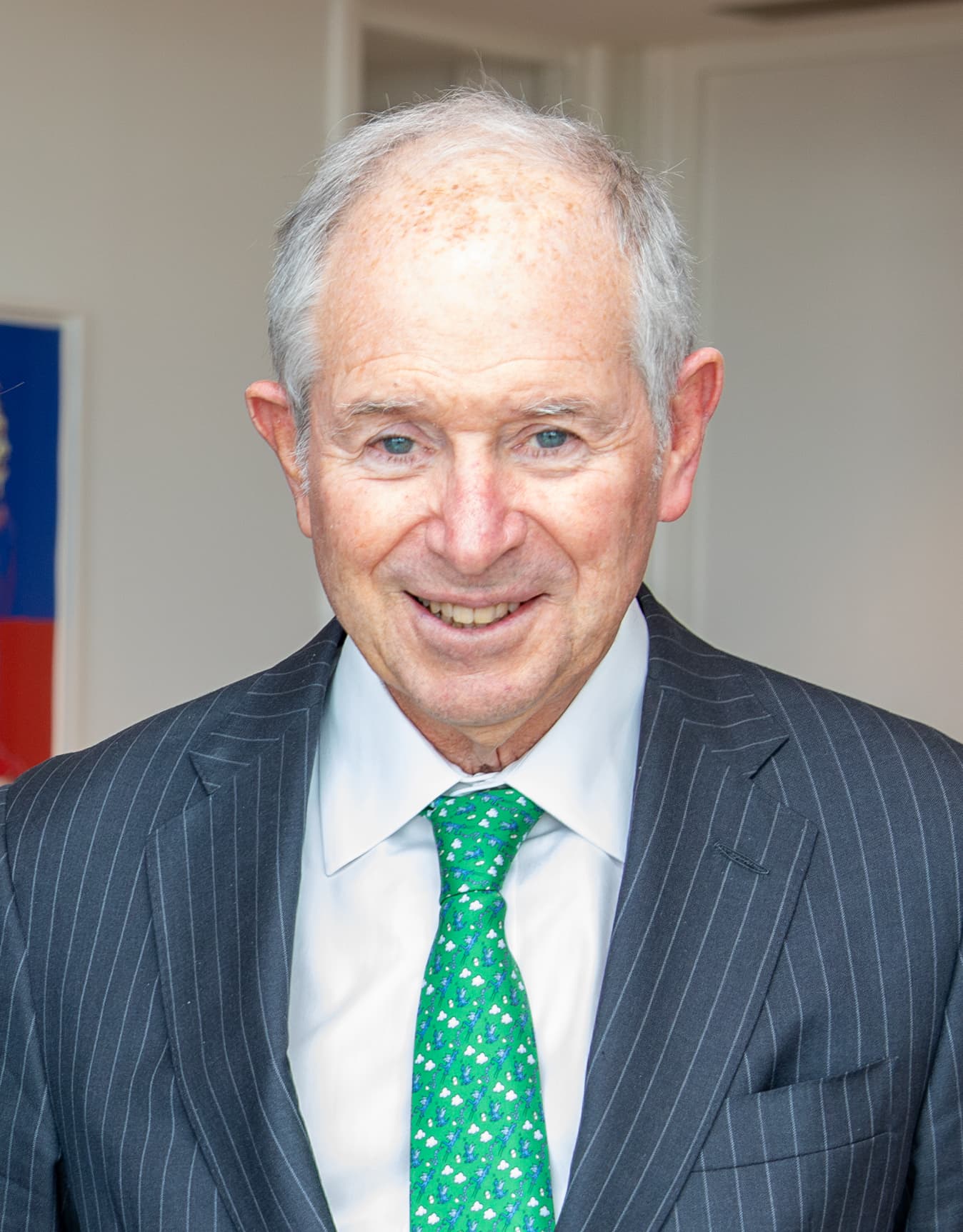
Chairman & CEO, Blackstone Group
Public Views
Experience
Documented career positions
Stephen Allen Schwarzman (born February 14, 1947) is a prominent American businessman, investor, and philanthropist, best known as the co-founder, chairman, and chief executive officer of The Blackstone Group (Blackstone Inc.), one of the world's largest alternative asset management firms. Throughout his career, Schwarzman has been a central figure in the private equity industry, known for his strategic influence in global finance and his significant contributions to educational and cultural institutions. Born in Philadelphia, Pennsylvania, and raised in suburban Huntingdon Valley, Schwarzman was the son of Arline and Joseph Schwarzman. His father owned a dry-goods store in Philadelphia, an experience that Schwarzman has often cited as an early influence in his ambition to build a different type of professional life. Schwarzman attended Abington Senior High School, where he was student body president, and later enrolled at Yale University. While at Yale, he was a member of the Skull and Bones society and founded the Davenport Ballet Society, graduating in 1969. He subsequently served briefly in the U.S. Army Reserve before enrolling at Harvard Business School, where he earned his Master of Business Administration in 1972. Schwarzman’s career in financial services began at the investment bank Donaldson, Lufkin & Jenrette. He later joined Lehman Brothers, where he rose rapidly through the ranks, becoming a managing director at the age of 31 and eventually leading the firm's global mergers and acquisitions team. In 1985, he left Lehman Brothers to co-found The Blackstone Group alongside his former boss, Peter G. Peterson. Starting with a modest initial capital base of $400,000, Blackstone evolved under Schwarzman’s leadership from a boutique merger-and-acquisition advisory firm into a diversified global asset management giant. By the 2020s, the firm had surpassed $1 trillion in assets under management, with investments spanning private equity, real estate, credit, and infrastructure. Beyond his professional achievements, Schwarzman has become a major figure in global philanthropy. His approach to giving often focuses on large-scale, transformative projects in education and technology. In 2013, he launched the "Schwarzman Scholars" program at Tsinghua University in Beijing, modeled after the Rhodes Scholarship, to foster cross-cultural understanding among future global leaders. His philanthropic portfolio also includes substantial donations to the New York Public Library, Yale University (to establish the Schwarzman Center), MIT (for the Schwarzman College of Computing), and the University of Oxford (for the Schwarzman Centre for the Humanities and an Institute for Ethics in AI). In 2020, he signed The Giving Pledge, committing to donate the majority of his wealth to philanthropic causes. Schwarzman has been recognized with numerous honors, including an honorary Knighthood (KBE) from the United Kingdom for his services to philanthropy. He has served on various high-profile boards, including the Council on Foreign Relations and the Business Council. A long-time resident of New York City, Schwarzman has maintained a significant presence in American public life, often engaging with economic policy and global trade issues. Throughout his career, he has authored reflections on business and leadership, most notably in his 2019 memoir, "What It Takes: Lessons in the Pursuit of Excellence."
AI-powered civic intelligence rating
Co-founded and built The Blackstone Group into the world's largest alternative asset manager, officially crossing the historic $1 Trillion AUM milestone in 2023
Pioneered the massive expansion of the 'Private Credit' and shadow-banking sectors, providing hundreds of billions in direct lending to global corporations
Funded the creation of the Schwarzman College of Computing at MIT with a $350 million donation to study the ethical implications of artificial intelligence
Universally targeted by progressive lawmakers and housing advocates who accuse Blackstone of aggressively buying up single-family homes and apartment complexes globally, driving up rents and fueling the global housing affordability crisis
Faced intense backlash from environmental groups for Blackstone's continued financing of major fossil fuel infrastructure projects despite corporate pledges to pursue ESG goals
His unapologetic, massive financial support for the populist wing of the Republican Party frequently draws intense ire from the liberal Wall Street establishment
Established the prestigious Schwarzman Scholars program at Tsinghua University in Beijing
Graduated from Yale University in 1969.
Graduated from Harvard Business School in 1972.
Became a Managing Director at Lehman Brothers in 1978.
Co-founded The Blackstone Group with Peter G. Peterson in 1985.
Served as Chairman of the Board of the John F. Kennedy Center for the Performing Arts from 2004 to 2010.
Donated $100 million to the New York Public Library in 2007, leading to the central building being renamed in his honor.
Took The Blackstone Group public in 2007.
Named to the Time 100 Most Influential People list in 2007.
Awarded the Légion d'honneur by the Republic of France in 2007.
Promoted to Officier of the Légion d'honneur by the Republic of France in 2010.
Founded the Schwarzman Scholars scholarship program at Tsinghua University with a $100 million personal gift in 2013.
Donated $150 million to Yale University to establish the Schwarzman Center in 2015.
Served as Chair of the President's Strategic and Policy Forum in 2017.
Donated $350 million to the Massachusetts Institute of Technology to establish the Schwarzman College of Computing in 2018.
Awarded the Order of the Aztec Eagle by Mexico in 2018 for support of the U.S.–Mexico–Canada Agreement.
Published his first book, 'What It Takes: Lessons in the Pursuit of Excellence', in 2019.
Donated £150 million to the University of Oxford to establish the Schwarzman Centre for the Humanities in 2019.
Signed The Giving Pledge in 2020, committing to donate the majority of his wealth to philanthropic causes.
Donated $25 million to the Animal Medical Center of New York in 2021.
Appointed an Honorary Knight Commander of the Order of the British Empire (KBE) in 2024 for services to philanthropy.
In August 2010, Schwarzman sparked significant public outcry when he compared President Barack Obama’s proposal to increase taxes on private equity carried interest to Hitler’s invasion of Poland, describing it as a 'war.' He subsequently issued a formal apology, stating that his remarks were inappropriate and insensitive.
In 2017, as the chairman of President Donald Trump's Strategic and Policy Forum, Schwarzman faced mounting pressure following the President's response to white nationalist protests in Charlottesville, Virginia. He resigned from the advisory council in August 2017 after a wave of other business leaders departed in protest.
Throughout the 2010s and 2020s, Blackstone, under Schwarzman's leadership, has faced criticism from housing advocates and tenants' rights organizations regarding its massive acquisition of single-family rental homes. Critics allege that the company's business model contributes to rent inflation and displacement, while Blackstone maintains that its investment provides necessary rental supply and improved property standards.
Following the January 6, 2021, attack on the U.S. Capitol, Schwarzman faced criticism for his previous financial support of the Trump administration and his ongoing ties to the former President. While Schwarzman publicly condemned the violence and the effort to overturn the election, some critics argued his past backing enabled the political environment that led to the event.
Schwarzman has frequently faced scrutiny regarding his extensive business investments in China and the influence of his philanthropic initiative, the Schwarzman Scholars program. Critics have questioned whether his access to high-level Chinese officials impacts his commentary on China's political landscape, though he has consistently defended his engagement as constructive and necessary for global understanding.