We're loading the complete profile of this person of interest including their biography, achievements, and contributions.
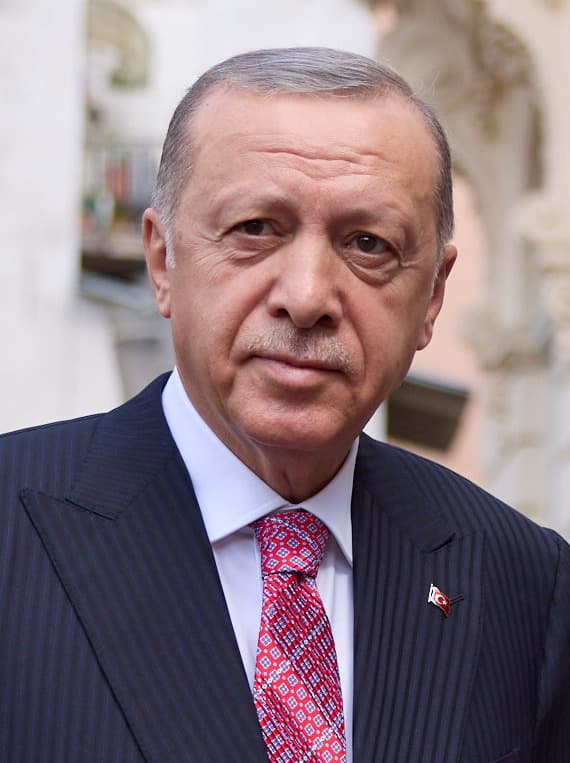
President of Turkey
Public Views
Experience
Documented career positions
Recep Tayyip Erdoğan (born February 26, 1954) is a prominent Turkish statesman who has served as the President of Turkey since 2014. Previously, he served as the Prime Minister of Turkey from 2003 to 2014. As one of the most consequential and polarizing figures in modern Turkish history, Erdoğan has overseen significant political, social, and economic transformations in the country, presiding over the transition from a parliamentary republic to an executive presidential system. Born in the Kasımpaşa district of Istanbul to a family originally from the Black Sea province of Rize, Erdoğan spent his childhood in a conservative, modest environment. His father, Ahmet Erdoğan, worked as a coastguard. After attending Kasımpaşa Piyale Primary School, he enrolled in the Istanbul Imam Hatip School—a religious vocational high school—graduating in 1973. He later pursued higher education in business administration at what is now Marmara University, graduating in 1981. During his youth, Erdoğan was an amateur footballer and became active in the Islamist political movement led by Necmettin Erbakan, serving in leadership roles within the National Salvation Party’s youth branches during the 1970s. Erdoğan’s political career gained national prominence in the 1990s. Following the 1980 military coup and the subsequent restructuring of political parties, he emerged as a rising star within the Islamist Welfare Party. In 1994, he was elected Mayor of Istanbul. During his four-year tenure, he earned a reputation as a pragmatic administrator, tackling chronic municipal issues such as water shortages, traffic congestion, and air pollution, which significantly boosted his popularity among the urban electorate. However, his mayoralty ended abruptly in 1998 when he was convicted of inciting religious hatred for reciting a poem during a public speech, a charge he maintained was political persecution. He was sentenced to prison, serving several months in 1999, and was banned from holding political office. In the aftermath of his imprisonment, Erdoğan helped found the Justice and Development Party (AKP) in 2001, adopting a platform that moved toward conservative democracy and closer alignment with Western economic and political standards. The AKP won a landslide victory in the 2002 general elections. Although initially barred from high office due to his criminal record, a subsequent legal amendment allowed him to run in a by-election in Siirt. He won the seat, and on March 14, 2003, he assumed the office of Prime Minister. As Prime Minister, Erdoğan’s early tenure was characterized by robust economic growth, the strengthening of ties with the European Union, and a reduction in the historic political influence of the Turkish military. Over the following decade, however, the political climate shifted. His government faced significant domestic challenges, including the Gezi Park protests in 2013 and a massive corruption scandal that emerged the same year. In 2014, Erdoğan was elected President in Turkey’s first direct popular vote for the office. Two years later, on July 15, 2016, his administration survived a violent and failed military coup attempt, which resulted in a sweeping government crackdown on alleged conspirators, including members of the judiciary, military, and press. A major milestone in Erdoğan's presidency was the 2017 constitutional referendum, which was narrowly approved by the public. This reform dismantled the parliamentary system in favor of an executive presidency, concentrating significant authority in the hands of the head of state. This new system, which fully took effect in 2018, allowed the president to appoint cabinet members, issue decrees, and influence the judiciary. Erdoğan’s legacy remains a subject of intense debate. Supporters credit him with modernizing Turkey’s infrastructure, championing the rights of conservative Muslims who had previously felt marginalized by the secular establishment, and pursuing an assertive, independent foreign policy. Critics, conversely, point to a marked decline in democratic institutions, the suppression of political dissent, restrictions on media freedom, and economic volatility, including significant inflation. Despite these challenges, Erdoğan has maintained a firm grip on power, winning reelection in 2018 and again in 2023, solidifying his position as the longest-serving leader in the history of the Republic of Turkey. He is married to Emine Erdoğan, and the couple has four children.
AI-powered civic intelligence rating
Longest-reigning leader in modern Turkish history, fundamentally altering the constitution to create an all-powerful executive presidency in 2017
Orchestrated the construction of massive national infrastructure, including the new Istanbul Airport and significant expansions of the Turkish defense industry (specifically Baykar drones)
Presided over a massive, self-inflicted economic crisis characterized by hyperinflation and a collapsing Lira, driven by his highly unorthodox refusal to raise interest rates according to traditional macroeconomic theory
Universally criticized by human rights watchdogs for jailing tens of thousands of political opponents, journalists, and Kurdish politicians (like Selahattin Demirtaş) under draconian anti-terrorism laws
His aggressive military incursions into Northern Syria against Kurdish militias (YPG/SDF) frequently put Turkey at direct odds with its NATO ally, the United States
Survived a violent, bloody military coup attempt in 2016, utilizing the aftermath to aggressively purge the military, judiciary, and academia of perceived internal enemies (the Gülen movement)
Successfully positioned Turkey as the indispensable mediator in the Black Sea, brokering the crucial (though fragile) grain export deals between Russia and Ukraine
Elected as head of the Beyoğlu youth branch of the Islamist National Salvation Party in 1976.
Appointed as Beyoğlu District Chairman of the Welfare Party in 1984.
Appointed as Istanbul Provincial Chairman of the Welfare Party in 1985.
Elected as Mayor of Istanbul on March 27, 1994, serving until 1998.
Co-founded the Justice and Development Party (AKP) on August 14, 2001.
Elected as a deputy for the province of Siirt in a by-election on March 9, 2003.
Appointed as the 25th Prime Minister of Turkey on March 14, 2003.
Named 'European of the Year' by European Voice in 2004 for his reform efforts.
Led the AKP to a second general election victory in 2007.
Received the King Faisal International Prize for Service to Islam in 2010.
Received the Nishan-e-Pakistan, the highest civilian award in Pakistan, in 2010.
Led the AKP to a third consecutive general election victory in 2011.
Received the Order of the Golden Fleece from Georgia in 2010.
Elected as the 12th President of Turkey in 2014, becoming the country's first directly elected president.
Awarded the Heydar Aliyev Order by Azerbaijan in 2014.
Awarded the Grand Cordon of the Order of Leopold by Belgium in 2015.
Re-elected as Chairman of the Justice and Development Party (AKP) on May 21, 2017.
Oversaw the transition to a presidential system following a successful constitutional referendum in 2017.
Re-elected as President of Turkey in 2018, assuming expanded executive powers.
Received the Order of Prince Yaroslav the Wise from Ukraine in 2020.
Served as Chairman of the Organization of Turkic States from November 2021 to November 2022.
Re-elected as President of Turkey in May 2023.
Awarded an Honorary Doctorate in International Relations by Universiti Malaya in 2025.
In 1999, Recep Tayyip Erdoğan served four months in prison after being convicted of 'inciting religious hatred' for reciting a poem in 1997 that contained lines describing mosques as 'barracks' and minarets as 'bayonets.' This conviction initially included a political ban that prevented him from holding office until it was later lifted.
In 2013, the Gezi Park protests began as a small demonstration against the redevelopment of an Istanbul park but escalated into massive, nationwide anti-government unrest. The government's violent crackdown on protesters, resulting in multiple deaths and thousands of injuries, drew international criticism regarding excessive force and the erosion of democratic rights.
In December 2013, a major corruption investigation, known as the '17-25 December' scandal, implicated several high-ranking government ministers and their associates in bribery, gold smuggling, and money laundering schemes. Erdoğan dismissed the investigation as a 'judicial coup' orchestrated by the Gülen movement, leading to the mass reassignment or dismissal of thousands of police officers, prosecutors, and judges involved in the probe.
Following the failed military coup attempt on July 15, 2016, the government declared a state of emergency and initiated widespread purges of the military, judiciary, civil service, and education sector. Tens of thousands of people were arrested or dismissed on allegations of links to the Gülen movement, drawing extensive domestic and international criticism for undermining the rule of law and human rights.
Erdoğan has faced sustained, long-term criticism from international human rights organizations and media watchdogs for his administration's suppression of press freedom. His government has been frequently cited for mass arrests of journalists, the forced closure of independent media outlets, and the use of 'insulting the president' laws to prosecute critics and citizens.
Beginning around 2021, Erdoğan faced significant economic criticism for his unconventional monetary policy of insisting on low interest rates despite surging inflation. Economists and international observers criticized this policy as a departure from orthodox economic principles, contributing to a severe currency crisis, a sharp rise in the cost of living, and economic instability in Turkey.