We're loading the complete profile of this person of interest including their biography, achievements, and contributions.
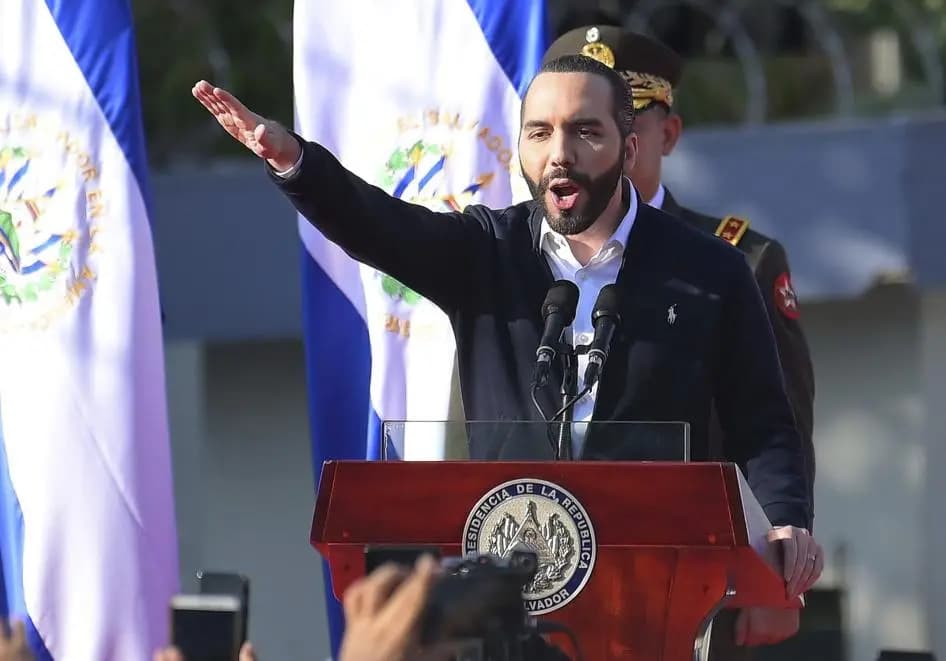
President of El Salvador
Public Views
Experience
Documented career positions
Nayib Armando Bukele Ortez (born July 24, 1981) is a Salvadoran politician and businessman who has served as the president of El Salvador since 2019. Known for his unorthodox governing style, extensive use of social media, and focus on security, Bukele has become one of the most prominent and polarizing figures in Latin American politics. His presidency has been marked by a significant reduction in gang-related violence, high domestic approval ratings, and international scrutiny regarding his consolidation of power and human rights record. Born in San Salvador to Armando Bukele Kattán, a prominent businessman of Palestinian descent and Muslim leader, and Olga Marina Ortez, Bukele was raised in a family of means. He attended the Panamerican School in San Salvador and later enrolled in the Central American University to study law but dropped out to focus on his family’s business interests. Before entering politics, he held management positions in his family's companies, which included advertising, textiles, and pharmaceutical firms, as well as the local distributorship for Yamaha Motor Company. Bukele entered the political arena in 2012 as a member of the Farabundo Martí National Liberation Front (FMLN), the leftist party that had dominated Salvadoran politics since the end of the civil war. He served as the mayor of the small town of Nuevo Cuscatlán from 2012 to 2015, where he gained attention for his populist initiatives. He was subsequently elected mayor of the capital, San Salvador, serving from 2015 to 2018. During his time as mayor, he frequently clashed with the FMLN leadership, eventually leading to his expulsion from the party in 2017. Following his ousting, he founded his own political movement, Nuevas Ideas (New Ideas). In the 2019 presidential election, Bukele ran as the candidate for the Grand Alliance for National Unity (GANA) after his own party faced registration delays. He secured a decisive victory, breaking the three-decade-long stranglehold that the FMLN and the conservative Nationalist Republican Alliance (ARENA) had held on the presidency. His 2019 inauguration marked the beginning of a new political era in El Salvador. Bukele’s presidency has been defined by his aggressive "Territorial Control Plan." Following a spike in gang violence in March 2022, he instituted a "State of Exception" that suspended certain constitutional rights, allowing for mass arrests of suspected gang members. This campaign has led to the detention of over 90,000 individuals and a significant decline in the nation's homicide rate, which was once among the highest in the world. While the policy enjoys widespread support among the Salvadoran population, it has drawn severe criticism from international human rights organizations, which point to mass arbitrary detentions, violations of due process, and prison overcrowding. Another signature, and highly controversial, policy of his first term was the adoption of Bitcoin as legal tender in 2021, making El Salvador the first country to take such a step. The initiative was intended to promote financial inclusion and attract foreign investment. However, adoption remained low among the public, and by early 2025, facing economic hardship and international pressure, the government rescinded Bitcoin's status as official legal tender. Throughout his tenure, Bukele has been accused of democratic backsliding. In February 2020, he famously entered the Legislative Assembly flanked by armed soldiers and police to pressure lawmakers to approve a security loan. In 2021, his party, Nuevas Ideas, won a legislative supermajority, allowing him to replace high-ranking judges and the attorney general, effectively consolidating control over the judiciary. Despite constitutional prohibitions against immediate presidential re-election, the Supreme Court reinterpreted the constitution to allow him to run again, and he was re-elected in a landslide in 2024. In 2025, the Legislative Assembly approved further constitutional amendments allowing for indefinite re-election. Bukele’s style—characterized by self-styled labels like "the world's coolest dictator" and his adept use of digital platforms to bypass traditional media—has made him a polarizing figure, viewed by many supporters as a necessary strongman and by critics as an autocrat dismantling the nation’s democratic institutions.
AI-powered civic intelligence rating
Completely dismantled the power of transnational street gangs (MS-13, Barrio 18) in El Salvador, dropping the national homicide rate by over 90% and returning the streets to civilian control
Built the CECOT (Terrorism Confinement Center), a massive, heavily publicized mega-prison designed to hold 40,000 gang members under extreme conditions
Human rights organizations (Amnesty International, Human Rights Watch) accuse him of destroying the rule of law by implementing a perpetual 'State of Exception,' resulting in the arbitrary arrest and indefinite detention of over 75,000 Salvadorans without due process
Used armed military personnel to storm the national parliament in 2020 to force lawmakers to approve a security loan loan
His 2024 re-election violated consecutive term limits explicitly outlined in the Salvadoran Constitution, achieved only after his party purged the Supreme Court and installed loyalist judges who reinterpreted the law
First national leader to officially adopt Bitcoin as legal tender (2021), surviving warnings from the IMF to see the national crypto portfolio become highly profitable during the 2024/2025 Bitcoin bull run
Consistently maintains domestic approval ratings exceeding 85%, making him one of the most popular democratically elected leaders globally
Elected mayor of Nuevo Cuscatlán in 2012, becoming the municipality's youngest mayor at the time.
Elected mayor of San Salvador in 2015, serving a three-year term until 2018.
Founded the political party Nuevas Ideas in 2017 after his expulsion from the FMLN.
Won the 2019 presidential election with 53% of the vote, ending El Salvador's long-standing two-party political system.
Inaugurated as the 81st President of El Salvador on June 1, 2019.
Implemented the Territorial Control Plan in July 2019, a multiphase security strategy aimed at reducing gang violence and homicide rates.
Launched the International Commission against Impunity in El Salvador (CICIES) in September 2019 to address corruption.
Secured a legislative supermajority for his party, Nuevas Ideas, in the 2021 legislative elections.
Signed legislation in 2021 making El Salvador the first country in the world to adopt Bitcoin as legal tender.
Initiated a nationwide state of exception in March 2022 to combat gang-related crime, leading to mass arrests of alleged gang members.
Proposed and saw the approval of legislative reforms in 2023 to reduce the number of national municipalities and legislative seats.
Re-elected as President of El Salvador in February 2024, securing approximately 85% of the vote.
Passed a constitutional amendment on July 31, 2025, which enabled indefinite presidential re-election, extended presidential terms from five to six years, and eliminated the two-round electoral system.
On February 9, 2020, Bukele entered the Legislative Assembly accompanied by armed soldiers to pressure lawmakers to approve a loan for security, an act widely criticized by international observers and rights groups as an intimidation tactic against democratic institutions.
In May 2021, the legislative assembly, newly controlled by Bukele's party, voted to dismiss the attorney general and the judges of the Constitutional Chamber of the Supreme Court, sparking international condemnation over the erosion of judicial independence and the separation of powers.
Beginning in March 2022, Bukele implemented a 'state of exception' to combat gang violence, resulting in the mass arrest of tens of thousands of individuals; human rights organizations including Amnesty International and Human Rights Watch have since documented reports of arbitrary detentions, due process violations, and deaths in state custody.
In September 2021, Bukele's government made Bitcoin legal tender in El Salvador, a policy that faced significant criticism from the International Monetary Fund (IMF) and various economists due to concerns regarding financial instability, lack of transparency, and the potential for money laundering.
Throughout his presidency, Bukele has faced allegations from various news organizations and independent investigations, such as those by El Faro, regarding the use of Pegasus spyware to monitor journalists, activists, and political opponents, claims which his administration has consistently denied.
In February 2024, Bukele was re-elected for a second consecutive term despite constitutional provisions that critics and legal experts argued explicitly prohibited immediate re-election, with the Supreme Court having issued a controversial ruling in 2021 that cleared the path for his candidacy.
The U.S. State Department has placed several of Bukele's close associates and administration officials on the 'Engel List' for alleged involvement in significant corruption, undermining democratic processes, and obstructing investigations into criminal acts.