We're loading the complete profile of this person of interest including their biography, achievements, and contributions.
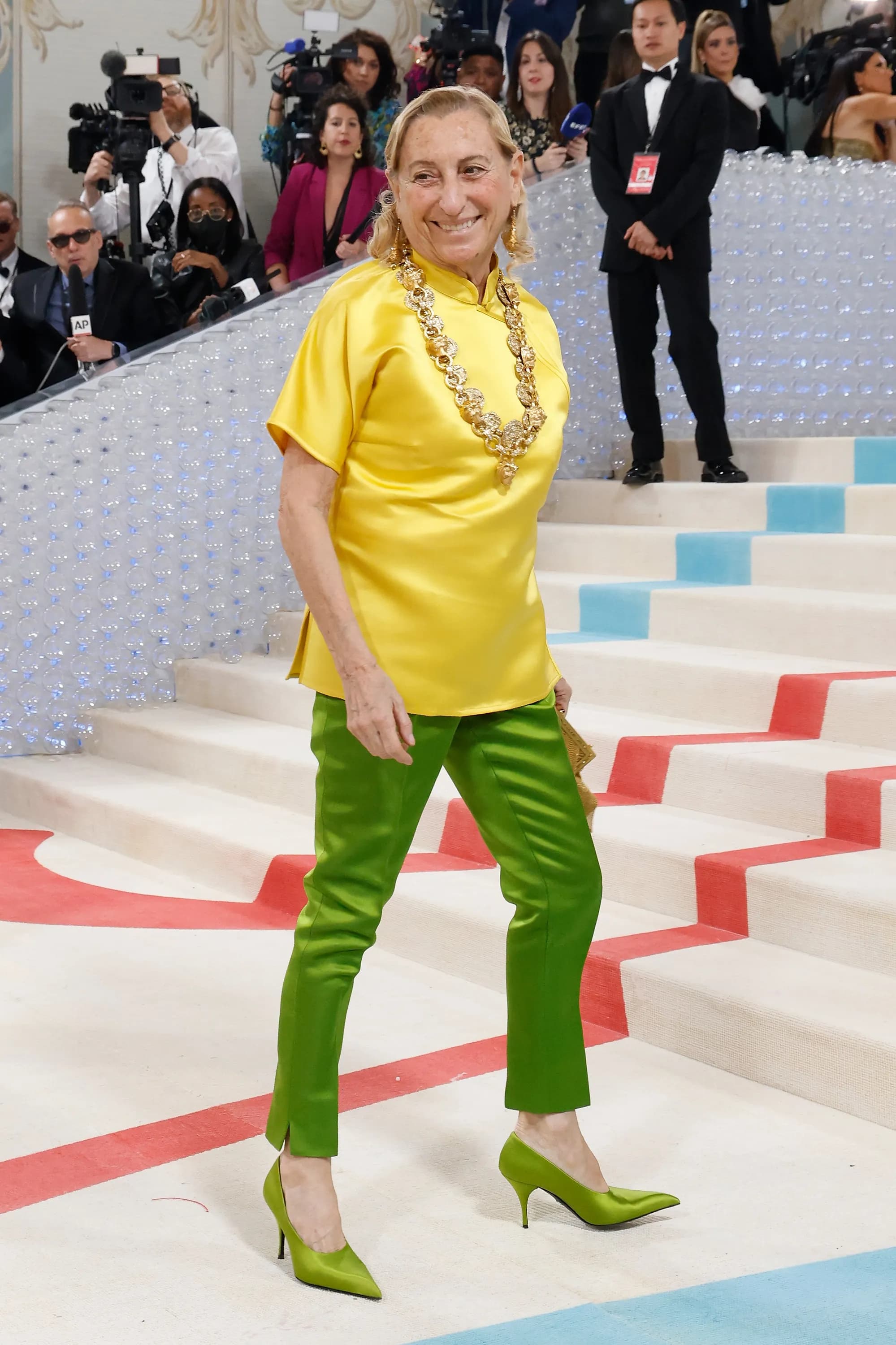
Co-CEO & Head Designer, Prada Group
Public Views
Experience
Documented career positions
Miuccia Prada, born Maria Bianchi on May 10, 1949, in Milan, Italy, is an Italian fashion designer and businesswoman who has fundamentally transformed the luxury industry through a conceptual, intellectually driven approach to design. As the co-CEO and creative director of the Prada Group, she is widely recognized for evolving her family's small leather goods enterprise into a global luxury conglomerate. Born into the Prada family, she is the granddaughter of Mario Prada, who founded the eponymous luxury house in 1913. Her early life was defined not by fashion, but by academic and political pursuits. She studied political science at the University of Milan, earning a doctoral degree. During the 1970s, she was active in the women's rights movement and the Italian Communist Party. Her formative years also included five years of training in mime at Milan's Piccolo Teatro, an experience she credits with providing her a deeper understanding of the body, movement, and the performative nature of clothing. Miuccia Prada entered the family business in 1970, initially managing one of its retail locations. She assumed control of the company in 1978. It was during this period that she met Patrizio Bertelli, a leather goods manufacturer who became her business partner and, later, her husband. Their partnership proved to be a decisive catalyst for the brand; while Bertelli focused on the commercial and industrial strategy, Miuccia Prada led the creative vision. Her early contributions included the 1985 introduction of a line of black, finely-woven "Pocono" nylon backpacks. This design was radical for the time, as it utilized a utilitarian, industrial material typically reserved for military tents rather than luxury goods, subverting conventional notions of status and exclusivity. Building on this success, Prada launched her first women’s ready-to-wear collection in 1989, which was characterized by a minimalist, intellectual aesthetic that earned her the moniker of "the thinking woman’s designer." She followed this in 1992 by launching Miu Miu, a subsidiary brand named after her childhood nickname, which allowed her to explore a more playful, youthful, and avant-garde aesthetic distinct from the primary Prada line. Throughout the 1990s and 2000s, the company expanded significantly, incorporating men’s collections and a series of high-profile acquisitions, including Jil Sander and Helmut Lang, and pursuing a public listing on the Hong Kong Stock Exchange in 2011. Beyond her design work, Miuccia Prada has exerted profound influence through her patronage of the arts. In 1993, she and Bertelli established the PradaMilanoarte, later renamed the Fondazione Prada, a cultural institution dedicated to contemporary art, architecture, and cinema. Through this organization, she has fostered interdisciplinary dialogues, collaborating with figures such as Rem Koolhaas and Herzog & de Meuron to create venues that challenge traditional museum spaces. Miuccia Prada’s legacy is defined by her ability to challenge the "bourgeois" standards of luxury. She famously pioneered the "ugly chic" aesthetic, deliberately utilizing unexpected color palettes, unconventional fabrics, and challenging silhouettes to provoke thought rather than merely satisfy traditional tastes. Her approach to fashion as a vehicle for social and cultural commentary has cemented her status as one of the most significant figures in the history of modern fashion, with her work frequently cited by critics and scholars for its persistent ability to capture and critique the zeitgeist. As of the mid-2020s, she continues to lead the Prada Group, sharing creative responsibilities for the Prada brand with Raf Simons, while maintaining her role as a primary force in the international luxury market.
AI-powered civic intelligence rating
Transformed her family's modest luggage business into the globally dominant Prada Group a multi-billion dollar luxury powerhouse that resisted the massive corporate consolidation of LVMH and Kering
Founded Miu Miu in 1993 which became the absolute hottest most culturally relevant brand of the 2020s dictating global Gen Z fashion trends and silhouettes
Investigated by Italian tax authorities in 2014 regarding the alleged transfer of untaxed assets to holding companies in Luxembourg (The Prada Group eventually repatriated the assets to Italy and paid massive settlements to clear the dispute)
Faced significant backlash in the late 2010s for the release of Pradamalia bag charms that heavily resembled racist blackface caricatures prompting the company to immediately pull the products and establish a diversity council
In 2014, Miuccia Prada and her husband, Patrizio Bertelli, were subject to an investigation by Italian authorities regarding allegations of tax evasion related to assets held in foreign subsidiaries. The couple had previously initiated a voluntary tax disclosure process, and the investigation concluded without further criminal proceedings following reported settlements with the Italian tax agency.
Appointed Raf Simons as co-creative director of Prada in a historic highly successful intellectual fashion partnership
Established the Fondazione Prada a premier contemporary art and architectural institution in Milan designed by Rem Koolhaas
Earned a doctorate in political science from the University of Milan in 1973.
Assumed control of the family-owned luxury goods business, Fratelli Prada, in 1978.
Partnered with Patrizio Bertelli in 1978, establishing a professional and personal alliance that revitalized the brand.
Introduced the first line of black, water-resistant Pocono nylon handbags in 1979.
Launched the first women's ready-to-wear collection for the Prada brand in 1988.
Founded the Miu Miu brand, a more affordable and avant-garde women's subsidiary named after her nickname, in 1992.
Co-founded PradaMilanoarte, which was later reorganized and renamed Fondazione Prada, in 1993.
Received the Council of Fashion Designers of America (CFDA) International Award in 1993.
Launched the first Prada menswear collection in 1994.
Received an honorary doctorate from the Royal College of Art in London in 2000.
Named one of the 100 most influential people in the world by Time Magazine in 2004.
Received the Council of Fashion Designers of America (CFDA) International Award for the second time in 2004.
Appointed Officier dans l'Ordre des Arts et des Lettres by the French Ministry of Culture in 2006.
Received the McKim Medal from the American Academy in Rome in 2010.
Honored with a Creative Award from the Costume Designers Guild in 2010.
Featured as the subject of the Metropolitan Museum of Art's 'Schiaparelli and Prada: Impossible Conversations' exhibition in 2012.
Named International Designer of the Year at the British Fashion Awards in 2013.
Appointed co-CEO of Prada Group alongside her husband Patrizio Bertelli in 2014.
Inaugurated the permanent exhibition venue for Fondazione Prada in Milan in 2015.
Appointed a Knight of the Grand Cross of the Order of Merit of the Italian Republic in 2015.
Received the Glamour Women of the Year Lifetime Achievement Award in 2016.
Presented with the British Fashion Council's Outstanding Achievement Award at the 2018 Fashion Awards.
Appointed Raf Simons as co-creative director of the Prada brand in 2020, marking a significant industry milestone.
Received the WWD John B. Fairchild Honor for Lifetime Achievement in 2021.
Honored by the Council of Fashion Designers of America (CFDA) with the Board of Directors’ Tribute in 2023.
In December 2018, Prada faced significant backlash after a line of 'Pradamalia' store figurines were criticized for resembling racist blackface caricatures. The company apologized, withdrew the products, and in 2020, entered into a settlement with the New York City Commission on Human Rights, which mandated diversity and racial equity training for executives, including Miuccia Prada, and staff.
In 2025, Prada was named as one of several luxury fashion houses involved in a broad investigation by Italian prosecutors into labor exploitation and sweatshop conditions within the Italian fashion supply chain. While the company was not initially under formal criminal investigation, authorities demanded information and scrutinized the brand's oversight of subcontractors accused of subjecting migrant workers to unsafe and exploitative labor practices.
In 2025, the company faced criticism for a range of sandals that bore a striking resemblance to traditional Indian 'Kolhapuri Chappals' without crediting their cultural origin. The incident sparked accusations of cultural appropriation and a lack of responsible sourcing, prompting a public acknowledgment from the brand's corporate social responsibility leadership.