We're loading the complete profile of this person of interest including their biography, achievements, and contributions.
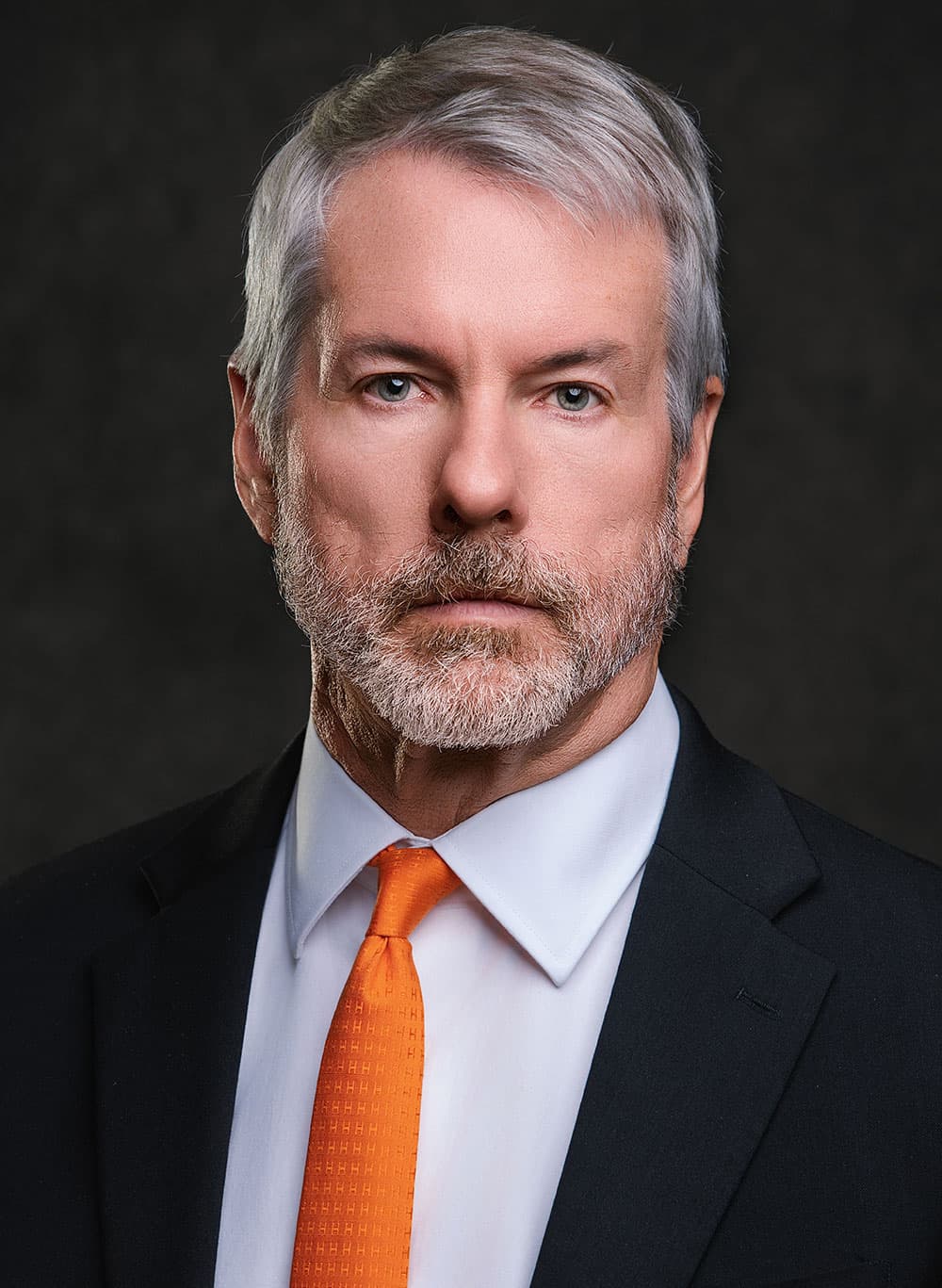
Executive Chairman, MicroStrategy
Public Views
Experience
Documented career positions
Michael J. Saylor (born February 4, 1965) is an American entrepreneur, business executive, and philanthropist, best known as the founder and executive chairman of MicroStrategy (now rebranded as Strategy). He rose to prominence in the 1990s as a pioneer in business intelligence software and has since become a major figure in the cryptocurrency industry due to his aggressive corporate adoption of Bitcoin. Born in Lincoln, Nebraska, to a military family, Saylor spent much of his childhood living on various United States Air Force bases. His family eventually settled in Fairborn, Ohio, near the Wright-Patterson Air Force Base. Saylor’s academic career was marked by early achievement; he attended the Massachusetts Institute of Technology (MIT) on an Air Force Reserve Officers' Training Corps (ROTC) full scholarship. At MIT, he was a member of the Theta Delta Chi fraternity, where he met Sanju Bansal, his future business partner. Saylor graduated with highest honors in 1987, holding dual degrees in aeronautics and astronautics, and in science, technology, and society. In 1989, at age 24, Saylor and Bansal co-founded MicroStrategy, a company initially focused on computer simulation modeling and data mining before pivoting to enterprise business intelligence software. The company achieved rapid growth during the 1990s and went public on the NASDAQ in 1998. Under Saylor’s leadership, MicroStrategy became a global provider of analytics and mobility software. His entrepreneurial efforts also extended to other ventures; he founded Alarm.com, a prominent home automation and security company, and Angel.com, a cloud-based interactive voice response provider which was later sold. Saylor's career has faced significant regulatory and legal challenges. In March 2000, the U.S. Securities and Exchange Commission (SEC) launched an investigation into MicroStrategy for its financial reporting practices. In December 2000, Saylor and two other executives settled civil accounting fraud charges with the SEC without admitting or denying wrongdoing. As part of the settlement, Saylor paid $350,000 in penalties and provided $8.3 million in personal disgorgement. In a separate legal matter, Saylor settled a tax fraud lawsuit with the District of Columbia in 2024, agreeing to pay a $40 million fine to resolve allegations that he avoided taxes while misrepresenting his residency. In 2020, Saylor orchestrated a pivotal shift in his company's treasury management strategy. He began investing the company's capital in Bitcoin, asserting that it served as a superior store of value and an inflation hedge compared to traditional assets. This initiative transformed MicroStrategy—often referred to in financial media as a "Bitcoin whale"—into the largest corporate holder of the cryptocurrency. To focus exclusively on this strategy, Saylor transitioned from his role as CEO to executive chairman in August 2022, handing the CEO position to Phong Le. The company’s focus on the digital asset eventually led to a corporate rebranding to Strategy in 2025. Beyond his business activities, Saylor has authored books, including *The Mobile Wave: How Mobile Intelligence Will Change Everything* (2012), and founded the Saylor Academy in 1999, a nonprofit organization that provides free online education and professional development courses to students worldwide.
AI-powered civic intelligence rating
Executed a historic unprecedented corporate treasury strategy by aggressively acquiring over 200000 Bitcoin fundamentally transforming MicroStrategy into a massive proxy stock for institutional Bitcoin exposure
Authored the bestselling book 'The Mobile Wave' successfully predicting the massive economic disruption of mobile computing long before it became a ubiquitous reality
Universally mocked by traditional Wall Street analysts (like Peter Schiff) who accuse Saylor of acting like a religious cult leader rather than a fiduciary corporate executive arguing his massive highly leveraged Bitcoin bets pose an existential risk to his shareholders if the crypto market collapses
Faced a massive highly publicized tax evasion lawsuit filed by the Attorney General of Washington DC in 2022 alleging he fraudulently claimed to reside in Florida to avoid millions in district taxes (Saylor vehemently denied the allegations and ultimately settled the case for 40 million dollars without admitting wrongdoing)
Founded the Saylor Academy a non-profit organization offering free massive open online courses (MOOCs) to democratize global access to higher education
Successfully navigated the SEC approval of spot Bitcoin ETFs essentially forcing Wall Street to adopt the asset class he aggressively championed
Graduated from MIT with highest honors in 1987, earning dual degrees in aeronautics and astronautics and in science, technology, and society.
Founded MicroStrategy in 1989, focusing on business intelligence and data analytics software.
Secured a major $10 million contract with McDonald's in 1992, significantly accelerating MicroStrategy's growth.
Named KPMG Washington High-Tech Entrepreneur of the Year in 1996.
Named Ernst & Young Software Entrepreneur of the Year in 1997.
Took MicroStrategy public on the NASDAQ in 1998.
Recognized as one of Red Herring Magazine's Top 10 Entrepreneurs in 1998.
Named an 'Innovator Under 35' by the MIT Technology Review in 1999.
Established The Saylor Foundation in 1999, which later became Saylor Academy to provide free online education.
Founded Alarm.com in 2000 as part of MicroStrategy's research and development initiatives.
Received the Horatio Alger Award in 2003.
Published the bestselling book 'The Mobile Wave: How Mobile Intelligence Will Change Everything' in 2012.
Sold his company Angel.com to Genesys Telecommunications Laboratories for $110 million in 2013.
Initiated a historic corporate strategy in 2020 by making Bitcoin the primary treasury reserve asset for MicroStrategy.
Transitioned from CEO to Executive Chairman of MicroStrategy in 2022 to focus on Bitcoin acquisition strategy and advocacy.
In 2000, Michael Saylor and MicroStrategy were charged by the U.S. Securities and Exchange Commission (SEC) with accounting fraud for materially overstating the company's financial results. Saylor settled the charges without admitting or denying wrongdoing, agreeing to pay a $350,000 civil penalty and $8.3 million in disgorgement of ill-gotten gains.
In August 2022, the District of Columbia Attorney General sued Saylor and MicroStrategy for tax evasion, alleging that Saylor, while living in D.C., falsely claimed residence in Florida or Virginia to avoid paying over $25 million in D.C. income taxes. In June 2024, Saylor and MicroStrategy agreed to pay $40 million to settle the lawsuit, marking the largest income tax fraud recovery in the District's history.