We're loading the full news article for you. This includes the article content, images, author information, and related articles.
An attack on President Hakainde Hichilema highlights deep-seated economic frustrations in Zambia, a key Kenyan trade partner, raising concerns about regional stability ahead of the 2026 elections.
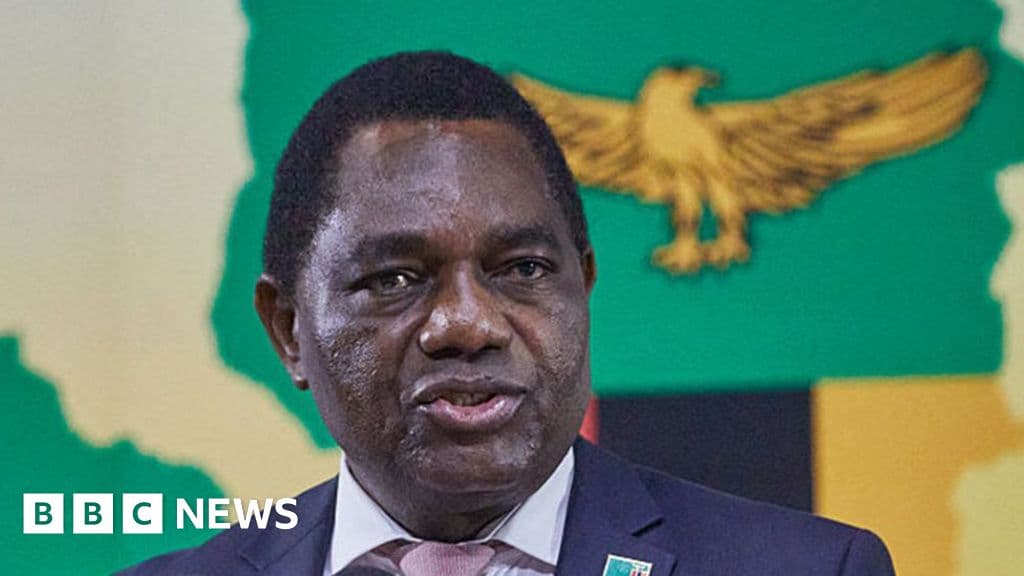
Zambian President Hakainde Hichilema was forced to abandon a public address on Saturday, November 8, 2025, after being pelted with stones in the city of Chingola, a dramatic illustration of rising public anger over the country's severe economic crisis. The incident, which occurred in the heart of Zambia's Copperbelt province, has sent shockwaves through the Southern African nation and is being closely watched by regional partners, including Kenya, as the country heads towards a general election scheduled for August 13, 2026.
President Hichilema was visiting Chiwempala Market to address residents affected by a recent fire and ongoing mining disputes when the crowd turned hostile. Witnesses reported that chants and slogans about economic hardship preceded the violence, with stones being thrown towards the presidential podium, forcing security personnel to shield the president and evacuate him from the scene. The unrest escalated after his departure, with protesters setting fire to a police vehicle and other property. In a subsequent statement, the Zambia Police Service (ZPS) confirmed the events, describing them as riots and arson, and announced the arrest of two suspects.
The attack is widely seen as a symptom of waning optimism in President Hichilema's administration. Elected in a 2021 landslide, the president, often dubbed the 'fix-it' president, inherited an economy burdened by high debt and corruption. His government has since embarked on an ambitious economic reform agenda, securing a crucial debt restructuring deal and attracting foreign investment pledges. State House has pointed to achievements such as stabilizing the currency, the Kwacha, introducing free primary and secondary education, and a record maize harvest as signs of progress.
However, these macroeconomic efforts have yet to translate into relief for many ordinary Zambians. The country is grappling with a severe cost of living crisis, with prices for essential goods like food and fuel soaring. The Jesuit Centre for Theological Reflection (JCTR), a local faith-based organization, reported in March 2025 that the gap between stagnant incomes and the cost of basic necessities continues to widen, deepening economic inequalities. This hardship is particularly acute in the Copperbelt, a region historically dependent on mining, where residents have voiced frustration over a lack of jobs and economic opportunities.
The incident in Chingola also highlights a deteriorating political climate. With the 2026 elections on the horizon, opposition figures have capitalized on the public's economic pain, accusing the president of being out of touch. Human rights organizations have raised concerns about increasing authoritarian tendencies within the Hichilema administration. Reports from Freedom House and Human Rights Watch in 2025 noted a pattern of restrictions on opposition rallies, harassment of journalists, and the use of restrictive laws to narrow political space. The government has also proposed controversial constitutional amendments that critics claim could entrench the ruling party's power by redrawing constituency boundaries.
In a press conference following the attack, President Hichilema condemned the violence as “lawlessness” and an act of “hatred,” urging Zambians to seek peaceful means to air grievances. He has accused opposition “party thugs” of orchestrating the unrest with a “hidden agenda” to destabilize the country ahead of the polls.
While Zambia is not a member of the East African Community (EAC), the unfolding events are of significant interest to Kenya. Kenya and Zambia are key bilateral partners and members of the Common Market for Eastern and Southern Africa (COMESA), with relations focused on trade, energy, and agriculture. In March 2025, a Kenyan business delegation led by the Kenya National Chamber of Commerce & Industry (KNCCI) visited Lusaka to explore deeper trade ties and address logistical bottlenecks. The two nations have also signed an MOU to interconnect their national power grids along with Tanzania.
Political instability in a significant trade partner like Zambia could disrupt these economic initiatives. The challenges faced by President Hichilema—reconciling painful but necessary economic reforms with public expectations for immediate relief—are a familiar narrative across the continent. The violent expression of discontent in Chingola serves as a stark reminder of the political risks leaders face when implementing austerity measures in a climate of high youth unemployment and economic inequality. For Kenya and the wider region, the stability and democratic trajectory of Zambia remain crucial for fostering a predictable and prosperous economic environment.
Keep the conversation in one place—threads here stay linked to the story and in the forums.
Sign in to start a discussion
Start a conversation about this story and keep it linked here.
Other hot threads
E-sports and Gaming Community in Kenya
Active 9 months ago
The Role of Technology in Modern Agriculture (AgriTech)
Active 9 months ago
Popular Recreational Activities Across Counties
Active 9 months ago
Investing in Youth Sports Development Programs
Active 9 months ago
Key figures and persons of interest featured in this article



