We're loading the full news article for you. This includes the article content, images, author information, and related articles.
Mbeere North MP Leo Wa Wamuthende defends President William Ruto’s recent controversial remarks, sparking debate on political civility in Kenya.
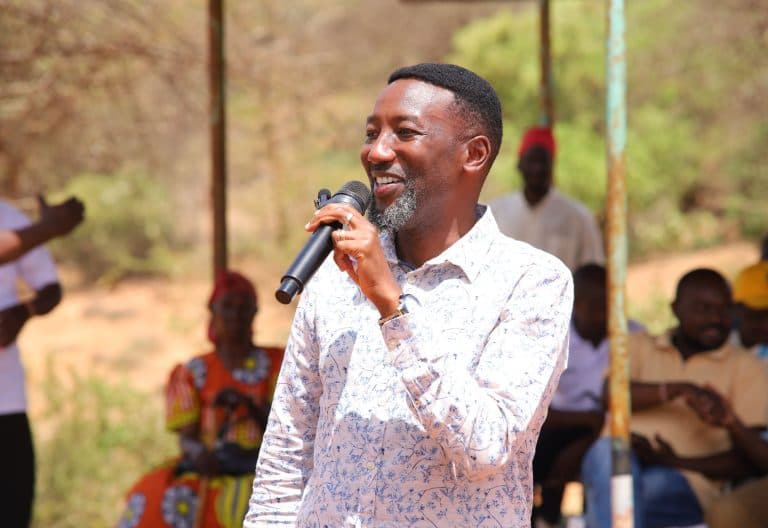
Standing before a crowded press pool in Nairobi, Mbeere North Member of Parliament Leo Wa Wamuthende rejected the growing narrative that President William Ruto has resorted to utilizing derogatory language in public discourse. The defense, delivered with characteristic fervor, aimed to quell the firestorm ignited by recent comments attributed to the President regarding his political opponents.
The controversy centers on a remark commonly interpreted by critics as calling into question the intellectual capacity of the political opposition, colloquially summarized as a lack of brains. For the administration, the fallout represents a precarious moment where the distinction between robust political debate and personal insult has blurred, threatening to deepen the existing polarization within the country. As citizens and civil society groups weigh in on the rhetoric, the implications for national stability remain significant, with millions of Kenyans watching to see how the President’s inner circle manages the optics of this ongoing verbal sparring.
The comment in question has triggered a wave of condemnation from the opposition and various civil society organizations, who argue that the head of state must uphold a standard of decorum regardless of political provocation. According to political analysts monitoring the situation, the frustration stems not just from the specific phrase used, but from a perceived pattern of confrontational communication that has defined the current legislative session.
Legislators from the opposition benches have characterized the remark as a departure from the respect due to public office. However, supporters of the President, including Wamuthende, argue that the critique is a deliberate misinterpretation of what they term as street-smart political realism. In an interview following his press statement, Wamuthende maintained that the President was merely highlighting a lack of viable policy alternatives from the opposition, rather than attacking the cognitive faculties of specific individuals.
The debate surrounding presidential rhetoric is not new to the Kenyan political scene, yet it takes on a specific urgency in 2026. Experts at the Institute of Policy Analysis and Research note that during periods of economic volatility, where the government is attempting to navigate complex fiscal reforms, the language used by leadership is scrutinized with greater intensity. When leaders pivot to ad hominem attacks, or what are perceived as such, it can undermine public trust in the institutions themselves.
Wamuthende’s defense of the President fits into a broader strategy of shielding the executive from sustained attacks. By framing the President’s comments as misunderstood, he attempts to neutralize the optics of the situation. However, this strategy carries its own risks. It risks alienating moderate voters who are increasingly fatigued by the constant cycle of outrage and defensive posturing that has characterized the political discourse over the last several months.
For the average Kenyan, the preoccupation with the President’s vocabulary often overshadows the immediate concerns of the cost of living, healthcare access, and agricultural inputs. Interviews conducted with residents in various urban centers suggest a growing divide: a portion of the population views the President’s sharp tongue as a sign of strength and a willingness to fight for his agenda, while another, perhaps larger segment, views it as unbecoming of the nation's highest office.
Professor Samuel Odhiambo, a scholar of political communications at the University of Nairobi, argues that the incident highlights a critical failure in current political management. According to Odhiambo, political rhetoric in the country has regressed, shifting from ideological battlegrounds to character assassinations. He suggests that while Wamuthende’s defense is standard loyalty-signaling, it fails to address the underlying issue: that the presidency requires a unifying tone that transcends partisan bickering, especially when the nation is facing multifaceted economic pressures.
Kenya has a documented history of presidents who have used aggressive or colorful language to convey political dominance. From the calculated silence of the Jomo Kenyatta era to the sharp-witted jabs of the Moi years, the use of language has always been a political tool. However, the digital age has transformed these moments from fleeting political theater into permanent records, subject to infinite analysis and outrage on social media platforms.
This shift in the medium has forced politicians like Wamuthende to become more aggressive in their media management. The speed at which a comment can be clipped, shared, and misconstrued—or correctly interpreted—creates an environment where the defense is often as significant as the original statement. It is a relentless cycle that leaves little room for nuance or meaningful dialogue, forcing the government and its supporters to be in a constant state of damage control.
As the legislative session progresses, the ability of the administration to pivot away from these rhetorical skirmishes will determine its effectiveness in passing key legislation. The opposition, energized by these moments of perceived verbal slip-ups, is unlikely to let the issue die down quickly. For Wamuthende, the path forward remains clear: continue to define the President’s narrative, even if that means constantly battling for the definition of a single, contentious word.
Whether this defense resonates with the broader electorate remains a matter of ongoing debate, yet the insistence by the Mbeere North MP underscores the loyalty demanded within the ruling coalition. In the end, the question remains: does the electorate care more about the language used in the boardroom, or the results delivered at the ballot box and the kitchen table?
Keep the conversation in one place—threads here stay linked to the story and in the forums.
Sign in to start a discussion
Start a conversation about this story and keep it linked here.
Other hot threads
E-sports and Gaming Community in Kenya
Active 10 months ago
The Role of Technology in Modern Agriculture (AgriTech)
Active 10 months ago
Popular Recreational Activities Across Counties
Active 10 months ago
Investing in Youth Sports Development Programs
Active 10 months ago
Key figures and persons of interest featured in this article



