We're loading the full news article for you. This includes the article content, images, author information, and related articles.
An unprecedented threat by the US to bar South Africa from the 2026 G20 summit signals escalating tensions with major implications for Africa's voice in global economic governance, raising concerns for Kenyan and regional diplomatic stability.
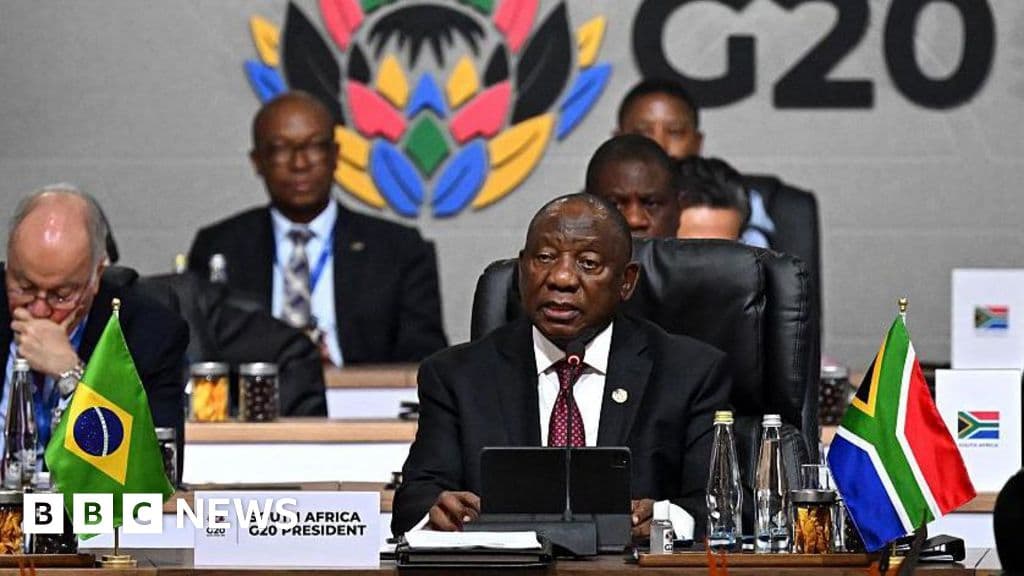
GLOBAL – A sharp diplomatic escalation between the United States and South Africa is unfolding after US President Donald Trump announced on Wednesday, November 26, 2025, that South Africa will not be invited to the 2026 G20 summit in Miami. The move, which would be the first time a member nation has been excluded in the forum's history, has been labelled "regrettable" by South African President Cyril Ramaphosa's office, which firmly rejected the U.S. assertions.
The crisis stems from the conclusion of the G20 Leaders' Summit held in Johannesburg from November 22-23, 2025—the first ever hosted on African soil. The Trump administration boycotted the summit and refused to send a high-level delegation, citing widely discredited claims of "horrific human rights abuses" and killings of white farmers in South Africa. Consequently, a dispute arose over the ceremonial handover of the G20 presidency. President Trump, in a social media post, claimed that South Africa "refused to hand off the G20 Presidency to a Senior Representative from our U.S. Embassy."
In a detailed statement on Wednesday, November 26, 2025, the South African Presidency countered this narrative, stating that because the U.S. had voluntarily chosen not to attend the summit, the "instruments of the G20 Presidency were duly handed over to a US Embassy official at the Headquarters of South Africa's Department of International Relations and Cooperation." Officials in Pretoria had previously stated it would be a breach of protocol for President Ramaphosa to hand the ceremonial gavel to a junior embassy official.
South Africa is a permanent member of the G20, an intergovernmental forum of the world's 20 largest economies. The G20 operates on consensus and lacks a formal mechanism for one member, even the host, to unilaterally expel or bar another. Any attempt to exclude a member would challenge the foundational principles of the group, which collectively accounts for about 85% of global GDP. President Trump's declaration has therefore been described by analysts as legally and diplomatically untenable, representing a significant challenge to the global order. In his statement, Trump also announced an immediate halt to "all payments and subsidies" to South Africa.
The South African government's response underscored its status as a sovereign nation and a member of the G20 "in its own name and right." "South Africa is a sovereign constitutional democratic country and does not appreciate insults from another country about its worth in participating in global platforms," the Presidency's statement read.
This diplomatic firestorm between a global superpower and Africa's most industrialized economy carries significant weight for Kenya and the broader East African region. The instability in relations between two of the region's key trading and strategic partners could have far-reaching consequences.
Firstly, the dispute threatens to undermine Africa's collective voice on the world stage. South Africa has historically been a crucial advocate for the continent's priorities within the G20, from debt relief to climate finance and sustainable development. Its potential exclusion, even if temporary, could diminish the continent's influence in shaping global economic policy, affecting initiatives that countries like Kenya rely on for development financing and trade access.
Secondly, the escalating tensions could create economic headwinds. The United States and South Africa are both vital economic partners for Kenya. A breakdown in their relations could disrupt established trade frameworks, including the African Growth and Opportunity Act (AGOA), and deter foreign investment across the continent as geopolitical risk increases. The fallout could force African nations into difficult diplomatic positions, potentially disrupting the unity of regional blocs like the African Union.
Finally, the situation sets a dangerous precedent for multilateralism. If a host nation can threaten to exclude a member from a key international forum, it erodes the consensus-based foundation of global governance. This could weaken institutions that are critical for addressing shared global challenges, from climate change to financial stability, which disproportionately affect developing regions like East Africa.
The G20 dispute is the latest flashpoint in a relationship that has become increasingly strained. The Trump administration has repeatedly invoked the issue of land reform and alleged violence against white farmers, claims which the South African government has consistently rejected as baseless and misinformed. Tensions had already led to Washington expelling the South African ambassador in March 2025. As the United States prepares to assume the G20 presidency on December 1, 2025, the international community is watching closely to see how this unprecedented diplomatic conflict will be resolved and what it portends for the future of global cooperation.
Keep the conversation in one place—threads here stay linked to the story and in the forums.
Sign in to start a discussion
Start a conversation about this story and keep it linked here.
Other hot threads
E-sports and Gaming Community in Kenya
Active 9 months ago
The Role of Technology in Modern Agriculture (AgriTech)
Active 9 months ago
Popular Recreational Activities Across Counties
Active 9 months ago
Investing in Youth Sports Development Programs
Active 9 months ago
Key figures and persons of interest featured in this article