We're loading the full news article for you. This includes the article content, images, author information, and related articles.
Government celebrates historic KJSEA results, but KNEC data reveals a silent crisis: 1 in 8 learners vanished before reaching Senior School.
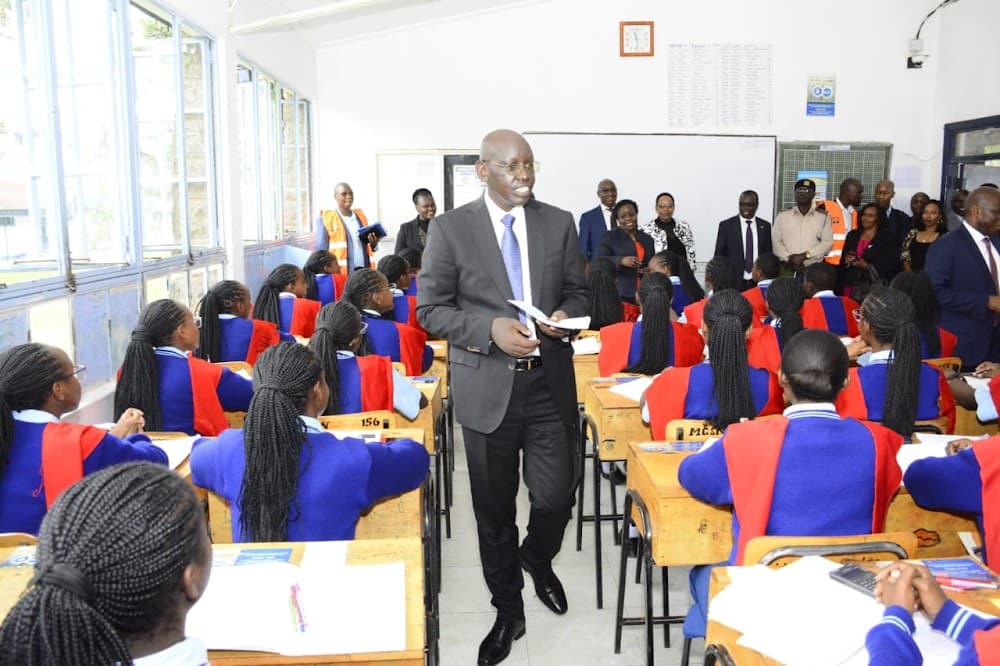
It was meant to be a victory lap for Kenya’s education reformers—the historic release of the first-ever Kenya Junior School Education Assessment (KJSEA) results. But as Education Cabinet Secretary Julius Migos Ogamba stood at Mitihani House to herald the transition of 1.1 million learners to Senior School, a ghost sat at the banquet. Somewhere between Grade 6 and Grade 9, over 150,000 children simply disappeared from the classroom.
The pioneer class of the Competency-Based Curriculum (CBC), often termed the “guinea pig cohort” by anxious parents, has faced hurdles from textbook shortages to teacher strikes. Now, data from the Kenya National Examinations Council (KNEC) confirms the system’s heaviest toll yet: a transition rate of just 88.17 percent. For a government that has staked its reputation on a “100 percent transition” policy, these empty desks represent not just a statistical variance, but a profound policy failure.
To understand the scale of the loss, one must look at the journey of this specific group. In 2019, when these learners sat for the Kenya Early Years Assessment (KEYA) at Grade 3, they numbered 1,282,150. By 2022, as they tackled the Grade 6 assessment (KPSEA), that figure had dipped slightly to 1,253,577.
But the cliff edge appeared in Junior Secondary. Only 1,130,587 learners sat for the inaugural KJSEA this year. That is a drop of nearly 152,000 students since 2019—a population roughly the size of Nyeri Town—wiped off the education map.
“The variance represents a transition rate of 88.17 percent,” the report notes dryly, dealing a blow to the Ministry’s narrative of seamless progression. While officials have not offered a definitive explanation, analysts point to a cocktail of economic hardship, the high cost of the new curriculum implementation for parents, and a quiet exodus to international systems or informal labor.
Perhaps the most startling revelation in the KNEC data is the gender disparity in these dropout rates. For years, the narrative has focused on the girl child, and rightly so. However, the CBC pioneer data flips the script.
While fewer girls are enrolled overall, they are holding onto their education with greater tenacity than their male counterparts. In counties like Kilifi and Kwale, the data also highlighted a significant number of “over-age” learners, suggesting that repetition and delayed entry continue to plague the Coast region, further complicating the transition matrix.
For the 1.13 million survivors who made it, the rules of the game have changed. Gone are the days of the high-stakes KCPE cut-off marks. The KJSEA results released on Thursday, December 11, replaced traditional rankings with competency descriptors.
According to KNEC CEO David Njengere, the majority of learners—75 percent—fell into the “Approaching Expectation” category. This new grading system combines the final assessment (60 percent) with school-based assessments from Grades 7 and 8 (40 percent). It is designed to paint a holistic picture of the learner, though for many parents used to the binary of “pass or fail,” the new terminology remains a puzzle.
“This is a landmark moment,” Njengere stated. “For the first time, the Kenyan education system will be reporting on learners' achievement using a rich array of data accumulated over a period of time.”
The immediate focus now shifts to January 12, 2026, when these learners will report to Senior School (Grade 10). This marks the beginning of the end for the 8-4-4 system in secondary schools. Students will be placed into three distinct pathways based on their performance and interest:
Basic Education Principal Secretary Julius Bitok has assured parents that placement results will be out by Christmas, promising a “fair and transparent” process guided by learner choices. Yet, with the shadow of the missing 150,000 looming large, the Ministry faces a tough question: If they couldn't keep these children in Junior School, how will they ensure the Senior School cohort doesn't shrink further?
As families in Nairobi and across the country check their results via SMS code 22263 (at a cost of KES 30), the celebration is muted by reality. The system has successfully transitioned a million children, but it has failed a hundred and fifty thousand others. In a country banking on its youth for the future, that is a deficit we cannot afford to ignore.
Keep the conversation in one place—threads here stay linked to the story and in the forums.
Sign in to start a discussion
Start a conversation about this story and keep it linked here.
Other hot threads
E-sports and Gaming Community in Kenya
Active 10 months ago
The Role of Technology in Modern Agriculture (AgriTech)
Active 10 months ago
Popular Recreational Activities Across Counties
Active 10 months ago
Investing in Youth Sports Development Programs
Active 10 months ago
Key figures and persons of interest featured in this article