We're loading the full news article for you. This includes the article content, images, author information, and related articles.
privacy isn’t a preference. It’s a form of protection.
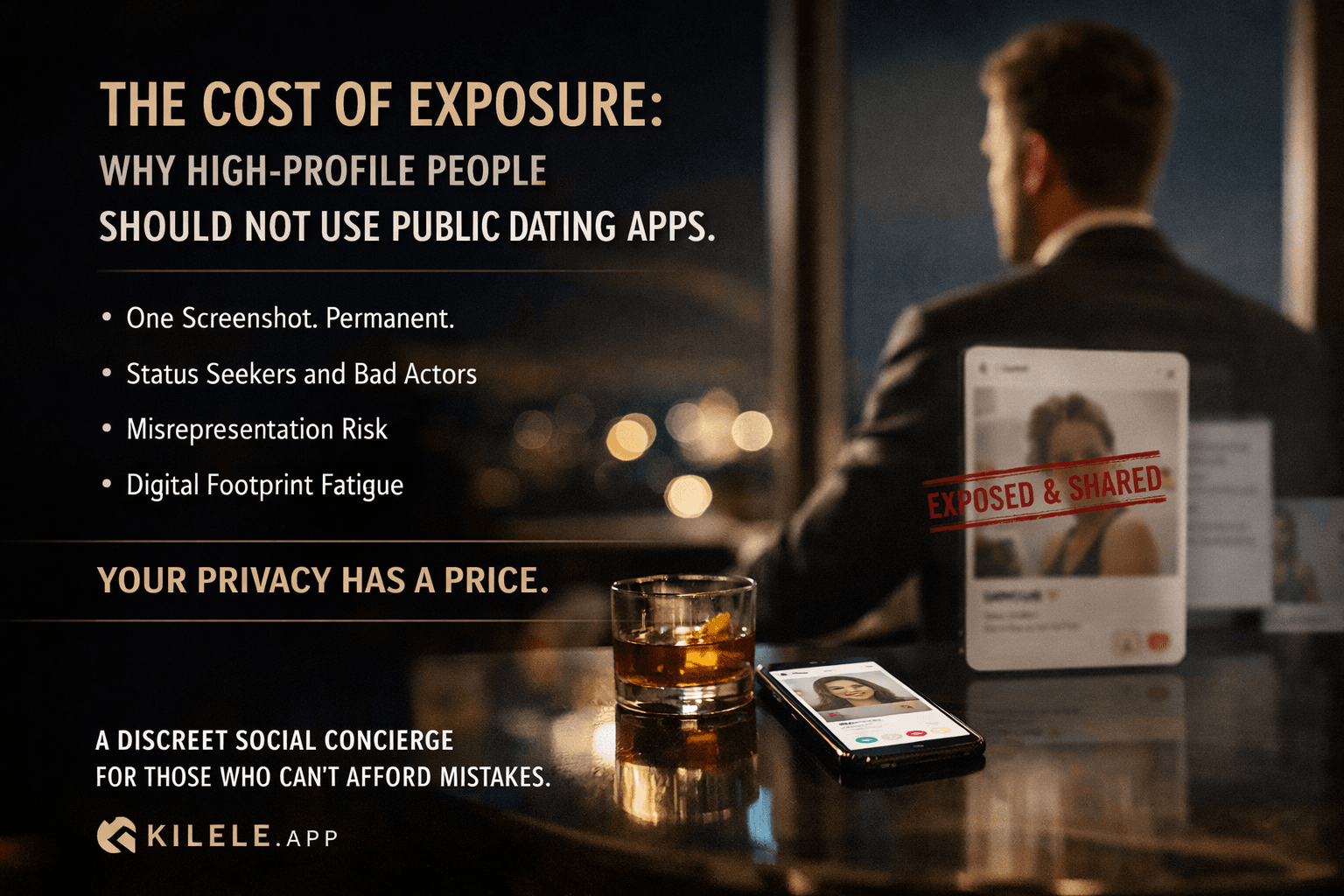
For people with public reputations, privacy isn’t a preference. It’s a form of protection.
Public dating apps were built for reach. They reward visibility, speed, and constant engagement—profiles that can be searched, screenshotted, shared, and amplified. That model works when the worst outcome is awkwardness.
But when your name carries weight—when you sit in boardrooms, lead teams, manage capital, advise institutions, or simply value a quiet life—exposure stops being a nuisance and becomes a risk surface.
And risk has a cost.
Most public platforms are structured around growth and monetization. That means the product is not only “dating.” The product is attention, activity, and data.
Even if you are careful, the system itself creates visibility loops:
Your profile is pushed to strangers you didn’t select.
Your images are displayed in environments you don’t control.
Your presence becomes discoverable through patterns—location, habits, time windows.
Your interactions become part of a data trail that can be misread, re-framed, or weaponized.
For high-profile people, the problem is simple: you can’t “settings” your way out of a system designed to surface you.
In private life, context matters.
On public platforms, context is optional.
A screenshot rarely carries nuance—only the headline version of you. A photo. A name. A prompt answer. A location. Enough to create a narrative.
The cost is not always public scandal. Sometimes it’s quieter:
A relationship strained by misinterpretation.
A personal brand questioned by the wrong audience.
A professional reputation forced to “explain” something that shouldn’t have been visible in the first place.
Public apps normalize the idea that your private social life is content. That’s a structural mismatch for people who cannot afford to be reduced to a screenshot.
When access is open and entry is low-friction, you don’t just meet people. You meet motivations.
Public platforms attract a wide range of intentions, including:
People seeking proximity to status, not alignment.
People collecting screenshots as social proof.
People who want “the story” more than the person.
People who treat dating as entertainment, not meaning.
If you’re a high-profile person, you don’t need more attention. You need clarity.
The open marketplace makes that expensive—because the time cost of sorting “signal” from “noise” is real, and the reputational cost of one wrong interaction is not evenly shared.
For public-facing people, impersonation is not rare—it’s predictable.
Public apps make it easy for bad actors to:
Mimic identities and appear credible.
Inflate claims to gain access.
Misrepresent intentions to secure a meeting.
Create confusion through partial truths.
Most platforms respond with “block and report.” That’s reactive. And for someone with reputational stakes, reactive is not enough.
The point isn’t paranoia. It’s design:
If a system makes it easy for the wrong person to reach you, the system is misaligned with your life.
Even when nothing “bad” happens, public apps create a constant low-grade exposure you feel in the background:
Being searchable.
Being seen by people you didn’t choose.
Wondering who recognized you.
Managing the discomfort of visibility that isn’t intentional.
This is why many high-profile people don’t dramatically announce they’re leaving public apps.
They just stop.
Because the fatigue is cumulative. And the relief of opting out is immediate.
People with high-responsibility lives don’t need more options. They need fewer, better ones.
A privacy-first approach isn’t “premium for optics.” It’s a different structure:
Curated entry rather than open access.
Controlled visibility rather than mass browsing.
Context-led introductions rather than algorithmic exposure.
Verification built into the system rather than outsourced to reporting tools.
Confidentiality treated as a baseline expectation.
The standard is simple: if your reputation matters, your social platform should behave like it matters.
Kilele is built as a discreet social concierge—designed for people who value trust, alignment, and controlled visibility.
It is not a public discovery feed.
What’s different in practice:
1) Invitation-led access
Membership is curated to protect quality and reduce bad actors.
2) Controlled visibility by design
You are not placed into mass browsing loops as the default. Introductions are handled with boundaries and context.
3) Verification standards that match real-world stakes
Trust isn’t a “feature.” It’s infrastructure.
4) Outcome-focused engagement
The goal is aligned introductions and refined social support—not endless activity for the sake of engagement metrics.
5) Confidentiality as a baseline
Your digital footprint is minimized. Exposure loops are reduced. Discretion isn’t requested—it’s assumed.
Kilele is built on a premise most public platforms can’t adopt without breaking their business model:
High-trust people require high-trust systems.
Kilele is designed for people with reputational exposure and real responsibility:
Executives and founders
Investors and decision-makers
Public-facing leaders
High-responsibility professionals
Privacy-first individuals who don’t want their personal life to become public material
It is not built for mass participation.
It is built for controlled, high-context social access.
If public apps feel misaligned with your lifestyle, that is not a personal problem.
It’s a structural mismatch.
Those platforms were designed for scale.
Your life is designed for precision.
Kilele is invitation-led and selectively reviewed.
If discretion, verification, and controlled visibility are non-negotiable in your world, you may apply for private membership at kilele.app.
Access is curated. Visibility is controlled. Reputation is protected.
Keep the conversation in one place—threads here stay linked to the story and in the forums.
Sign in to start a discussion
Start a conversation about this story and keep it linked here.
Other hot threads
E-sports and Gaming Community in Kenya
Active 9 months ago
The Role of Technology in Modern Agriculture (AgriTech)
Active 9 months ago
Popular Recreational Activities Across Counties
Active 9 months ago
Investing in Youth Sports Development Programs
Active 9 months ago