We're loading the full news article for you. This includes the article content, images, author information, and related articles.
Senegal’s Petrosen E&P will attend Caribbean Energy Week 2026 in Paramaribo to engage Staatsolie on seismic interpretation, offshore development, and capacity-building.
PARAMARIBO, Suriname — February 25, 2026.
A transatlantic energy alignment is quietly taking shape—one that could redefine how emerging oil and gas frontiers collaborate, compete, and scale.
Senegal’s national oil company, Petrosen E&P, is set to participate in Caribbean Energy Week (CEW) 2026 in Paramaribo, marking a strategic step toward deepening technical cooperation with Suriname’s state energy company, Staatsolie.
While geographically distant, the two nations are increasingly linked by a shared reality: complex offshore basins, high-stakes exploration, and the urgent need to translate discoveries into commercially viable production.
At the center of this engagement is a recognition that geology does not respect geography.
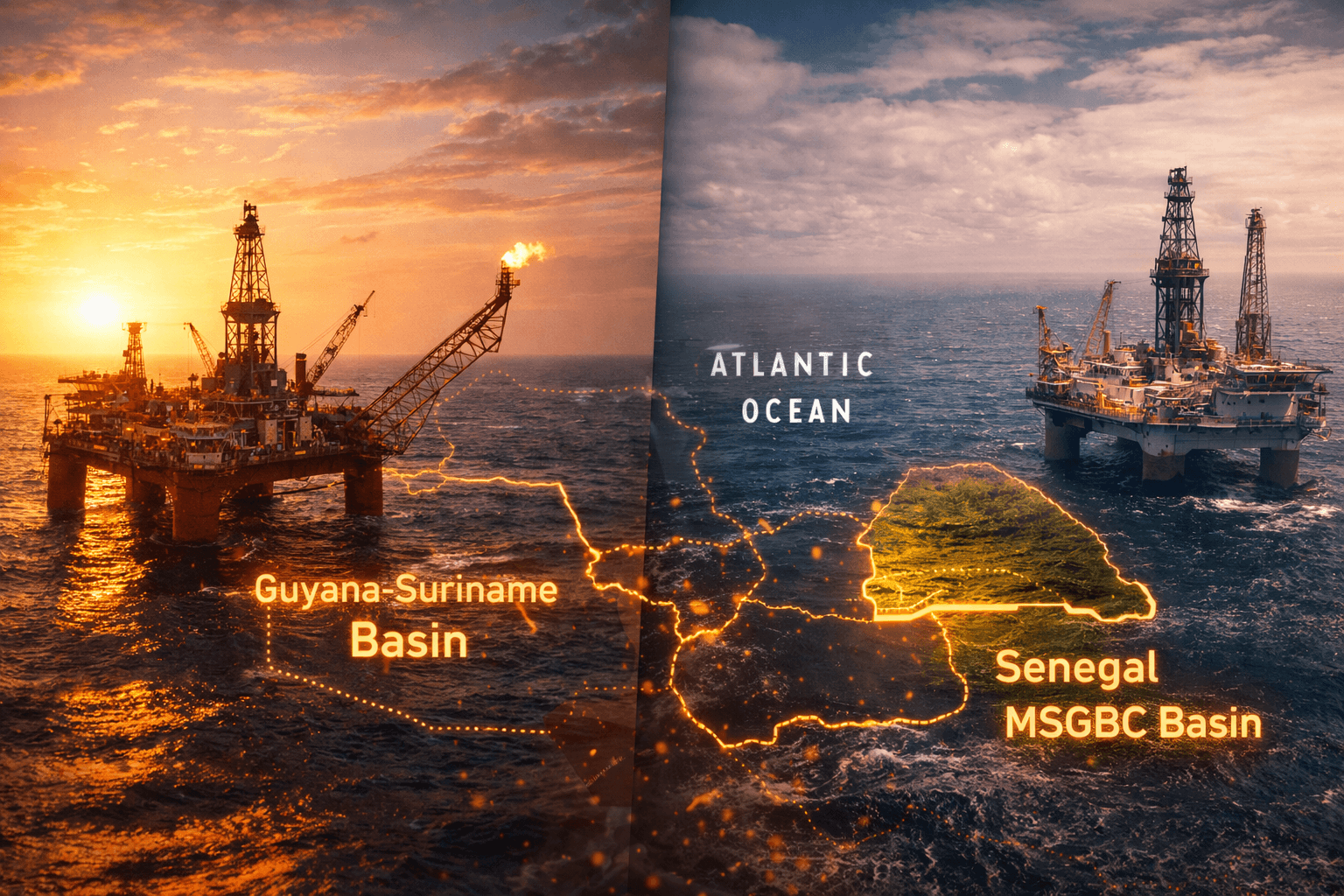
Senegal’s MSGBC Basin and Suriname’s Guyana-Suriname Basin are both hydrocarbon-rich yet technically demanding environments. Success in these basins depends less on discovery and more on precision—seismic interpretation, reservoir modelling, and disciplined field development planning.
This is where Senegal brings strategic value.
Over the past decade, the country has evolved from exploration frontier to execution benchmark in West Africa, with projects that demonstrate a full-cycle transition from seismic data to production.
Senegal’s credibility in this dialogue is anchored in recent milestones:
Sangomar Oil Field — currently producing approximately 100,000 barrels per day, marking Senegal’s entry into oil production
Greater Tortue Ahmeyim (GTA) LNG Project — a cross-border deepwater gas development with Mauritania, now exporting LNG
Yakaar–Teranga Gas Project — a major domestic gas development with long-term energy implications
Earlier discoveries such as SNE-1 and FAN-1 were unlocked through advanced seismic interpretation, setting the foundation for these developments.
The broader lesson is not discovery—it is conversion: turning geological success into structured, financed, and operational projects.
On the other side of the Atlantic, Suriname is entering a critical growth phase.
Through Staatsolie, the country is accelerating its offshore program with a focus on data-driven exploration and investor engagement:
3D seismic surveys offshore Saramacca and Coronie
An Open-Door Licensing Program aimed at attracting global operators
Active deepwater developments, including:
A production sharing contract with Petronas (Block 66)
The Sloanea gas discovery in Block 52, now commercially declared
Suriname’s challenge is familiar: reducing subsurface uncertainty while moving quickly toward development decisions.
This is precisely where Senegal’s experience becomes relevant.
The Petrosen delegation—comprising senior technical and data specialists—signals that this is not a symbolic visit.
It is a working engagement, focused on:
Seismic data interpretation and basin analysis
Exploration data management systems
Promotion strategies for attracting international partners
Workforce capacity-building in upstream operations
This level of technical exchange reflects a broader shift in how emerging producers collaborate—not through policy alignment alone, but through shared operational intelligence.
Taking place from March 30 to April 1, 2026, Caribbean Energy Week is positioning itself as more than a regional event.
It is becoming a cross-basin convergence point—bringing together:
National oil companies (NOCs)
International operators
Investors and financiers
Technical experts across upstream and LNG value chains
For Senegal and Suriname, it offers a neutral ground to translate shared challenges into joint solutions.
This engagement points to a larger trend.
As new hydrocarbon provinces emerge globally, traditional North-South knowledge flows are being complemented—and in some cases replaced—by South-South collaboration.
Countries like Senegal and Suriname are no longer waiting for external validation. They are:
Sharing expertise across similar geological contexts
Accelerating learning curves through peer exchange
Reducing exploration and development risk collectively
In a capital-constrained environment, this model is not just efficient—it is strategic.
Energy frontiers succeed not just on what they discover, but on how quickly they learn.
Senegal has moved through that curve.
Suriname is entering it.
Caribbean Energy Week 2026 is where those trajectories meet—and where a new playbook for offshore development may begin to take shape.
Distributed by APO Group on behalf of Energy Capital & Power. Enhanced analysis and editorial by Streamline.
Keep the conversation in one place—threads here stay linked to the story and in the forums.
Sign in to start a discussion
Start a conversation about this story and keep it linked here.
Other hot threads
E-sports and Gaming Community in Kenya
Active 9 months ago
The Role of Technology in Modern Agriculture (AgriTech)
Active 9 months ago
Popular Recreational Activities Across Counties
Active 9 months ago
Investing in Youth Sports Development Programs
Active 9 months ago