We're loading the full news article for you. This includes the article content, images, author information, and related articles.
Governor James Orengo asserted his political autonomy during President Ruto's Siaya visit, highlighting the tension between development and ideology.

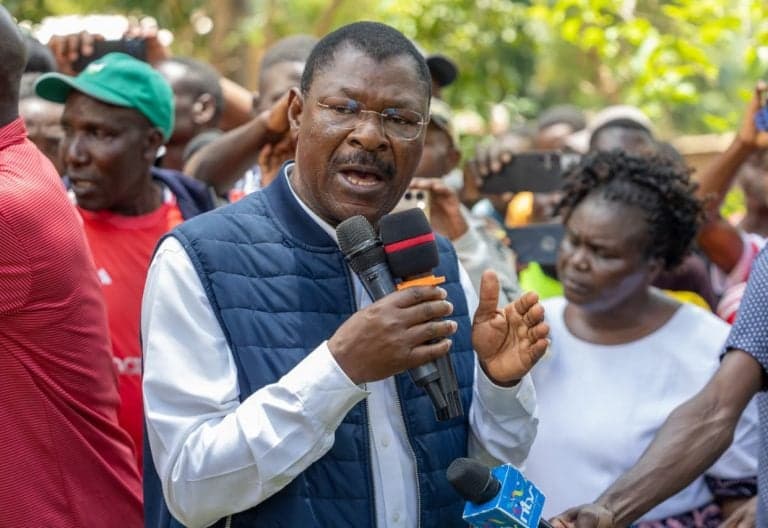
The scorching heat of Siaya County provided the backdrop for a tense display of political theater as Governor James Orengo, in the presence of President William Ruto, emphatically declared his political autonomy. Standing before a crowd that has historically served as a bedrock for opposition politics, Orengo’s assertion that he remains committed to his own political lane—"Niko na siasa zangu"—rippled through the local and national political architecture. It was a calculated moment of defiance that underscored the precarious equilibrium between development collaboration and ideological loyalty in modern Kenyan governance.
For the informed observer, this moment serves as a litmus test for the durability of regional political strongholds in the face of the National Government’s aggressive development outreach. As President Ruto continues to tour various counties to launch infrastructure projects, the reception he receives from governors—particularly those from the opposition—reveals a shifting dynamic. Orengo’s statement was not merely a local soundbite it was a signaling mechanism to his base, ensuring that economic cooperation with the State House is not interpreted as an endorsement of the President’s governing agenda or an abandonment of his party’s political platform.
The office of the Governor in Kenya operates in a paradoxical space. On one hand, the devolved unit is entirely dependent on the National Treasury for equitable share disbursements and development project funding. On the other, the Governor is an elected representative of a specific regional constituency, often harboring political allegiances that run contrary to the ruling administration. When a President visits a county like Siaya, the script usually calls for a show of unity, yet the underlying current is often one of suspicion and tactical positioning.
Governor Orengo, a veteran of Kenyan legal and political battles, understands the optics of this dance better than most. By stating he has his own politics, he effectively drew a line in the sand. He signaled that while he is willing to partner with the President on road projects, water infrastructure, or the KES 1.2 billion (approximately $9.2 million) urban renewal initiatives recently proposed, he is not subject to political assimilation. This approach prevents the erosion of his standing among his constituents, who value the fierce defense of their ideological identity as much as they value service delivery.
President Ruto’s visit to Siaya is part of a broader, nationwide strategy to secure political footprints in regions that overwhelmingly voted against his coalition in the last general election. The economic incentive is clear: the promise of multi-billion shilling projects is a powerful tool to engage local leadership. However, the conversion of infrastructure into political capital remains an unproven hypothesis in the Nyanza region.
For local residents, the economic reality is stark. The region has grappled with underinvestment in key sectors such as value-addition manufacturing for its agricultural output, particularly in the rice and sugar belts. Data from the County Government of Siaya suggests that while the national government has increased budgetary allocations for road connectivity, the unemployment rate among the youth remains significantly higher than the national average of approximately 12 percent. The following breakdown highlights the current tension between development needs and political discourse:
To understand the weight of Orengo’s words, one must look at the historical trajectory of Siaya. This region has long been the political epicenter for challenges against central authority, fostering a culture of political skepticism that is deeply embedded in the local psyche. When a leader like Orengo speaks, he is echoing a sentiment that has defined the region’s voting patterns for decades. The "Siasa" (politics) he refers to is not just a disagreement on policy it is a fundamental difference in the vision for the nation’s governance.
Experts in constitutional law and political science at the University of Nairobi argue that such statements protect the health of a multiparty democracy. If Governors were to abandon their political beliefs simply because the President visited their region, the opposition’s ability to hold the government accountable would wither. By maintaining his own lane, Orengo ensures that the conversation remains robust and that the government of the day cannot claim a consensus that does not exist.
While this event unfolded in a local stadium in Siaya, its ramifications are national. Kenya is currently navigating a period of fiscal consolidation and high public debt, which necessitates a fragile harmony between national and county governments. Any friction between a key opposition governor and the President can potentially delay project implementation or lead to bureaucratic bottlenecks that ultimately hurt the citizens. However, it is also a reminder that the "development-for-votes" model remains the primary currency of Kenyan politics.
As the nation looks toward the 2027 electoral cycle, these interactions will only intensify. Every presidential visit to an opposition-led county will become a high-stakes meeting where words are carefully chosen and political signaling is paramount. For the residents of Siaya, the expectation is that they will eventually receive the promised infrastructure, regardless of the political posturing occurring on the podium. Whether that happens remains to be seen, but the baseline has been set: development is welcome, but political allegiance is not for sale.
The incident leaves voters to navigate a complex reality where they must evaluate whether their leaders are prioritizing tangible progress or merely maintaining the status quo of political resistance. As the dust settles on this presidential visit, the focus shifts back to the silent, daily struggle of governance, leaving the question of whether the political rhetoric will actually deliver the promised prosperity or remain just another feature of a long-standing political game.
Keep the conversation in one place—threads here stay linked to the story and in the forums.
Sign in to start a discussion
Start a conversation about this story and keep it linked here.
Other hot threads
E-sports and Gaming Community in Kenya
Active 10 months ago
The Role of Technology in Modern Agriculture (AgriTech)
Active 10 months ago
Popular Recreational Activities Across Counties
Active 10 months ago
Investing in Youth Sports Development Programs
Active 10 months ago
Key figures and persons of interest featured in this article