We're loading the full news article for you. This includes the article content, images, author information, and related articles.
General Muhoozi Kainerugaba’s claim that Uganda will intervene in the Middle East has sparked diplomatic alarm, raising questions about state policy.

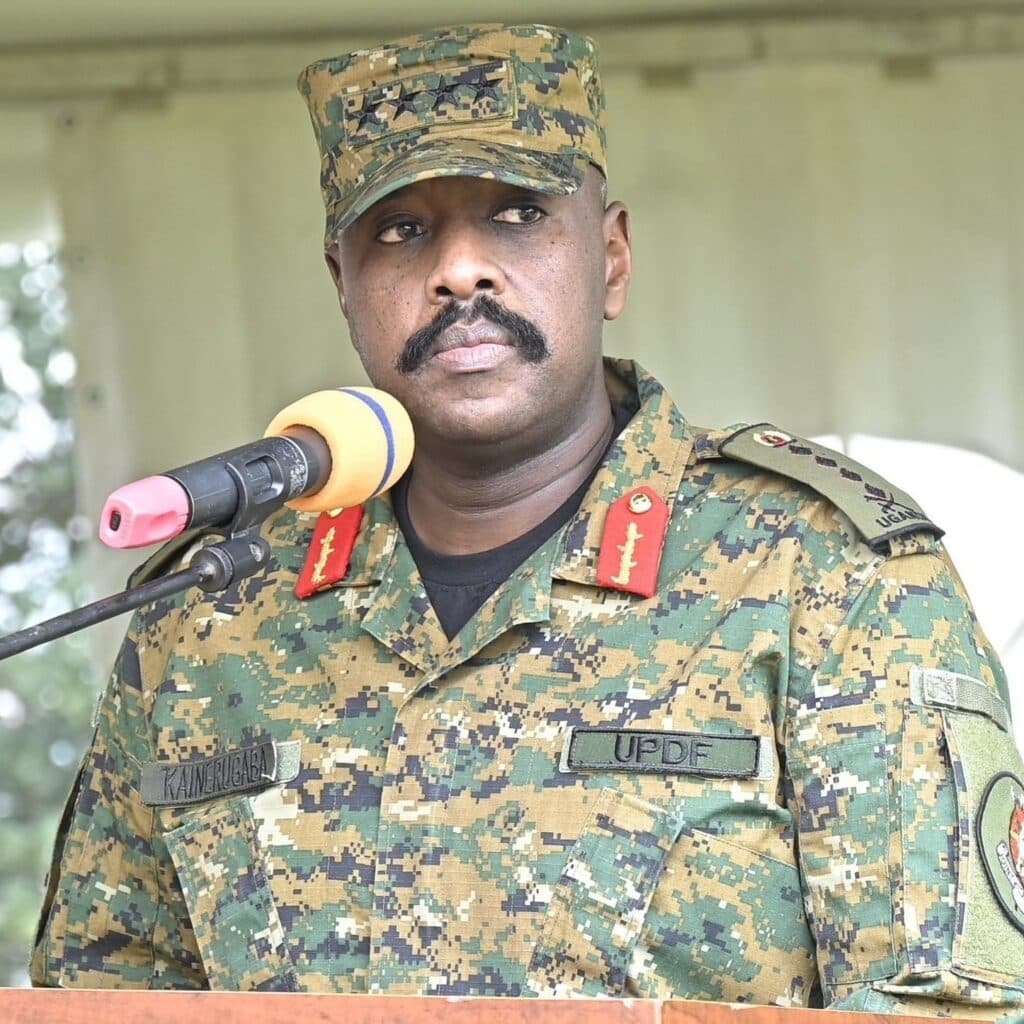
General Muhoozi Kainerugaba, the Chief of Defence Forces (CDF) and son of President Yoweri Museveni, has declared that Uganda stands ready to join the conflict in the Middle East to defend Israel if provoked. The statement, delivered via social media, has sent shockwaves through the diplomatic corridors of East Africa, forcing a sharp re-evaluation of Uganda’s foreign policy alignment and the military’s role in global geopolitical crises.
This declaration marks a departure from Uganda’s traditional stance of non-alignment, raising urgent questions about the constitutional authority governing the deployment of the Uganda People’s Defence Forces (UPDF) beyond the East African theater. As the nation balances precarious economic interests with its regional security commitments, the prospect of entering a high-intensity Middle Eastern conflict threatens to alienate key trading partners and distract from the country’s primary focus on regional stabilization.
General Kainerugaba’s rhetoric is not an isolated incident but part of a pattern of controversial, high-stakes communication that often bypasses the established channels of the Ministry of Foreign Affairs. While the CDF possesses significant influence, his public pronouncements frequently conflict with the official state position, which typically advocates for a peaceful resolution to international disputes. Analysts warn that such statements, while arguably intended to signal ideological loyalty, carry profound risks in a volatile global climate.
By framing the potential military intervention as a response to provocation against Israel, Kainerugaba has thrust Uganda into a polarizing international discourse. Observers in Nairobi, Dar es Salaam, and Addis Ababa are viewing the statement with deep skepticism, noting the stark contrast between this rhetoric and the reality of Uganda’s current military capabilities, which are optimized for counter-insurgency and peacekeeping operations rather than the long-range power projection required for a Middle East campaign.
The UPDF maintains a formidable presence in regional conflict zones, primarily through its involvement in the African Union Transition Mission in Somalia (ATMIS) and its offensive operations against the Allied Democratic Forces (ADF) in the Democratic Republic of the Congo. However, these operations are fundamentally different from the demands of a confrontation in the Levant. Military strategists point to several critical constraints that make such an intervention a logistical impossibility:
Beyond the logistical impossibilities, the statement ignores the complex web of economic and political relationships Uganda has carefully cultivated over decades. Uganda maintains historical security ties with Israel, dating back to the 1970s, but it has also fostered burgeoning energy and infrastructure cooperation with Iran. In recent years, Iranian firms have explored investment opportunities in Uganda’s oil sector, an industry that is central to the country’s long-term economic development strategy.
Economists at the Central Bank of Uganda emphasize that the nation’s export revenue, currently facing headwinds from global market volatility, cannot afford the political fallout of taking sides in a Middle Eastern war. A misstep in foreign policy could jeopardize trade agreements, discourage foreign direct investment (FDI), and invite unnecessary scrutiny from international organizations. While the government in Kampala has not yet issued a formal retraction, the silence from the President’s office suggests a frantic effort to mitigate the damage caused by the CDF’s unfiltered declaration.
The core issue remains the confusion surrounding who directs Uganda’s foreign policy: the Ministry of Foreign Affairs or the military leadership. When the son of the President, who also serves as the CDF, makes policy pledges on social media, the international community often interprets these as official directives. This ambiguity complicates Uganda’s standing in international forums, particularly the United Nations and the African Union, where consistency and predictability are the cornerstones of diplomatic credibility.
Constitutional experts argue that for a nation to commit its armed forces to a conflict, the decision must undergo rigorous parliamentary scrutiny and presidential authorization—a process that has not occurred. The disregard for these protocols risks eroding the institutional integrity of the UPDF, transforming it from a national defense entity into an instrument of personal political messaging. For the Ugandan citizen, the risk is not just the potential for conflict, but the degradation of the diplomatic stability that is essential for the nation’s growth.
As the dust settles on this latest social media firestorm, the international community will be watching to see if Kampala moves to clarify its stance or allows the rhetoric to persist. Whether this was a calculated move to gain leverage or an impulsive outburst, the cost of the declaration is already being felt in the uncertainty it breeds. Ultimately, diplomacy requires more than bold words it demands a clear, unified, and actionable state policy that reflects the reality of a nation’s limits and its true national interests.
Keep the conversation in one place—threads here stay linked to the story and in the forums.
Sign in to start a discussion
Start a conversation about this story and keep it linked here.
Other hot threads
E-sports and Gaming Community in Kenya
Active 10 months ago
The Role of Technology in Modern Agriculture (AgriTech)
Active 10 months ago
Popular Recreational Activities Across Counties
Active 10 months ago
Investing in Youth Sports Development Programs
Active 10 months ago
Key figures and persons of interest featured in this article