We're loading the full news article for you. This includes the article content, images, author information, and related articles.
The structural collapse of Migori's crucial transport artery following unprecedented torrential downpours has severed vital trade routes to Tanzania, exposing critical vulnerabilities in local infrastructure as the Kenya Meteorological
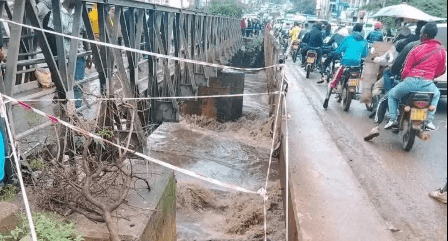
The structural collapse of Migori's crucial transport artery following unprecedented torrential downpours has severed vital trade routes to Tanzania, exposing critical vulnerabilities in local infrastructure as the Kenya Meteorological Department warns of intensifying rainfall across the Lake Victoria Basin.
In a devastating blow to regional commerce and commuter safety, the primary bridge traversing Migori Town has succumbed to the relentless fury of unseasonal, intense precipitation. The collapse paralyzes immediate local transit and severs a critical economic artery.
This infrastructural failure could not possibly be more detrimental to the regional economy. With local businesses still painstakingly navigating their recovery from previous macroeconomic shocks, the sudden severance of the main trade route through Migori Town guarantees immediate supply chain bottlenecks and inflationary pressures on essential goods. The disruption threatens to derail the fragile economic stability of the entire southwestern corridor.
The catastrophic failure in Migori is far from an isolated incident; rather, it represents the leading edge of a broader, menacing meteorological front sweeping across the East African highland and lake regions. The Kenya Meteorological Department has issued an urgent, unequivocal advisory regarding the prevailing weather patterns. According to the latest predictive models, the Lake Victoria Basin is poised to receive rainfall volumes exceeding the twenty-millimetre threshold within a single twenty-four-hour window.
This heavy rainfall is projected to intensify further, potentially surpassing the thirty-millimetre mark, significantly elevating the risk profile for low-lying and downstream communities. The sheer volume of water rushing through established river systems threatens to overwhelm existing drainage capacities, transforming usually benign waterways into raging torrents capable of uprooting trees and tearing apart concrete bridges with terrifying ease.
To comprehend the sheer magnitude of the Migori bridge collapse, one must understand the town's strategic positioning along the Isebania border corridor. This route is an essential conduit for the East African Community's cross-border trade, facilitating the daily movement of millions of shillings worth of commercial goods. When the primary crossing point becomes impassable, the ripple effects are instantaneously felt from the wholesale markets of Nairobi to the retail hubs of Mwanza.
Commercial truck drivers now face the agonizing prospect of extended delays, rotting perishable cargo, and the acute dangers of navigating unpaved, structurally unsound alternative routes. For the small-scale traders who depend on the daily flow of transit passengers, the bridge's destruction effectively zeroes out their income, precipitating an immediate microeconomic crisis at the household level across the county.
The recurring nightmare of infrastructural degradation during Kenya's rainy seasons brings the urgent discourse on climate adaptation directly to the muddy, impassable streets of Migori. Engineers are increasingly raising alarms that the historical hydrological data used to design these bridges decades ago is no longer a reliable predictor of today's extreme weather events. The rainfall is simply heavier and faster than historical baselines anticipated.
Addressing this deficit requires a paradigm shift in how the national and county governments approach public works. It is no longer sufficient to merely replace broken bridges; they must be entirely reimagined. This involves integrating comprehensive climate risk assessments into procurement phases, ensuring future structures feature wider spans and superior hydraulic clearance to safely pass the unprecedented volumes of floodwater.
In response to the escalating crisis, the County Government of Migori has instituted several emergency protocols designed to preserve life and mitigate further property damage. These critical measures currently include the following operational directives:
The time for reactive disaster management has definitively passed; an era of proactive, climate-resilient engineering must urgently begin to secure East Africa's economic future against the elements.
Keep the conversation in one place—threads here stay linked to the story and in the forums.
Sign in to start a discussion
Start a conversation about this story and keep it linked here.
Other hot threads
E-sports and Gaming Community in Kenya
Active 9 months ago
The Role of Technology in Modern Agriculture (AgriTech)
Active 9 months ago
Popular Recreational Activities Across Counties
Active 9 months ago
Investing in Youth Sports Development Programs
Active 9 months ago