We're loading the full news article for you. This includes the article content, images, author information, and related articles.
The Kenya National Highways Authority (KeNHA) has officially rubbished a widely circulated public notice that falsely ordered the eviction of traders along the busy Murang'a Highway, assuring the public of its commitment to lawful procedures.
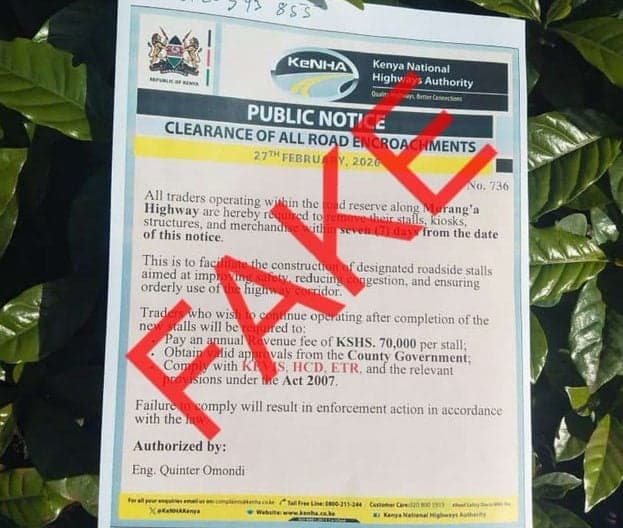
The Kenya National Highways Authority (KeNHA) has officially rubbished a widely circulated public notice that falsely ordered the eviction of traders along the busy Murang'a Highway, assuring the public of its commitment to lawful procedures.
The Kenya National Highways Authority (KeNHA) has firmly dismissed a fraudulent public notice circulating online, which alleged imminent mass evictions of businesses and residents along the Murang'a Highway corridor.
This incident underscores the growing epidemic of digital misinformation and its capacity to incite unwarranted panic among small-scale traders and local investors whose livelihoods depend on major transport corridors across the East African region.
The rapid circulation of the fabricated eviction notice sent shockwaves through the local business community operating along the Murang'a Highway. Traders, already grappling with a challenging economic environment, expressed profound anxiety over the potential loss of their commercial premises. The fake document, which bore convincingly forged official letterheads and signatures, claimed that all semi-permanent and permanent structures situated within the designated road reserve had to be demolished within an impossibly tight fourteen-day window. KeNHA was swift to disown the malicious document, issuing a comprehensive and categorical statement across its official digital platforms and through mainstream national media channels to restore calm and order among the affected populace.
In recent years, critical government agencies have increasingly become the primary targets of sophisticated disinformation campaigns. These malicious digital efforts often aim to disrupt public order, extort vulnerable citizens under false pretenses, or achieve narrow, disruptive political objectives. The Directorate of Criminal Investigations (DCI) has officially noted a sharp, worrying rise in such cyber-related offenses, prompting urgent calls for heightened digital literacy and verification protocols among the general Kenyan populace. For major infrastructure bodies like KeNHA, managing public perception and trust is just as critical as the physical construction of roadways, given that community cooperation is absolutely essential for the smooth execution of multi-billion shilling development projects.
The Murang'a Highway serves as a vital, irreplaceable economic artery connecting the highly productive agricultural heartlands of the Mount Kenya region to the bustling capital city, Nairobi. It facilitates the daily, high-volume transport of essential fresh produce, premium tea, and coffee exports, alongside a vibrant and heavily relied-upon passenger transit sector. Any disruption along this critical transport corridor, even one triggered by a mere digital rumour, can have immediate, cascading, and devastating effects on the national supply chain and local inflation rates. Local county authorities have therefore urgently advised business owners to remain hyper-vigilant and to immediately report any suspicious individuals purporting to be state agents or debt collectors.
Legitimate state-sponsored eviction exercises, whenever they are deemed absolutely necessary for essential road expansion or infrastructural maintenance, are governed by incredibly strict legal protocols. These protocols mandate extensive, documented public participation forums, adequate and legally binding notice periods, and, in numerous cases, comprehensive financial compensation frameworks for the legitimately displaced. KeNHA has emphatically reiterated that it does not conduct its sensitive public operations through anonymous social media blasts or unverified WhatsApp forwards. The roads authority engages directly and transparently with affected communities through established government channels, utilizing regional county commissioners, local administrative chiefs, and officially gazetted public notices.
Kenya's historical experience with road reserve evictions is undeniably fraught with deep-seated socio-economic tension. During the massive, transformative expansion of the Thika Superhighway and the more recent, high-profile construction of the Nairobi Expressway, thousands of informal businesses were permanently displaced. While these engineering mega-projects ultimately unlocked immense, long-term economic value and significantly eased perennial urban traffic congestion, the initial transition periods were characterized by profound socio-economic upheaval. The stark, traumatic memories of heavy bulldozers flattening commercial kiosks and residential structures remain vividly fresh in the minds of many working-class Kenyans. It is precisely this underlying, unresolved historical trauma that the malicious purveyors of the fake Murang'a Highway notice sought to ruthlessly exploit. By strategically weaponizing the legitimate, existential fears of the working class, these shadowy actors demonstrated a callous, dangerous disregard for the psychological stability and economic security of the community.
Furthermore, the overarching legal framework governing the management and clearance of public land has been significantly tightened and democratized under the progressive Constitution of Kenya 2010. The National Land Commission (NLC), working in tandem with implementing agencies like KeNHA, is strictly bound by the constitutional principles of fair administrative action and human rights. Any genuine, lawful directive compelling citizens to vacate public land must be preceded by detailed environmental and social impact assessments. The contemporary legal regime robustly protects citizens from arbitrary, overnight displacement, ensuring that basic humanity, procedural fairness, and human dignity are rigorously upheld even in the face of overriding, urgent public interest and infrastructure development.
To proactively mitigate the damaging impact of such digital hoaxes in the foreseeable future, key industry stakeholders are strongly advocating for a much more robust, proactive communication strategy from state corporations. This vital modernization includes the rapid implementation of verifiable, cryptographically secure digital signatures on all official correspondence, the establishment of real-time community engagement web portals, and the initiation of swift, uncompromising legal action against the identified perpetrators of fake news.
The remarkable resilience of the Kenyan entrepreneurial spirit is clearly evident in the swift, uninterrupted return to commercial normalcy along the highway immediately following the roads authority's definitive clarification. However, the unsettling event serves as a stark, unavoidable reminder of the profound vulnerabilities inherent in the modern digital age. As the Kenyan government continues its aggressive push to expand and modernize the nation's vast infrastructure network, safeguarding both the psychological well-being and the vital economic security of the hard-working citizenry must remain a paramount, non-negotiable concern for all state actors.
We remain steadfastly committed to transparent, inclusive infrastructure development and strongly urge all Kenyans to treat unverified, alarmist digital documents with the absolute contempt they deserve, ensuring that our collective national progress is not maliciously derailed by the reckless actions of a few individuals.
Keep the conversation in one place—threads here stay linked to the story and in the forums.
Sign in to start a discussion
Start a conversation about this story and keep it linked here.
Other hot threads
E-sports and Gaming Community in Kenya
Active 9 months ago
The Role of Technology in Modern Agriculture (AgriTech)
Active 9 months ago
Popular Recreational Activities Across Counties
Active 9 months ago
Investing in Youth Sports Development Programs
Active 9 months ago