We're loading the full news article for you. This includes the article content, images, author information, and related articles.
Six Kenyan judges have escalated their battle against the executive branch, suing the Attorney General and Treasury Principal Secretary over the government's refusal to honor a Sh124 million compensation decree.
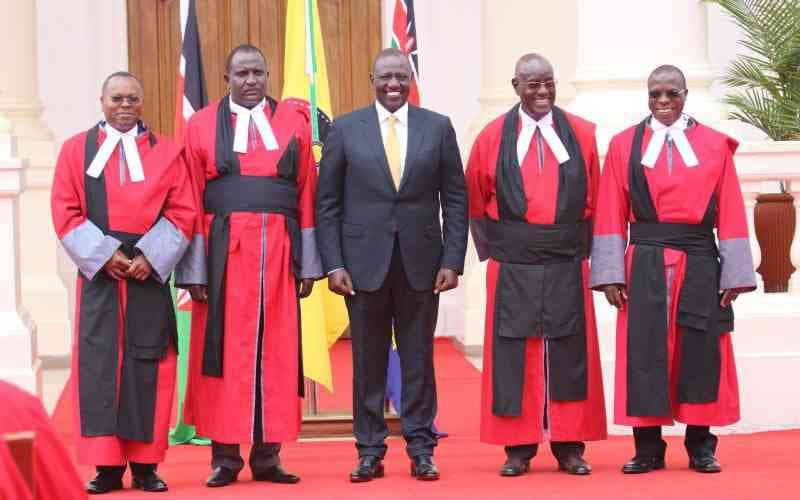
Six Kenyan judges have escalated their battle against the executive branch, suing the Attorney General and Treasury Principal Secretary over the government's refusal to honor a Sh124 million compensation decree.
The long-standing friction between Kenya’s judiciary and the executive has erupted into a fresh legal showdown, exposing systemic administrative defiance.
Justices George Odunga, Joel Ngugi, Weldon Korir, Aggrey Muchelule, Evans Makori, and Judy Omange were awarded the massive payout following an unconstitutional three-year delay in their appointments. This matters now because the government’s blatant refusal to pay valid court decrees severely undermines the rule of law, signaling a dangerous precedent where state officers ignore judicial authority without consequence.
In October 2024, the High Court directed the state to pay the six judges a staggering Sh124 million (approx. KES 124m) as compensation for the mental anguish and constitutional rights violations inflicted by former President Uhuru Kenyatta. Despite the ruling, the funds have yet to materialize. Forced into action, the aggrieved judges have formally petitioned the court to compel Attorney General Dorcas Oduor, Solicitor General Shadrack Mose, and Treasury PS Chris Kiptoo to release the money.
The petition is anchored on Article 156 of the Kenyan Constitution, which mandates the Attorney General to ensure compliance with court decrees against the state.
Justice Aggrey Muchelule, in his sworn affidavit, emphasized that the failure by the accounting officers to settle the liabilities constitutes "unlawful and unreasonable administrative inaction."
The root of this costly debacle lies in the previous administration's refusal to swear in 41 judges recommended by the Judicial Service Commission (JSC), citing vague, unsubstantiated intelligence reports. It wasn't until President William Ruto took office in September 2022 that the impasse was resolved. However, the financial damage was already done.
This case is not an isolated incident. Just weeks prior, another cohort of 22 judges was awarded Sh55 million for similar delays. In total, the Kenyan taxpayer is now staring at a Sh180 million bill generated entirely by the unconstitutional overreach of the executive branch. As the government struggles to raise revenues and manage national debt, shelling out millions in avoidable legal penalties is a bitter pill for the public to swallow.
The ongoing standoff is a critical stress test for Kenya's democratic institutions, demanding that the executive yield to the supremacy of the courts.
As the judges await their rightful compensation, the case serves as a harsh reminder that executive impunity ultimately extracts its heaviest toll from the pockets of ordinary citizens.
Keep the conversation in one place—threads here stay linked to the story and in the forums.
Sign in to start a discussion
Start a conversation about this story and keep it linked here.
Other hot threads
E-sports and Gaming Community in Kenya
Active 9 months ago
The Role of Technology in Modern Agriculture (AgriTech)
Active 9 months ago
Popular Recreational Activities Across Counties
Active 9 months ago
Investing in Youth Sports Development Programs
Active 9 months ago
Key figures and persons of interest featured in this article