We're loading the full news article for you. This includes the article content, images, author information, and related articles.
The transfer, part of a fragile ceasefire, brings a somber moment of truth as forensic experts in Tel Aviv work to identify the remains of one of the final two hostages.
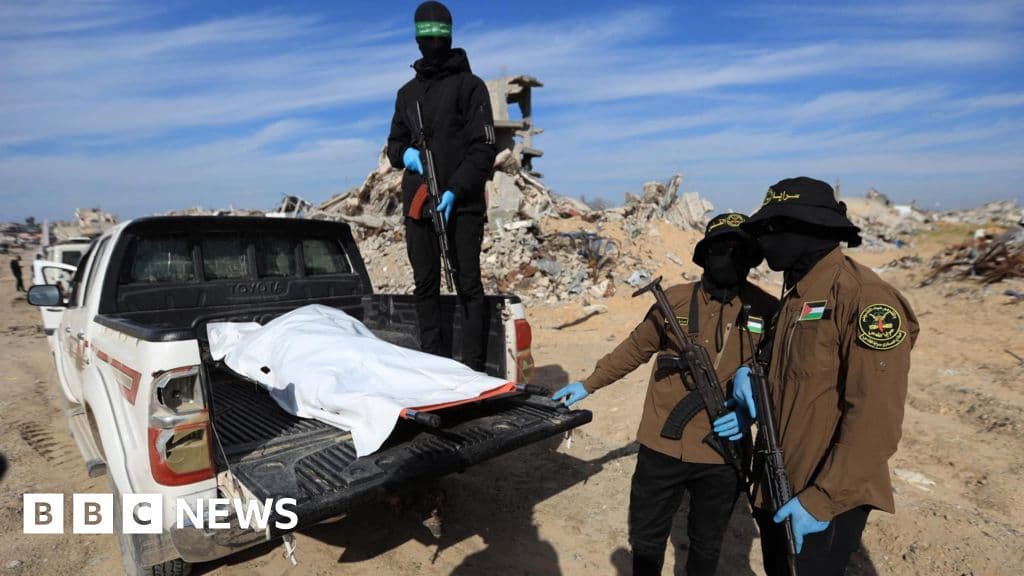
Israel has received a coffin from Palestinian militant groups, a grim delivery in a fragile, US-brokered ceasefire that has largely paused two years of devastating war. The coffin, transferred via the Red Cross, is believed to contain the remains of one of the last two deceased hostages held in Gaza since the October 7, 2023 attacks.
This somber handover is a crucial test of the ceasefire agreement that took effect on October 10, 2025. For the families of the missing, it represents a potential end to an agonizing wait, while for the region, it underscores the human cost of a conflict that continues to simmer despite the truce.
The remains were moved to Israel's National Institute of Forensic Medicine for identification. The two remaining deceased hostages are Ran Gvili, a 24-year-old Israeli police officer, and Suthisak Rintalak, a 43-year-old Thai agricultural worker. Both were killed during the initial Hamas-led attack, and their bodies were taken into Gaza. The process is fraught with uncertainty; a previous handover of remains on Tuesday was found not to belong to either hostage after forensic examination.
The exchange is a key component of the ceasefire's first phase, which stipulated the return of all 20 living hostages and the bodies of 28 deceased captives. In return, Israel has released hundreds of Palestinian prisoners and detainees.
While no Kenyans are among the hostages, the conflict's ripple effects are felt in Nairobi. Kenya's government has officially legislated its support for a two-state solution, moving beyond diplomatic statements to a firm legal stance. However, its diplomatic actions have appeared inconsistent, at times abstaining from UN votes critical of Israel while also condemning the "punishing occupation" of Palestinian territories.
President William Ruto has condemned both the Hamas attacks as terrorism and the broader struggle of Palestinians, stating, "Both are wrong." This balancing act reflects the complex pressures on Kenya, which maintains strong economic and security ties with Israel while also being mindful of its significant Muslim population and its historical support for Palestinian self-determination.
The fate of foreign workers like Thailand's Suthisak Rintalak serves as a stark reminder of the conflict's global reach, affecting families far from its epicenter. As forensic experts in Tel Aviv work to bring certainty to one family, the final hostage's return remains a poignant symbol of the unresolved grief shadowing the region.
Keep the conversation in one place—threads here stay linked to the story and in the forums.
Sign in to start a discussion
Start a conversation about this story and keep it linked here.
Other hot threads
E-sports and Gaming Community in Kenya
Active 9 months ago
The Role of Technology in Modern Agriculture (AgriTech)
Active 9 months ago
Popular Recreational Activities Across Counties
Active 9 months ago
Investing in Youth Sports Development Programs
Active 9 months ago