We're loading the full news article for you. This includes the article content, images, author information, and related articles.
Deputy President Rigathi Gachagua alleges a specific threat on his life prompted him to wear a helmet and bulletproof vest at a chaotic Narok by-election rally, escalating the political confrontation with the government.
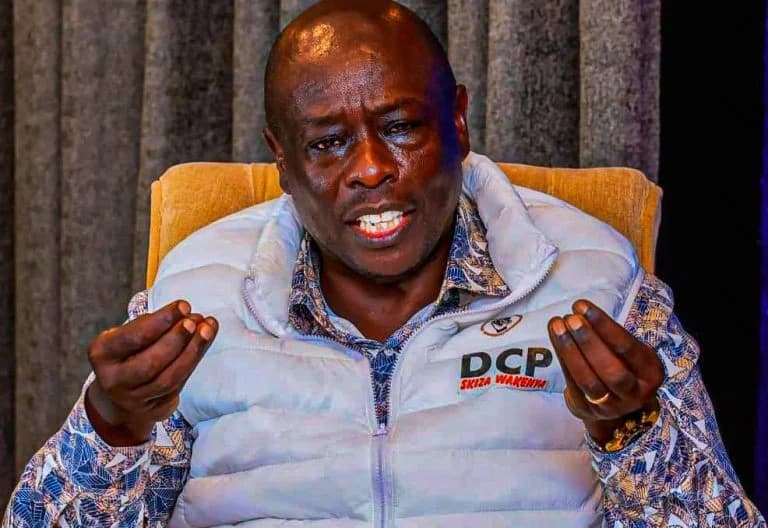
NAROK, KENYA – Democracy for Citizens Party (DCP) leader and Deputy President Rigathi Gachagua claimed he wore a military-style ballistic helmet and a bulletproof vest during a campaign rally on Monday, November 24, 2025, after receiving intelligence from police insiders about a direct threat to his life. "Police insiders warned him of planned attacks during the by-election rally," one report stated, with Gachagua specifying they were "targeting my head." The rally, held on the final day of campaigns for the hotly contested Narok Town Ward by-election, descended into chaos, further deepening the political rift between the Deputy President and the administration of President William Ruto.
The event, in support of DCP candidate Douglas Masikonde, was abruptly halted when police fired teargas into the crowd just five minutes into Gachagua’s speech. The confrontation followed a significant police buildup, with officers mounting roadblocks on major highways leading into Narok town in what Gachagua’s camp described as a deliberate attempt to obstruct the rally. In a statement, Gachagua asserted, “Clear instructions had been issued by this cowardly and brutal regime to block me and my entourage from accessing Narok Town.” He added that he managed to enter the town only after local villagers guided him through alternative paths.
The government offered a starkly different account of the events. On Tuesday, November 26, 2025, Interior Cabinet Secretary Kipchumba Murkomen stated that security agencies had acted on intelligence indicating a high probability of violent clashes between two rival political groups. “The National Police Service realized that there was going to be a clash between two groups... the security team advised that both camps should stop the violent rallies because it was turning violent,” Murkomen explained. He asserted that the police action was a necessary preventive measure to protect citizens and maintain order. “We are happy that someone is blaming us at the comfort of his house peacefully, no injuries, no death. It would have been a different story if we had allowed the situation to proceed,” he added.
Despite these assurances, Gachagua’s DCP party has formally condemned the police action, accusing the Inspector General of Police, Douglas Kanja, of complicity and calling for his resignation. In a letter to the Inspector General, Gachagua claimed the police presence was coordinated by political rivals and accused the police command of surrendering its authority to politicians. The DCP also lodged a formal complaint with the Independent Electoral and Boundaries Commission (IEBC), alleging a broader state-sponsored plot to use intimidation and violence to rig the by-election scheduled for Thursday, November 27, 2025.
The Narok Town Ward by-election has become a significant political flashpoint, symbolizing the escalating rivalry between the ruling United Democratic Alliance (UDA) and the opposition, which has coalesced around Gachagua. The seat fell vacant following the death of MCA Lukas Kudate in February 2024. The UDA has fielded Robert Kanyinke Ole Kudate, the late MCA's son, in a move seen as a strategy to consolidate support. Gachagua’s DCP is backing Douglas Masikonde, who has received a boost after the Wiper party withdrew its candidate in his favor, presenting a united opposition front.
This contest is not merely a local affair. For Kenya, it is a barometer of the political climate ahead of the 2027 general elections. The heavy security deployment and subsequent violence tap into deep-seated fears about the misuse of state security apparatus in political contests. Narok County, located in the historically volatile Rift Valley, has a complex history of election-related and ethnic violence, particularly during the 1992, 1997, and 2007 general elections. Gachagua’s party explicitly referenced this history in its letter to the IEBC, warning that the current tensions could trigger ethnic violence reminiscent of the 1992 clashes in Narok if not properly managed.
Civil society organizations have also raised alarms. Vocal Africa Group, a human rights organization, issued a statement on November 25, 2025, highlighting an “upsurge in electoral-related violence, open bribery and involvement of state officers in partisan campaigns” in the run-up to the by-elections. The group called on the National Police Service to ensure impartiality and urged the IEBC to disqualify candidates violating electoral laws to maintain the credibility of the polls. As voters in Narok head to the polls, the incident serves as a critical test for Kenya's democratic institutions and their ability to manage high-stakes political competition peacefully.
Keep the conversation in one place—threads here stay linked to the story and in the forums.
Sign in to start a discussion
Start a conversation about this story and keep it linked here.
Other hot threads
E-sports and Gaming Community in Kenya
Active 9 months ago
The Role of Technology in Modern Agriculture (AgriTech)
Active 9 months ago
Popular Recreational Activities Across Counties
Active 9 months ago
Investing in Youth Sports Development Programs
Active 9 months ago
Key figures and persons of interest featured in this article