We're loading the full news article for you. This includes the article content, images, author information, and related articles.
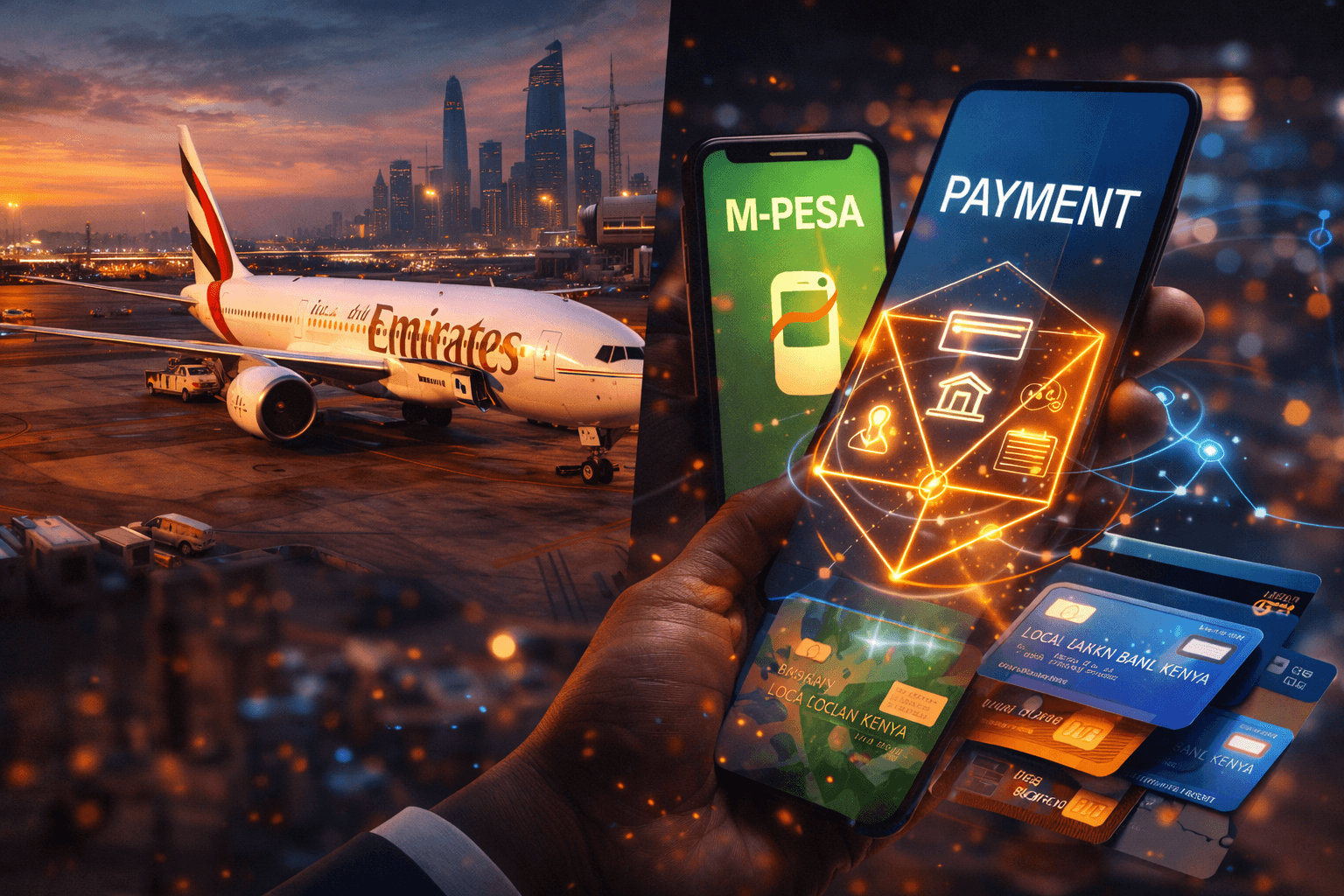
Emirates has launched split payments in Kenya via Cellulant’s Tingg, letting travellers combine payment methods or split instalments within 24 hours to bypass limits.
By Streamline Editorial Desk
NAIROBI, Kenya — February 25, 2026.
In a market where mobile money dominates daily life but struggles with high-value transactions, a quiet but consequential innovation has entered Kenya’s travel ecosystem.
Emirates, the world’s largest international airline, has partnered with Cellulant to introduce a split-payment solution—a move that could fundamentally reshape how African consumers access global travel.
At first glance, it appears as a payment feature. In reality, it addresses a structural limitation that has long constrained digital commerce across the continent.
Africa’s digital payments revolution has been defined by scale.
With over 1 billion registered mobile money wallets and transaction volumes exceeding $1 trillion annually, mobile-first payments have become the backbone of consumer behavior. In Kenya, platforms like M-Pesa are not alternatives—they are infrastructure.
Yet this dominance comes with a friction point.
Transaction caps—both per-payment and daily limits—have quietly restricted consumers from completing high-value purchases, particularly in sectors like aviation, where ticket prices often exceed mobile wallet thresholds.
The result has been consistent but underreported: abandoned bookings, delayed purchases, and lost revenue across the travel ecosystem.
The new solution, powered by Cellulant’s Tingg payment gateway, is designed with this exact constraint in mind.
Instead of forcing customers to fit into rigid payment systems, it allows payments to adapt to user behavior:
Combine multiple payment methods (mobile money, bank transfer, cards)
Split payments into up to five instalments within 24 hours
Stay within existing transaction limits without interrupting the booking process
This is not credit. It is not financing. It is payment orchestration—a model that aligns with how African consumers already transact.
For Emirates, it is a customer experience upgrade.
For the market, it is a structural unlock.
Kenya is not a random launch point—it is a signal.
As one of the most advanced mobile money ecosystems globally, Kenya offers both scale and behavioral maturity. Consumers are accustomed to digital transactions, but also acutely aware of system limitations.
According to Christophe Leloup, Emirates’ Country Manager for Kenya, the move reflects a deeper strategy:
“Kenya is one of the most dynamic markets on our global network… By introducing split payments through Tingg, we unlock greater flexibility while enabling more customers to access our services.”
Cellulant echoes this positioning.
“Extending mobile money convenience to global travel payments is essential,” says Michael Muriuki, Chief Product and Technology Officer. “We are removing transaction limits as a barrier.”
The emphasis is clear: access is the objective.
The launch is not happening in isolation.
From March 1, 2026, Emirates is increasing capacity on the Dubai–Nairobi route by introducing a third daily flight—responding to sustained high demand and strong seat occupancy on existing routes.
This creates a deliberate alignment:
Increased flight capacity
Expanded payment accessibility
Demand is no longer just being stimulated—it is being enabled.
While the immediate application is airline ticketing, the implications extend far beyond travel.
High-value transactions across Africa—from real estate deposits to electronics, education fees, and medical services—face similar constraints.
What this model introduces is a new layer in the payments stack:
Flexibility without debt.
Access without systemic overhaul.
Scalability without friction.
Cellulant’s footprint—spanning 24+ countries and over 200 payment methods—suggests that this is not a localized experiment, but a scalable framework.
With planned expansion into additional African markets, the model could redefine how global brands transact with mobile-first economies.
For years, Africa’s payment narrative has been about adoption.
This marks a shift toward optimization.
The question is no longer whether consumers can pay—it is whether systems are designed to accommodate how they pay.
Emirates and Cellulant have identified a gap that was never technological—it was structural.
And by solving it, they are not just improving checkout experiences.
They are expanding market access.
In Africa, demand has never been the problem.
Access has.
This is what it looks like when the system finally adjusts.
Distributed by APO Group on behalf of The Emirates Group. Enhanced analysis and editorial by Streamline.
Keep the conversation in one place—threads here stay linked to the story and in the forums.
Sign in to start a discussion
Start a conversation about this story and keep it linked here.
Other hot threads
E-sports and Gaming Community in Kenya
Active 9 months ago
The Role of Technology in Modern Agriculture (AgriTech)
Active 9 months ago
Popular Recreational Activities Across Counties
Active 9 months ago
Investing in Youth Sports Development Programs
Active 9 months ago