We're loading the full news article for you. This includes the article content, images, author information, and related articles.
CHAD: Chad closed its eastern border with Sudan “until further notice” on Monday saying the move was needed to stop repeated incursions by Sudanese armed groups.
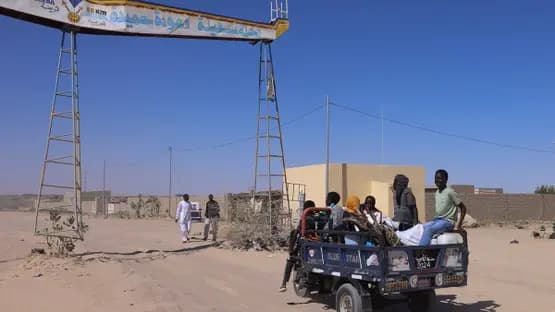
In a desperate bid to insulate itself from the catastrophic fallout of the Sudanese civil war, Chad has completely sealed its eastern border following violent, bloody incursions by heavily armed militias into its sovereign territory.
The decisive, emergency border closure enacted by N'Djamena underscores the rapidly deteriorating security architecture in the Sahel region. After intense, artillery-heavy combat erupted in the strategic border town of al-Tina between the renegade Rapid Support Forces (RSF) and local factions loyal to the Sudanese Armed Forces (SAF), Chadian authorities recognised that the conflict was no longer merely a neighbour's crisis, but an imminent domestic threat.
This aggressive containment strategy matters on a continental scale because the Sudanese war is morphing into a highly contagious regional conflagration. With nearly one million displaced Sudanese civilians already sheltering in Chadian refugee camps, the fragile host nation is buckling under an unprecedented humanitarian and logistical burden that threatens to completely destabilise its own internal security.
The trigger for the indefinite border closure was a series of brazen territorial violations that blatantly compromised Chad's national security. Government spokesperson and Communications Minister Mahamat Gassim Cherif articulated that the shutdown was an absolute necessity to halt the lethal spillover of cross-border militia violence that recently claimed the lives of both soldiers and innocent civilians.
The town of al-Tina, a crucial transit node, witnessed fierce firefights as the RSF intensified its campaign to secure supply lines and dominate the frontier. The Chadian military response has been swift, heavily reinforcing its border outposts to repel further unauthorised armed entries, while simultaneously attempting to manage the relentless, chaotic influx of traumatised refugees fleeing the slaughter.
Despite the draconian border shutdown, the Chadian government has pledged to authorise "exceptional exemptions" strictly for verified humanitarian operations. The sealed border constitutes the primary logistical artery for international aid convoys attempting to deliver life-saving sustenance and medical supplies to the war-ravaged populations trapped deep inside the Darfur region.
Balancing uncompromising national security with obligations under international humanitarian law is proving to be a highly precarious tightrope. Every day the border remains sealed, the probability of mass starvation in western Sudan increases exponentially, placing severe diplomatic pressure on the Chadian leadership to keep the humanitarian corridors functional.
For Kenya and the broader Intergovernmental Authority on Development (IGAD) bloc, the Chadian border crisis represents a terrifying escalation that directly impacts East African stability. The Horn of Africa is intrinsically linked to the Sahel through complex, transnational migration routes and overlapping geopolitical alliances.
Kenya, under President William Ruto, has heavily invested diplomatic capital in attempting to mediate a ceasefire between SAF Commander Abdel Fattah al-Burhan and RSF leader Mohamed Hamdan Dagalo (Hemedti). Chad's drastic actions demonstrate that regional peace initiatives are catastrophically failing, as the theatre of war actively expands. The unchecked proliferation of illicit small arms and the mass displacement of millions invariably fuel transnational terrorism and human trafficking networks that eventually wash up on the shores of Lake Victoria and the Indian Ocean.
The civil war that erupted in April 2023 over a botched plan to integrate the RSF into the regular national army has entirely shattered Sudan and is now consuming its neighbours. The closure of the Chadian border is not a solution; it is a profound symptom of a total regional system failure.
As the international community watches with mounting horror, the onus falls heavily on the African Union and allied regional blocs to enforce a binding cessation of hostilities. Until the core political grievances in Khartoum are addressed, the borders drawn in the sand will offer no true protection against the tidal wave of misery emanating from Sudan.
"When a neighbour's house is engulfed in an inferno, locking your own doors offers no salvation from the encroaching flames; true security demands extinguishing the fire at its source."
Keep the conversation in one place—threads here stay linked to the story and in the forums.
Sign in to start a discussion
Start a conversation about this story and keep it linked here.
Other hot threads
E-sports and Gaming Community in Kenya
Active 9 months ago
The Role of Technology in Modern Agriculture (AgriTech)
Active 9 months ago
Popular Recreational Activities Across Counties
Active 9 months ago
Investing in Youth Sports Development Programs
Active 9 months ago
Key figures and persons of interest featured in this article