We're loading the full news article for you. This includes the article content, images, author information, and related articles.
The neutralization of Mexico's most feared cartel leader, 'El Mencho,' has triggered a terrifying wave of retaliatory violence, leaving popular tourist resorts ablaze and military forces scrambling.
The neutralization of Mexico's most feared cartel leader, 'El Mencho,' has triggered a terrifying wave of retaliatory violence, leaving popular tourist resorts ablaze and military forces scrambling.
A devastating wave of narco-terrorism has engulfed multiple Mexican states, transforming idyllic tourist havens into terrifying war zones following a high-stakes military operation.
The brutal unrest was violently triggered by the death of Nemesio Oseguera Cervantes, globally infamous as "El Mencho," the ruthless leader of the Jalisco New Generation (CJNG) drug cartel. Killed during a massive, intelligence-led security operation to arrest him, his demise created an instant, explosive power vacuum. In direct retaliation, cartel foot soldiers unleashed highly coordinated chaos, blockading highways, hijacking public transport, and setting vehicles ablaze in broad daylight. The violence notably spilled into the globally renowned beach resort of Puerto Vallarta, profoundly shattering the illusion of safety for thousands of international tourists and expatriates. For Kenyans watching the international news, the chaotic scenes serve as a stark reminder of the devastating power wielded by transnational organized crime syndicates and the severe fragility of state security when confronted by heavily armed, billionaire cartels.
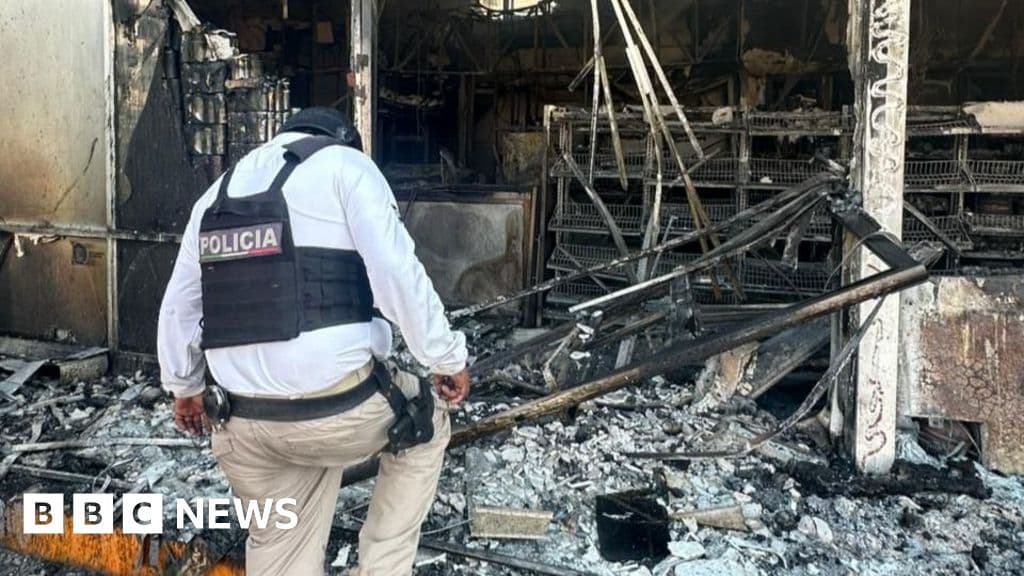
The sheer speed and coordination of the cartel's response completely caught local authorities and residents off guard. Plumes of thick, toxic black smoke rapidly dominated the skyline as heavily armed sicarios executed a scorched-earth strategy designed to paralyze the state infrastructure. Jerry Jones, an American expatriate who relocated to Puerto Vallarta for its renowned safety and walkability, described a scene of absolute, heartbreaking destruction. "The first inkling that we had that something was going on was one of our readers sent us a video of a bus being set on fire," he recounted. Within minutes, the carnage had spread across the entire city. In one particularly brazen attack, cartel members targeted a local store, systemically destroying more than 30 civilian vehicles in the parking lot. This is not random violence; it is a calculated demonstration of the cartel’s immense logistical capability and absolute disregard for human life.
Under the brutal leadership of El Mencho, the CJNG evolved into arguably the most powerful, heavily militarized, and geographically expansive criminal organization on the planet. They are responsible for flooding global markets, including transit routes in Africa, with synthetic opioids like fentanyl. The cartel operates with the discipline and firepower of a sovereign military force, utilizing drones, armored vehicles, and high-caliber weaponry. The Mexican government's strategy of targeting top-tier kingpins—often referred to as the "kingpin strategy"—has historically led to immediate, extreme violence as lieutenants viciously battle for control of the fractured empire. The current chaos is a direct, predictable consequence of this decapitation tactic, leaving ordinary citizens caught squarely in the devastating crossfire.
The economic fallout for Mexico's vital tourism sector will be immediate and catastrophic. International governments, including the United States, have hastily issued severe travel advisories, explicitly warning citizens to shelter in place or evacuate entirely. The violence in Puerto Vallarta destroys the carefully cultivated narrative that resort areas remain magically immune from the country's ongoing drug war. For economies heavily reliant on foreign visitors—a reality well understood in Kenya—the sudden collapse of security is an economic death sentence for local businesses, hotels, and service workers.
As the Mexican military deploys thousands of soldiers to forcefully retake control of the burning streets, the fundamental question of state sovereignty remains deeply contested. The cartel's ability to instantly plunge several states into total anarchy proves that the drug war is far from over; it is merely entering a highly volatile new phase. "We are hostages in our own homes," lamented one local resident, summarizing the tragic reality of living under the perpetual, terrifying shadow of the cartels.
Keep the conversation in one place—threads here stay linked to the story and in the forums.
Sign in to start a discussion
Start a conversation about this story and keep it linked here.
Other hot threads
E-sports and Gaming Community in Kenya
Active 9 months ago
The Role of Technology in Modern Agriculture (AgriTech)
Active 9 months ago
Popular Recreational Activities Across Counties
Active 9 months ago
Investing in Youth Sports Development Programs
Active 9 months ago