We're loading the full news article for you. This includes the article content, images, author information, and related articles.
As the mission morphs into the tougher 'Gang Suppression Force', a fresh contingent lands in Port-au-Prince while 100 battle-hardened veterans return home.
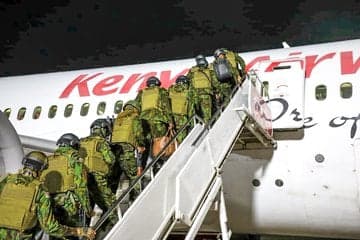
NAIROBI — The stakes in the Caribbean have just gotten higher. On Monday, a fresh contingent of 230 elite Kenyan police officers touched down at Toussaint Louverture International Airport in Port-au-Prince, marking a decisive escalation in Kenya’s commitment to stabilizing Haiti.
This deployment is not merely a rotation; it is a strategic reinforcement. These officers are the first to arrive under the newly mandated Gang Suppression Force (GSF), a robust successor to the initial Multinational Security Support (MSS) mission. Their arrival comes as gang violence in the Haitian capital reaches fever pitch, with armed groups now controlling an estimated 90 percent of the city.
As the Kenya Airways flight taxied on the tarmac, the mood was one of grim determination. Led by Deputy National Security Advisor Joseph Boinett and Senior Assistant Inspector General James Kamau, the new team was received by GSF Commander Godfrey Otunge and Haitian transitional leaders.
But for every boot that hit the ground, another prepared to leave. In a move that will bring relief to families back in Nairobi, 100 officers who have served on the frontlines for the past 18 months are scheduled to fly home. This rotation is critical for maintaining morale in a mission that has proven far more dangerous and complex than initially anticipated.
The shift from 'Security Support' to 'Gang Suppression' is more than just semantics. Authorized by the recent UN Security Council Resolution 2793 (2025), the GSF has a sharper, more aggressive mandate to dismantle the gangs that have held Haiti hostage. Commander Otunge did not mince words during the reception ceremony.
“Kenya stands with Haiti—for as long as it takes—until peace prevails,” Otunge declared, signaling that the rules of engagement may be tightening against the gangs united under the 'Viv Ansanm' alliance.
While the geopolitical goals are clear, the financial reality remains murky. The mission’s annual budget is estimated at a staggering $800 million (approx. KES 104 billion), yet the UN trust fund holds only a fraction of that—roughly $113 million (approx. KES 14.6 billion).
While the United States has provided over $1 billion (approx. KES 130 billion) in logistics and equipment, direct funding for officer salaries and operations remains a patchwork of voluntary contributions. For the Kenyan taxpayer, the assurance remains that this is a UN-backed initiative, but the slow trickle of global funds raises questions about the mission's long-term sustainability.
President William Ruto, however, remains undeterred. Speaking from Washington D.C. just days prior, he emphasized that Kenya “will not walk away,” viewing the mission as a testament to Kenya’s rising role as a global security anchor.
As the 100 returning officers prepare to reunite with their families in Embakasi and beyond, the 230 newcomers face a daunting reality: a city under siege, a mandate to fight, and the weight of a nation’s reputation on their shoulders.
Keep the conversation in one place—threads here stay linked to the story and in the forums.
Sign in to start a discussion
Start a conversation about this story and keep it linked here.
Other hot threads
E-sports and Gaming Community in Kenya
Active 9 months ago
The Role of Technology in Modern Agriculture (AgriTech)
Active 9 months ago
Popular Recreational Activities Across Counties
Active 9 months ago
Investing in Youth Sports Development Programs
Active 9 months ago