We're loading the full news article for you. This includes the article content, images, author information, and related articles.
In Nairobi’s luxury housing market, true security is no longer just about walls and guards. A closer look at 37byINEZA shows why layered systems, design, surveillance, and controlled access matter more than spectacle.
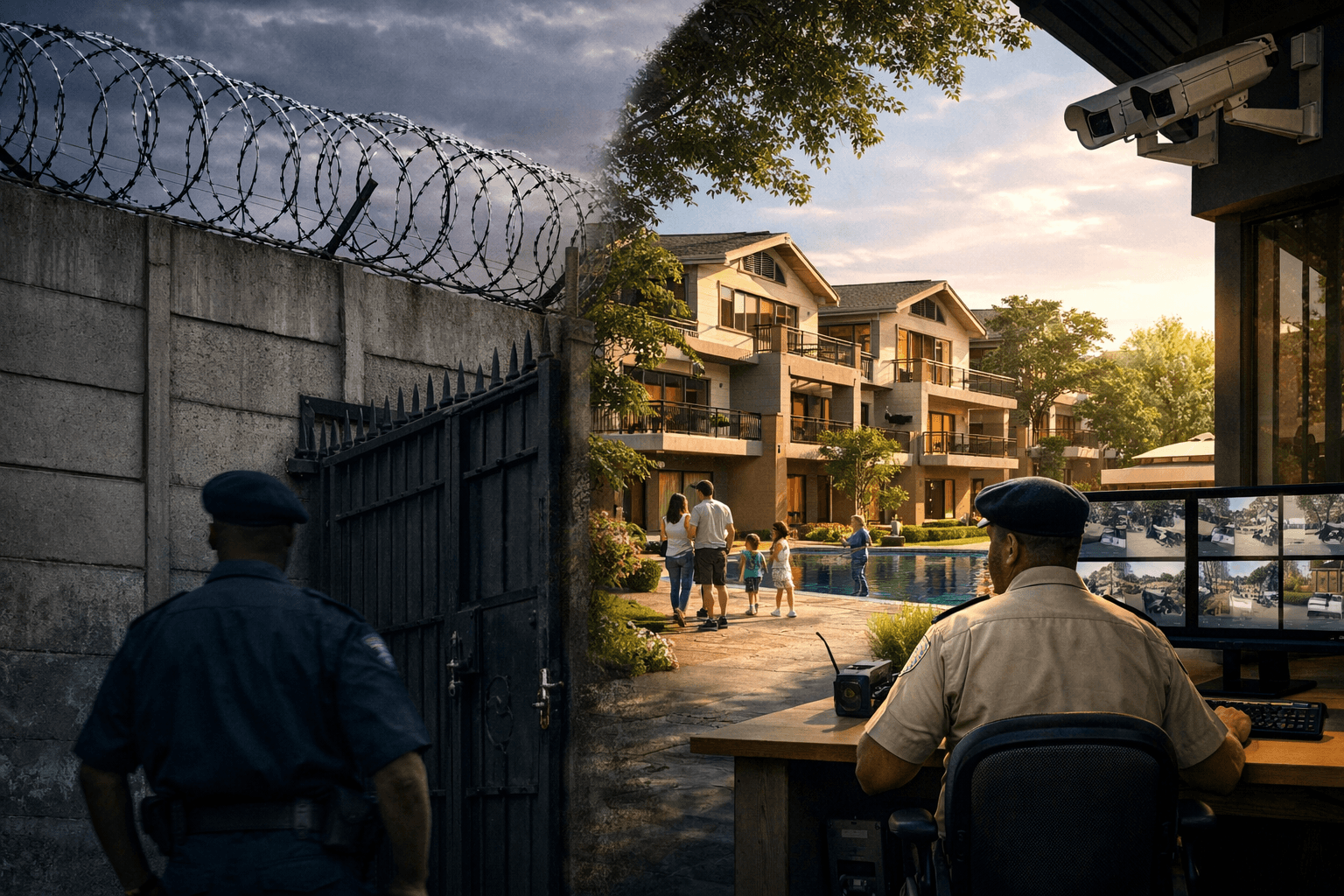
In Nairobi’s upper-end residential market, security has long been sold through appearance. Tall perimeter walls, electric fencing, heavy gates, reinforced doors, grilles, and a visible guard presence have become familiar shorthand for safety. For many buyers, that language feels reassuring. It suggests control, exclusivity, and protection.
But in a maturing luxury property market, that assumption deserves closer scrutiny.
A more important distinction is now taking shape across Nairobi’s premium housing sector: the difference between security theatre and security that actually works. One is designed to impress during a site visit. The other is designed to function quietly, consistently, and effectively every day.
Much of Nairobi’s high-end housing stock has been shaped by a fortress mentality. Security has often been interpreted through visible resistance: higher walls, more barriers, more hardware, more signs of restriction. It is a model that is easy to sell because it is easy to understand. A buyer arrives, sees a heavily defended perimeter, and instinctively feels protected.
Yet visible defence is not the same thing as effective defence.
A home can look secure from the outside and still have weak internal monitoring, poorly controlled visitor access, blind spots, limited natural visibility, and a design that forces residents to live defensively inside their own homes. In such cases, what is being sold is not always resilience. Sometimes it is simply the appearance of strength.
If there is one question capable of cutting through polished sales language, it is this:
That single request reveals more than branding ever can.
A genuinely secure residential environment should be able to explain, clearly and practically, how visitors are managed, how contractors are screened, how entry is authorised, how incidents are escalated, how patrols are conducted, how systems are maintained, and how emergencies are handled. When those answers do not exist in a structured way, the security story may be more visual than operational.
That is the real dividing line between reassurance and resilience.
A stronger security model is never single-layered. It is integrated.
The most effective developments do not rely on one dominant symbol of protection. They combine several layers that reinforce one another: perimeter defence, controlled access, surveillance, visibility-focused design, resident territoriality, and architecture that allows people to live openly without feeling exposed.
|
Security layer |
What it does |
Why it matters |
|---|---|---|
|
Perimeter defence |
Creates the first line of external protection |
Deters intrusion and establishes a controlled boundary |
|
Access control |
Manages who enters and under what conditions |
Reduces unauthorised movement into the estate |
|
Surveillance systems |
Extends visibility across the development |
Limits blind spots and improves incident awareness |
|
Natural surveillance |
Uses design and visibility to discourage concealment |
Makes unsafe behaviour harder to hide |
|
Territorial reinforcement |
Builds shared ownership of common space |
Encourages resident awareness and accountability |
|
Open-living capability |
Allows openness without weakening safety |
Shows whether security is truly supporting lifestyle |
A strong perimeter still matters. There is nothing outdated about boundary control. The mistake is assuming that the wall is enough.
A secure development needs a boundary that works as part of a larger structure, not as a substitute for one. Solid walls and electric fencing may slow intrusion or discourage it, but they cannot independently solve weak access control, poor surveillance coverage, or internal design weaknesses.
In many estates, entry procedures appear formal but remain surprisingly loose. A guard asks a few questions, a visitor signs in, and the process ends there.
A stronger model treats entry as layered verification. Controlled gate access, resident confirmation, intercom systems, clear approval processes, and structured visitor management rules all matter because they reduce dependence on guesswork and individual discretion.
Access control should not merely look strict. It should make entry accountable.
Many developments install cameras that are highly visible but thin in practice. Surveillance near gates and entry points may create confidence, but confidence is not the same as coverage.
Effective surveillance is broad enough to reduce internal blind spots, monitor shared areas, strengthen perimeter awareness, and support review when something goes wrong. If the system only watches where visitors are likely to look, it is serving the sales process more than the residents.
This is where the conversation becomes more sophisticated.
Security is not only about hardware and manpower. It is also about how space is designed. Well-lit roads, visible shared areas, open sightlines, fewer concealed corners, and layouts that allow passive observation all strengthen security without making homes feel imprisoned.
This approach draws from Crime Prevention Through Environmental Design, or CPTED. The principle is straightforward: spaces that are visible, legible, and naturally watched are harder to exploit than spaces that are dark, isolated, and visually fragmented.
A development becomes safer not only by blocking threats, but by reducing opportunities for threats to hide.
Security is often described as though it is purely physical. It is not.
The social structure of a development matters. Lower density, well-used shared spaces, strong territorial identity, and active common areas all contribute to a safer environment because they increase presence, familiarity, and observation. When residents feel ownership over shared spaces, unusual activity becomes more noticeable and less tolerable.
This is why density and estate planning are not secondary details. They shape whether security feels anonymous and reactive or shared and self-reinforcing.
This may be the clearest test of all.
If a home still needs heavy internal grilles, visible defensive barriers, and restrictive compromises for residents to feel safe, then the security system has not fully done its job. Real security should support openness, light, glazing, garden connection, and indoor-outdoor living without making residents feel vulnerable.
That standard changes the conversation entirely.
It asks buyers to stop judging security only by what looks strong and begin judging it by what makes normal living possible.
|
Security theatre |
Actual security |
|---|---|
|
Built to impress during short visits |
Built to function every day |
|
Relies on visual intimidation |
Relies on integrated layers |
|
Focuses on walls, gates, and visible barriers |
Combines perimeter, access, surveillance, design, and community logic |
|
Often depends on one dominant line of defence |
Uses multiple overlapping systems |
|
Can force defensive living indoors |
Supports openness and quality of life |
The lesson is not that visible deterrence is useless. It is that visible deterrence is incomplete when it is not backed by operations, design intelligence, and layered protection.
Luxury branding can conceal weak fundamentals. These are some of the clearest warning signs.
Too much reliance on the perimeter
If the wall is doing most of the storytelling, the rest of the system may be underdeveloped.
No operational clarity
If there is no clear explanation of visitor rules, patrol logic, emergency response, or access procedures, caution is justified.
Isolation marketed as safety
A place can feel cut off without actually being well protected.
Open living treated as a liability
If windows, openness, and outdoor connection seem impossible without defensive add-ons, the security model may be weaker than it appears.
Guard-only logic
Human presence matters, but guard-only systems remain limited without technology and procedure.
Oversized developments with weak control logic
As scale increases, monitoring, verification, and accountability become harder to maintain.
For serious buyers, the most useful response to a security claim is not admiration. It is verification.
|
What to test |
What to look for |
|---|---|
|
SOP and procedures |
Visitor management, patrols, emergencies, escalation, system maintenance |
|
Perimeter quality |
Wall condition, electric fencing, lighting, visibility |
|
Entry control |
Verification steps, intercom system, resident approval process |
|
Surveillance coverage |
Camera positioning across perimeter, roads, and shared areas |
|
Natural surveillance |
Lighting, sightlines, absence of dark pockets and concealment zones |
|
Territorial logic |
Density, shared amenities, common-space design, resident oversight |
|
Open-living capability |
Whether the architecture supports openness without extra defensive barriers |
This is where 37byINEZA becomes relevant as more than a luxury address.
Located on Kwaheri Road behind Runda, the project consists of 37 five-bedroom townhouses with DSQ set on five acres. Each residence sits on roughly one-eighth of an acre, with unit sizes of about 353 square metres, or nearly 3,800 square feet. Pricing starts from KSh 69.5 million for cash buyers and KSh 73.5 million under mortgage terms.
What makes it notable in this conversation is not simply its price point or location, but the way security has been embedded into the wider development logic.
The perimeter is treated as a first layer rather than a complete answer. Entry is controlled. CCTV coverage extends beyond the symbolic. The planning leans into visibility, lower density, and community structure. Shared amenities, including a residents’ clubhouse, heated 20-metre swimming pool, covered padel court, basketball court, gym, landscaped lawns, and children’s play areas, strengthen daily use of common space rather than leaving the estate socially empty.
Most importantly, the architecture does not appear forced into a defensive compromise. The homes are designed for openness, light, and calm rather than barricaded living. That is a meaningful distinction in a city where luxury and fear are too often sold together.
Security claims do not exist in isolation from developer credibility.
Tofauti Lifestyle Limited is identified as the developer behind the scheme, with a wider delivery team that includes principal architect Deepak Mehta, project managers LMJ Consultancy Ltd, main contractor Canton Building & Construction Ltd, quantity surveyors Africost (K) Consulting, and electrical engineers Gamma Delta Eastern Africa.
That matters because buyers are not only buying design language. They are buying the likelihood that design promises will be properly executed.
The developer’s earlier project, Ineza Boutique Homes in Kiambu, is cited as a delivered 132-unit scheme that achieved full occupancy after completion in March 2024. In market terms, that delivery history gives buyers a stronger basis for judging whether premium promises are likely to translate into lived reality.
This conversation is ultimately bigger than one development.
Nairobi’s premium property sector is mature enough to demand better standards. Buyers should no longer accept “secure” as a decorative word in a brochure. They should expect security to be measurable, layered, explainable, and compatible with good living.
Because the best homes should not merely defend against fear. They should make confidence possible.
And that may be the clearest conclusion of all: the strongest residential security is not the one that looks the harshest from outside. It is the one that allows life inside to feel open, calm, elegant, and fully protected.
Keep the conversation in one place—threads here stay linked to the story and in the forums.
Sign in to start a discussion
Start a conversation about this story and keep it linked here.
Other hot threads
E-sports and Gaming Community in Kenya
Active 10 months ago
The Role of Technology in Modern Agriculture (AgriTech)
Active 10 months ago
Popular Recreational Activities Across Counties
Active 10 months ago
Investing in Youth Sports Development Programs
Active 10 months ago