We're loading the full news article for you. This includes the article content, images, author information, and related articles.
At least 15 people have lost their lives after a Bolivian Air Force C-130 Hercules cargo plane transporting newly minted banknotes crashed onto a bustling avenue in El Alto, triggering chaos as crowds scrambled for scattered cash.
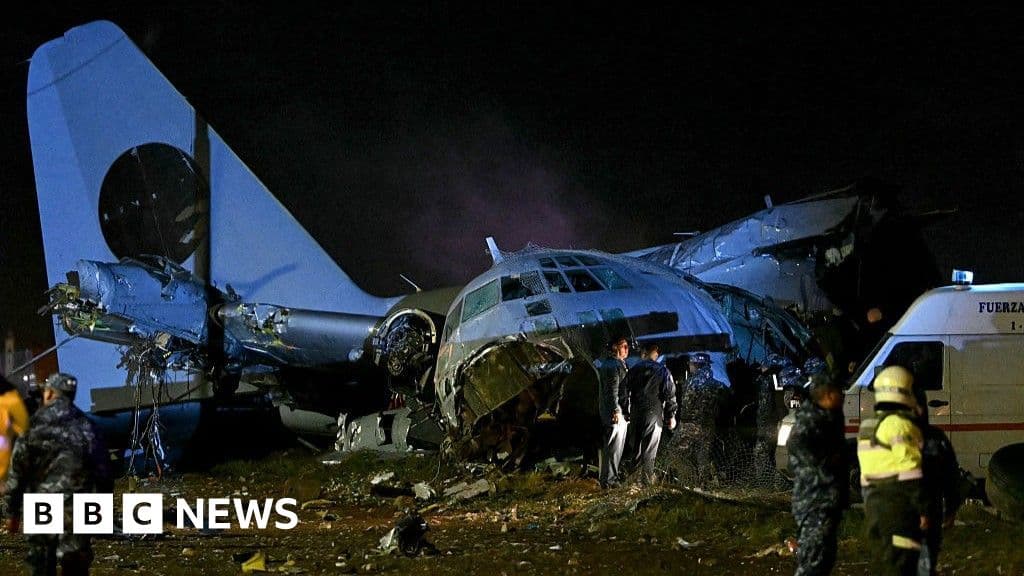
At least 15 people have lost their lives after a Bolivian Air Force C-130 Hercules cargo plane transporting newly minted banknotes crashed onto a bustling avenue in El Alto, triggering chaos as crowds scrambled for scattered cash.
A horrific aviation disaster has struck the high-altitude city of El Alto, Bolivia, where a military transport plane laden with freshly printed currency plummeted onto a busy highway, claiming at least 15 lives in a devastating inferno.
The surreal tragedy, characterized by the macabre juxtaposition of scattered corpses and fluttering banknotes, highlights extreme vulnerabilities in the airborne transport of sovereign assets and raises profound, urgent questions about crowd control and emergency response protocols in densely populated urban centers.
The ill-fated aircraft, a robust C-130 Hercules operated by the Bolivian Air Force, was reportedly arriving from the eastern commercial hub of Santa Cruz. According to preliminary statements from the Bolivian Air Navigation and Airports Authority (NAABOL), the massive transport plane lost control while attempting a routine landing at the El Alto International Airport—notably one of the highest commercial airports in the world. Instead of coming to a safe halt, the aircraft skidded violently off the runway, breaching the airport's defensive perimeter and plowing directly into a heavily congested adjacent avenue.
The sheer kinetic force of the impact instantly crushed at least a dozen civilian vehicles, instantly transforming a typical Friday commute into a scene of unspeakable carnage. Plumes of thick, acrid black smoke billowed into the Andean sky as local firefighters and emergency response units raced against time to extinguish the flames engulfing the wreckage. Tragically, fire chief Pavel Tovar confirmed that the death toll quickly rose to 15, with dozens more critically injured and rushed to nearby medical facilities.
Adding a deeply disturbing and chaotic dimension to the tragedy was the nature of the plane’s highly sensitive cargo. The military flight had been chartered to transport vast quantities of newly printed banknotes destined for the Central Bank of Bolivia. Upon impact, the plane's fuselage ripped open, sending thousands of uncirculated bills fluttering into the streets and surrounding fields.
In a shocking display of opportunistic desperation, local media footage captured crowds of bystanders abandoning rescue efforts to frantically scramble for the scattered cash amidst the burning debris and deceased victims. The situation rapidly deteriorated, forcing heavily armed riot police to deploy large quantities of tear gas to disperse the aggressive crowds and secure the crash site. Defence Minister Marcelo Salinas was forced to issue a stern public broadcast, desperately clarifying that the scattered money held absolutely no legal tender value as it lacked official serial numbers and had not yet been formally issued by the Central Bank.
The dramatic breakdown of security during this crash holds sobering lessons for developing nations, including Kenya, where the secure transport of sovereign wealth and sensitive assets remains a high-stakes logistical challenge. The Central Bank of Kenya (CBK), for instance, heavily relies on heavily guarded, specialized ground transport fleets backed by elite General Service Unit (GSU) and Administration Police detachments to move currency between Nairobi and regional branches.
However, utilizing air transport for valuables over challenging terrains—much like the treacherous Andean topography surrounding La Paz—poses unique, catastrophic risks. The similarities between Bolivia's mountainous terrain and Kenya's Great Rift Valley underscore the absolute necessity for impeccable aircraft maintenance and elite pilot training when state assets are airborne.
As the immediate fires are extinguished, the grim task of body recovery and forensic investigation begins. Aviation authorities have indefinitely suspended all operations at El Alto International Airport, grounding dozens of domestic and international flights. Investigators are meticulously combing through the charred debris to locate the aircraft's flight data recorders, hoping to determine whether a sudden mechanical failure, extreme high-altitude weather conditions, or pilot error precipitated the fatal runway excursion.
As the flames are extinguished and the last of the blood-stained bills are collected by security forces, a nation is left to mourn a profound tragedy where basic human greed tragically collided with catastrophic mechanical failure.
Keep the conversation in one place—threads here stay linked to the story and in the forums.
Sign in to start a discussion
Start a conversation about this story and keep it linked here.
Other hot threads
E-sports and Gaming Community in Kenya
Active 9 months ago
The Role of Technology in Modern Agriculture (AgriTech)
Active 9 months ago
Popular Recreational Activities Across Counties
Active 9 months ago
Investing in Youth Sports Development Programs
Active 9 months ago