We're loading the full news article for you. This includes the article content, images, author information, and related articles.
From skiing on trash to taming the matatu mafia, Denmark’s capital offers a radical blueprint for fixing Nairobi’s broken urban heart.
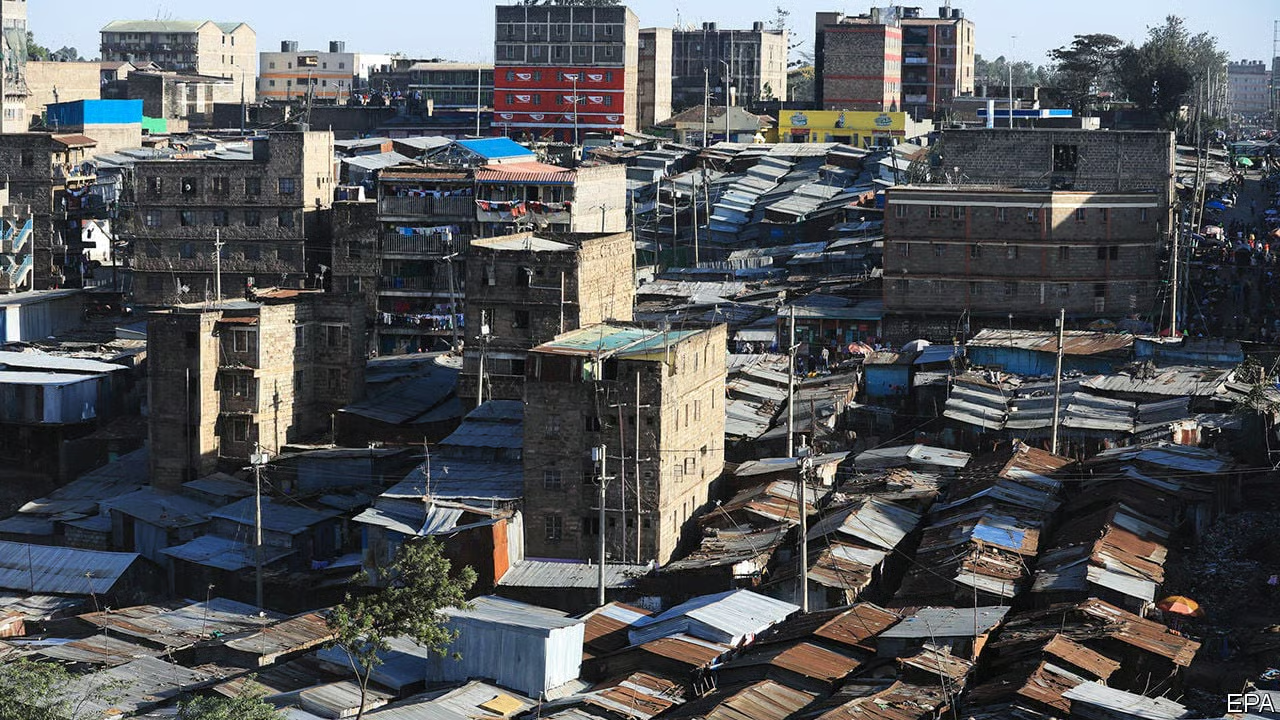
It sounds like a fever dream: a waste incinerator so clean you can ski down its roof, a metro system that runs without drivers, and streetlights that actually stay on. But for Copenhagen, this is Tuesday. For Nairobi, currently choking on the fumes of the Dandora dumpsite and gridlocked by the whims of private transport cartels, the Danish capital isn’t just a travel destination—it is a warning of what we are missing.
As Nairobi’s population swells, the cracks in our urban infrastructure are widening into chasms. The recent discourse sparked by columnist Kaltum Guyo’s visit to Denmark has brought an uncomfortable truth to the surface: our city’s dysfunction is not inevitable. It is a choice. The 'Danish Model'—a blend of ruthless efficiency, civic duty, and green innovation—offers a stark alternative to the 'survival of the fittest' ethos that currently governs the Green City in the Sun.
The most visceral contrast lies in how the two cities handle what they throw away. In Nairobi, the Dandora dumpsite is a festering wound, a public health hazard of gargantuan proportions that poisons the air for miles. In Copenhagen, they built CopenHill (Amager Bakke).
This is not just an incinerator; it is a waste-to-energy plant that converts thousands of tons of trash into electricity and district heating for over 100,000 households. But the kicker? It doubles as an artificial ski slope and hiking trail. Residents recreationally climb the very facility that burns their garbage.
“The environmental impact on local communities in Dandora cannot be overemphasized,” notes Guyo. While we debate where to move our dumpsite, Denmark has integrated theirs into the urban fabric, turning a potential eyesore into a recreational hub. It is a masterclass in circular economics that Nairobi’s policymakers have ignored for decades.
Movement in Copenhagen is defined by silence and speed. The driverless metro system runs 24/7, creating the backbone of a true 24-hour economy. In contrast, Nairobi’s transport sector remains held hostage by what many call the 'matatu mafia'—a chaotic, privately-run system that prioritizes profit over public service.
For a city to function, transport must be a public good, not a turf war. The Danish approach prioritizes the pedestrian and the cyclist, with infrastructure so safe that cabinet ministers ride bikes to work. In Nairobi, non-motorized transport is often an afterthought, leaving pedestrians to dodge speeding buses on non-existent sidewalks.
Infrastructure is only half the battle; the other half is mindset. The cleanliness of Copenhagen—even in its suburbs—is not just the result of street sweepers, but of a deep-seated culture of civic duty. As Guyo observed, “Denmark and Singapore thrive because patriotism and a sense of civic duty are part of their DNA.”
In Kenya, our politics are often inward-looking, and our urban planning frequently serves the elite. We manicure the diplomatic zones of Gigiri while Eastlands drowns in neglect. The Danish model proves that a city is only as strong as its weakest suburb. Until we demand systems that serve the ordinary citizen as efficiently as the tourist, Nairobi will remain a city of sharp, painful contradictions.
“Simply admiring successful systems from afar while failing to invest in the right infrastructure amounts to economic suicide,” warns the analysis. The blueprint is there. The technology exists. The only missing ingredient is the political will to dismantle the chaos that benefits the few, and build a city that works for the many.
Keep the conversation in one place—threads here stay linked to the story and in the forums.
Sign in to start a discussion
Start a conversation about this story and keep it linked here.
Other hot threads
E-sports and Gaming Community in Kenya
Active 9 months ago
The Role of Technology in Modern Agriculture (AgriTech)
Active 9 months ago
Popular Recreational Activities Across Counties
Active 9 months ago
Investing in Youth Sports Development Programs
Active 9 months ago