We're loading the full news article for you. This includes the article content, images, author information, and related articles.
Anthropic is clashing with the U.S. Department of Defense over AI safeguards, “all lawful purposes,” surveillance risks, and autonomous weapons. Here’s what’s at stake.
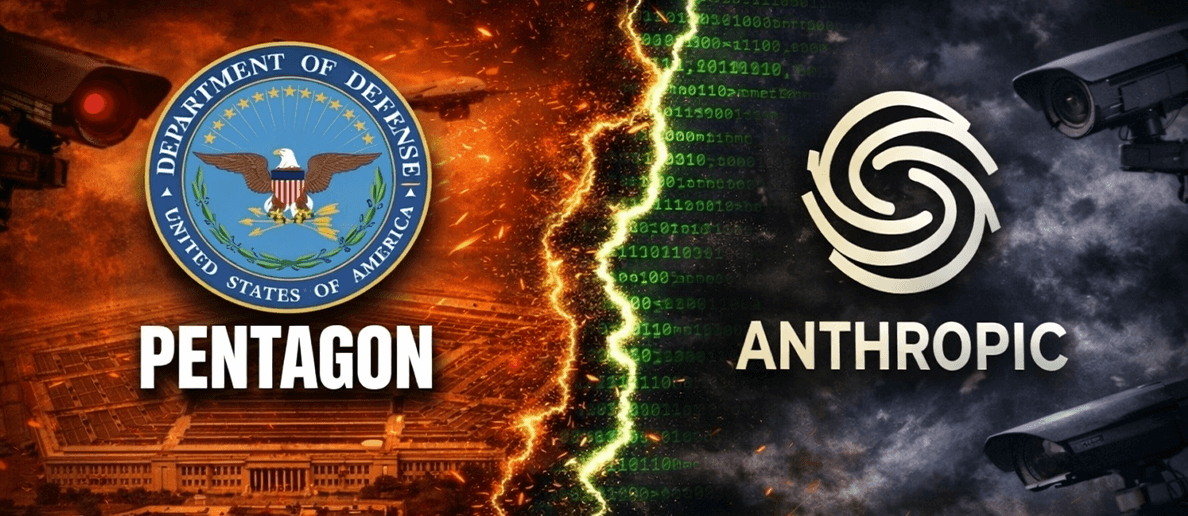
In mid-February 2026, a behind-the-scenes negotiation between Anthropic (maker of the Claude AI models) and the U.S. Department of Defense (DoD) spilled into public view — framed by officials and commentators as a clash over “AI safeguards,” “all lawful purposes,” and whether a private AI lab can tell the military where the red lines must remain.
But underneath the headline drama is a more consequential story: this dispute is an early stress-test of how democratic states will integrate frontier AI into national security without quietly normalising mass surveillance or sliding into fully autonomous lethality.
What happens next will shape not only Anthropic’s future in government work, but the template the Pentagon uses to pressure every major AI provider.
Reporting from Reuters (citing Axios) says the Pentagon has been pressing leading AI firms — including Anthropic, OpenAI, Google, and xAI — to allow their models to be used for “all lawful purposes,” explicitly including areas such as weapons development, intelligence, and battlefield operations.
Anthropic, according to Axios and other reports, has resisted that framing unless there are firm restrictions — particularly around:
Mass domestic surveillance (especially surveillance of Americans at scale), and
Fully autonomous weapons (systems that can select/engage targets without meaningful human control).
This is not a minor contractual argument. It’s a collision between two philosophies:
The Pentagon’s position (as described in reporting): If it’s lawful and authorised, the military should not be blocked by a vendor’s moral policy.
Anthropic’s position (as described in reporting and consistent with its public safety posture): Some categories of use remain too high-risk to allow, even if a government can legally authorise them.
Anthropic is not a distant outsider to U.S. national security. In July 2025, the company announced a two-year prototype agreement with a ceiling of $200 million awarded through the DoD’s Chief Digital and Artificial Intelligence Office (CDAO), aimed at prototyping frontier AI capabilities for defense operations.
Anthropic also publicly highlighted work with partners such as Palantir, where Claude is integrated into mission workflows on classified networks — a detail that matters because it implies Claude has already been embedded deeper than a typical “pilot.”
That operational footprint is precisely why the current dispute has teeth: once a model becomes “in the plumbing” of sensitive workflows, removing it is not like uninstalling a consumer app. It becomes institutional dependency — and dependency creates leverage.
The conflict sharpened after reporting that Claude was used in a U.S. military operation connected to Venezuela’s Nicolás Maduro. Axios reported that the military used Claude during an operation to capture Maduro, and that this contributed to tension between Anthropic and the Pentagon.
Because this allegation touches covert and politically explosive territory, readers should note what is confirmed versus what is reported:
Reported: U.S. military use of Claude in a Maduro-related operation (per Axios and follow-on coverage).
Not independently verifiable from public evidence: specific operational details, decision chains, or how Claude was used in the mission cycle.
Still, the impact of the reporting is straightforward: it turned an abstract ethics debate into a concrete, headline-grabbing example — and forced the question Anthropic has tried to manage carefully: Can a company credibly claim “hard limits” while its model is being integrated into classified mission workflows?
Axios then reported an extraordinary escalation: the Pentagon considering cutting ties with Anthropic and potentially labeling the company a “supply chain risk.”
In the logic of defense procurement, that phrase is not rhetorical. If applied broadly, it could pressure contractors and partners to avoid Anthropic tooling — effectively turning a policy dispute into a market-access penalty.
Axios quotes a senior official describing disentangling as difficult and suggesting Anthropic would “pay a price” for forcing the department’s hand.
Even if the harshest step is never formally implemented, the message is already delivered: AI access is strategic power, and the Pentagon is prepared to use procurement muscle to discipline vendors who refuse its terms.
The Wall Street Journal’s reporting adds a second layer: the fight is being narrated not only as safety policy, but as ideology — “woke” tech versus military readiness.
That framing is strategically useful to both sides:
For Pentagon hardliners, it turns a vendor contract dispute into a culture-war symbol — simplifying complex questions of surveillance oversight and autonomous force into a loyalty test.
For Anthropic, the same framing can make the company look like a principled actor resisting pressure — but it also risks being cast as a political liability in national-security procurement.
Strip away the personalities and slogans, and the core question becomes:
When a frontier AI model is deployed inside the most powerful security bureaucracy on earth, who sets the binding rules — elected government, military command, or the private lab that trained the model?
Anthropic has built its public brand around structured risk governance — including its Responsible Scaling Policy, which frames catastrophic-risk thresholds and escalating safeguards. The Pentagon, meanwhile, is accelerating a multi-vendor frontier AI push — and doesn’t want a single supplier’s internal policy to become a de facto external regulator of military capability.
This conflict is what happens when both logics collide inside one contract.
1) Anthropic holds the line, and the Pentagon compromises.
This would set a precedent that vendors can impose non-negotiable guardrails — encouraging other labs to do the same. It would also create pressure for DoD to build clearer, auditable AI-use doctrines that can satisfy both national security and civil-liberties concerns.
2) The Pentagon forces a climbdown (“all lawful purposes” wins).
This would signal to every AI vendor that refusing defense terms risks blacklisting or loss of future procurement. It could rapidly normalise broader AI use in intelligence and targeting pipelines — with oversight lagging capability.
3) A messy split and rapid replacement attempts.
Axios reporting suggests Claude has been unusually embedded in classified contexts compared with rivals, which could make replacement difficult in the near term. A rushed transition can increase operational and security risk — especially if integration is done under political pressure rather than technical readiness.
This story matters globally because U.S. defense doctrine becomes downstream policy for allies, contractors, and surveillance-tech markets. Once a standard is set — “AI can be used for all lawful purposes” — the debate shifts from whether to deploy AI in sensitive domains to how fast and with what constraints.
And for ordinary citizens, the two red-line issues at the centre of the dispute are not theoretical:
Mass surveillance scales faster when language models can summarise, prioritise, and pattern-match enormous volumes of communications and data.
Autonomous weapons reduce friction in the use of force when machines compress decision time and obscure accountability.
If democratic societies do not lock in governance before deployment becomes normal, governance will arrive after — as damage control.
Keep the conversation in one place—threads here stay linked to the story and in the forums.
Sign in to start a discussion
Start a conversation about this story and keep it linked here.
Other hot threads
E-sports and Gaming Community in Kenya
Active 9 months ago
The Role of Technology in Modern Agriculture (AgriTech)
Active 9 months ago
Popular Recreational Activities Across Counties
Active 9 months ago
Investing in Youth Sports Development Programs
Active 9 months ago