We're loading the full news article for you. This includes the article content, images, author information, and related articles.
High-stakes talks at Mar-a-Lago yield a tentative ‘90 percent’ agreement, but the fate of Russian-occupied lands remains the volatile stumbling block holding back a ceasefire.
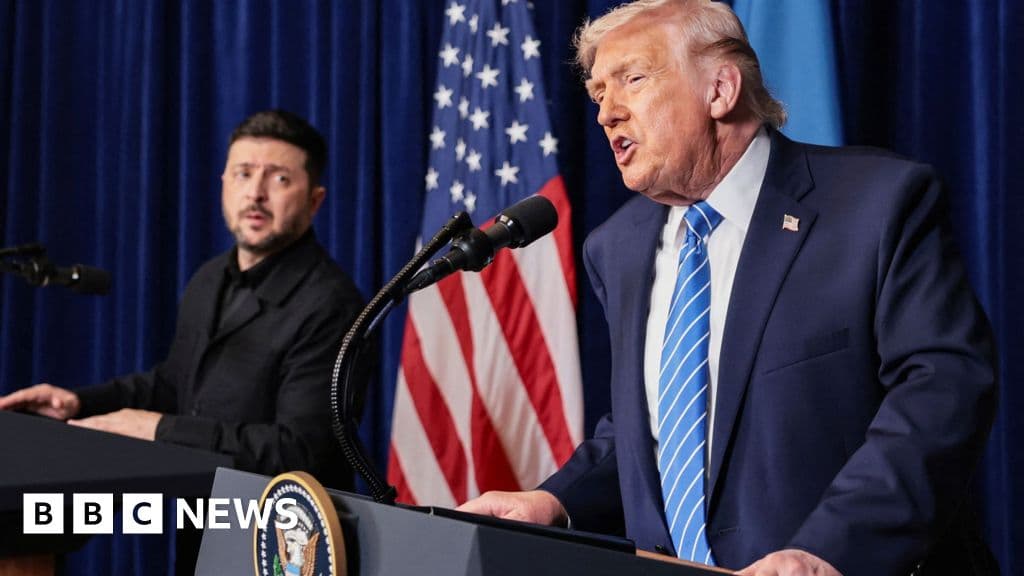
The path to ending Europe’s bloodiest conflict in decades narrowed significantly this weekend, as U.S. President Donald Trump and Ukrainian President Volodymyr Zelensky signaled a breakthrough in high-stakes talks at Mar-a-Lago.
For a world weary of war—and a Kenyan economy battered by the resulting fuel and fertilizer spikes—the emerging consensus offers a glimmer of stability, though the fate of occupied territories remains a formidable barrier to a final signature.
Emerging from the Florida estate, both leaders projected a rare unity. Zelensky, addressing reporters, revealed that negotiators had reached an agreement on "90%" of a comprehensive 20-point peace plan. Trump corroborated the sentiment, noting that crucial security guarantees for Ukraine were "close to 95%" finalized.
This marks a significant pivot from the diplomatic stalemate that has characterized the last year of fighting. Zelensky described the dialogue as "substantive," emphasizing the value of the progress made by American and Ukrainian teams over recent weeks.
"We had a substantive conversation on all issues," Zelensky noted in a statement via Telegram, confirming that technical teams would reconvene next week to hammer out the remaining details.
However, the optimism is tempered by what Trump termed "one or two very thorny issues." The core friction point remains geography. Russia, which launched its full-scale invasion in February 2022, currently controls approximately 20% of Ukrainian territory.
The negotiations have hit a wall regarding the Donbas region in eastern Ukraine. A proposal to convert this Russian-controlled area into a demilitarized zone remains "unresolved," according to the U.S. President.
Trump’s comments to the press highlighted the fluidity—and danger—of the situation on the ground:
While the talks are happening in Florida, the repercussions are being felt in Nairobi. The nearly four-year war has been a primary driver of global inflation, disrupting supply chains that Kenya relies on. The conflict previously sent the cost of fertilizer and fuel to historic highs, directly impacting the cost of living for the mwananchi.
A resolution could stabilize global grain markets and energy prices, potentially easing the pressure on the Kenya Shilling (KES) against the dollar. However, analysts caution that a peace deal that cedes too much territory could set a precarious precedent for international sovereignty.
As teams prepare for the next round of talks, the world watches with bated breath. The framework for peace is visible, but as is often the case in geopolitics, the devil is in the details of the map.
Keep the conversation in one place—threads here stay linked to the story and in the forums.
Sign in to start a discussion
Start a conversation about this story and keep it linked here.
Other hot threads
E-sports and Gaming Community in Kenya
Active 9 months ago
The Role of Technology in Modern Agriculture (AgriTech)
Active 9 months ago
Popular Recreational Activities Across Counties
Active 9 months ago
Investing in Youth Sports Development Programs
Active 9 months ago



