We're loading the full news article for you. This includes the article content, images, author information, and related articles.
President Donald Trump has announced a dramatic expansion of American naval power, unveiling plans for a new class of powerful battleships named after himself as part of a new 'Golden Fleet' initiative.
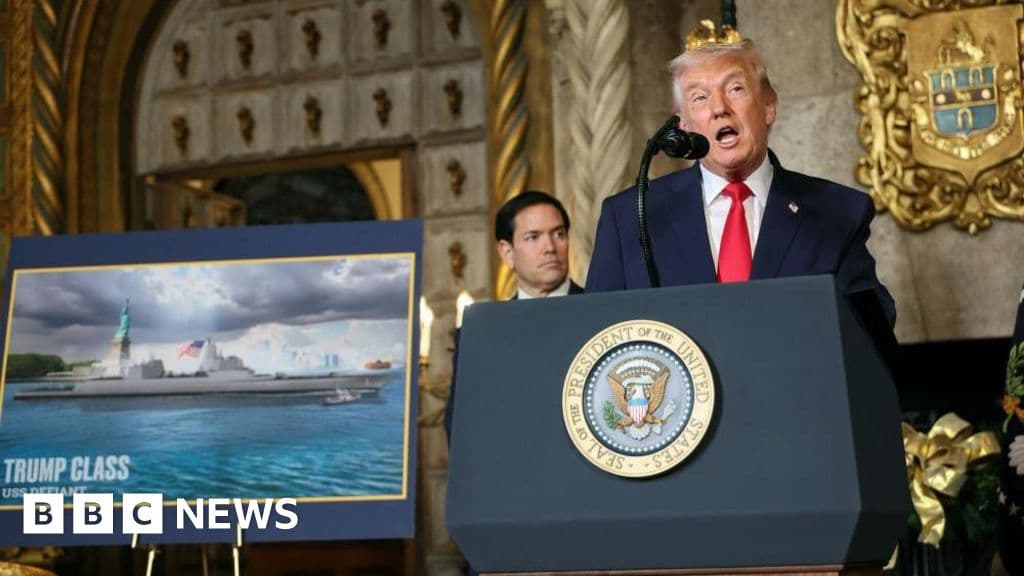
In a move set to redefine naval warfare, President Donald Trump has announced the United States will build a new generation of heavily armed battleships, with the first vessels to be named after himself. The declaration, made from his Mar-a-Lago club in Florida, launches a massive shipbuilding effort dubbed the 'Golden Fleet,' aimed at asserting American maritime dominance.
This initiative directly confronts warnings from defense officials about the United States falling behind China's formidable shipbuilding capacity. The plan calls for an initial construction of two 'Trump-class' warships, with a long-term goal of up to 25, representing a generational investment in American sea power. The first ship of this new class is slated to be named the USS Defiant.
Flanked by top administration officials, including Secretary of War Pete Hegseth and Secretary of the Navy John Phelan, Trump promised the ships would be the "largest, deadliest, and most versatile" warships on the oceans. These vessels are projected to be colossal, displacing 35,000 to 40,000 tons—more than double the size of the US Navy's current largest surface combatants, the Zumwalt-class destroyers.
The administration claims these battleships will be equipped with futuristic weaponry. The plans include:
Each battleship comes with a staggering price tag, estimated to be between $10 billion and $15 billion (approx. KES 1.3 to 1.95 trillion). Trump emphasized that the domestic construction of these vessels would create thousands of American jobs.
While the announcement focuses on the strategic competition between the US and China, the ripple effects of such a massive military investment will be felt globally. For Kenya, a key partner in regional security, a significant shift in American military posture could influence everything from maritime security in the Indian Ocean to the balance of power in East Africa. The immense cost also raises questions about global resource allocation, as the price of a single battleship dwarfs the annual budgets of many developing nations.
Navy Secretary John Phelan noted the new ships would serve as command centers for entire battle groups, coordinating everything from drones to other warships. "We're going to make battle groups great again," Phelan stated, echoing a familiar Trump slogan. When asked if the fleet was designed to counter China, President Trump was dismissive, stating, "It's a counter to everybody. It's not China."
The project is not without its challenges. The US shipbuilding industry has faced significant delays and cost overruns in recent years, a fact Secretary Phelan himself has acknowledged. Yet, the administration appears resolute. As Secretary Hegseth put it, the new fleet marks a "generational commitment to American sea power."
Keep the conversation in one place—threads here stay linked to the story and in the forums.
Sign in to start a discussion
Start a conversation about this story and keep it linked here.
Other hot threads
E-sports and Gaming Community in Kenya
Active 9 months ago
The Role of Technology in Modern Agriculture (AgriTech)
Active 9 months ago
Popular Recreational Activities Across Counties
Active 9 months ago
Investing in Youth Sports Development Programs
Active 9 months ago



