We're loading the full news article for you. This includes the article content, images, author information, and related articles.
As South Korea hosts the leaders of the United States and China for the APEC summit, the delicate balancing act offers critical lessons for Kenya and East Africa on navigating the treacherous currents of great power rivalry while safeguarding national economic and security interests.
SEOUL, SOUTH KOREA – In the bustling streets of Gwanghwamun square, central Seoul, the stark reality of South Korea's geopolitical dilemma was on full display. On Wednesday, 29 October 2025 (EAT), just days before the Asia-Pacific Economic Cooperation (APEC) summit, hundreds of protestors gathered near the United States embassy, their chants of "No Trump!" echoing through the city. A short distance away, a rival demonstration voiced equally strong opposition to Beijing's influence, with banners proclaiming "No China" and "CCP Out!".
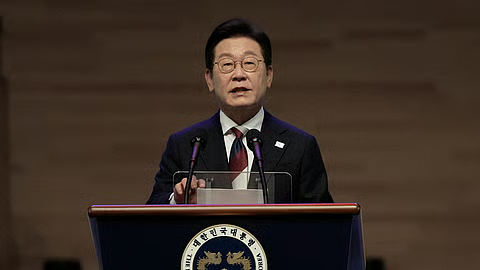
These scenes underscore the immense pressure facing South Korean President Lee Jae-myung, who is navigating a high-stakes diplomatic ballet. He is tasked with hosting both U.S. President Donald Trump and Chinese President Xi Jinping, leaders of two global superpowers with deeply intertwined, yet often conflicting, interests in the Korean Peninsula and the wider Indo-Pacific region. The summit, held in Gyeongju, is the first time in 13 years that leaders from both Washington and Beijing have visited South Korea simultaneously.
South Korea's predicament is rooted in a fundamental economic and security paradox. China is, by a significant margin, South Korea's largest trading partner. In 2024, bilateral trade reached approximately $328.08 billion, with China accounting for 25% of South Korea's total exports. This deep economic integration, formalized by a 2015 bilateral Free Trade Agreement, makes Beijing an indispensable partner for Seoul's prosperity.
Simultaneously, the United States remains South Korea's crucial security guarantor and a vital economic ally. The 1953 Mutual Defense Treaty forms the bedrock of this relationship, with approximately 28,500 U.S. troops stationed in the country as a deterrent against North Korean aggression. This alliance, often described as being "forged in blood" during the Korean War, is a cornerstone of regional stability.
President Lee Jae-myung, who took office in June 2025, has advocated for a "pragmatic, national-interest-centered diplomacy," aiming to balance these competing allegiances. His administration seeks to maintain the robust security alliance with Washington without alienating Beijing, a departure from his predecessor's more confrontational stance towards China.
South Korea's diplomatic balancing act holds significant relevance for Kenya and the broader East African region. Like Seoul, Nairobi maintains critical and complex relationships with both Washington and Beijing. China stands as Kenya's largest bilateral lender and a primary trading partner, funding key infrastructure projects such as the Standard Gauge Railway (SGR). In the first quarter of 2025, trade between Kenya and China grew by 11.9% to approximately $2.24 billion.
Meanwhile, the United States is a major market for Kenyan exports, particularly under frameworks like the African Growth and Opportunity Act (AGOA), and a key partner in regional security. The escalating trade tensions between the U.S. and China, marked by renewed tariffs under the Trump administration, place nations like Kenya in a precarious position, potentially disrupting trade and investment flows.
As observed by Darcie Draudt-Vejares of the Carnegie Endowment for International Peace, South Korea epitomizes the challenge faced by many nations: being deeply economically integrated with both superpowers. President Lee's strategy of seeking to be a "bridge of exchanges and cooperation" between East and West is a model that African nations, including Kenya, are watching closely. This approach requires careful diplomacy to leverage the benefits of relationships with both powers while avoiding being caught in their geopolitical crossfire.
The APEC summit in Gyeongju, therefore, is more than a regional meeting; it is a test case for middle-power diplomacy in an era of superpower competition. The outcomes of the trilateral discussions between Lee, Trump, and Xi on trade, security, and technology will reverberate globally, offering insights and potential pathways for countries like Kenya striving to chart a sovereign and prosperous course in a complex, multipolar world.
Keep the conversation in one place—threads here stay linked to the story and in the forums.
Sign in to start a discussion
Start a conversation about this story and keep it linked here.
Other hot threads
E-sports and Gaming Community in Kenya
Active 9 months ago
The Role of Technology in Modern Agriculture (AgriTech)
Active 9 months ago
Popular Recreational Activities Across Counties
Active 9 months ago
Investing in Youth Sports Development Programs
Active 9 months ago



