We're loading the full news article for you. This includes the article content, images, author information, and related articles.
Satellite imagery confirms Iran is reinforcing tunnel entrances at the "Pickaxe Mountain" nuclear complex, pouring concrete and leveling earth to protect the underground site from potential airstrikes.
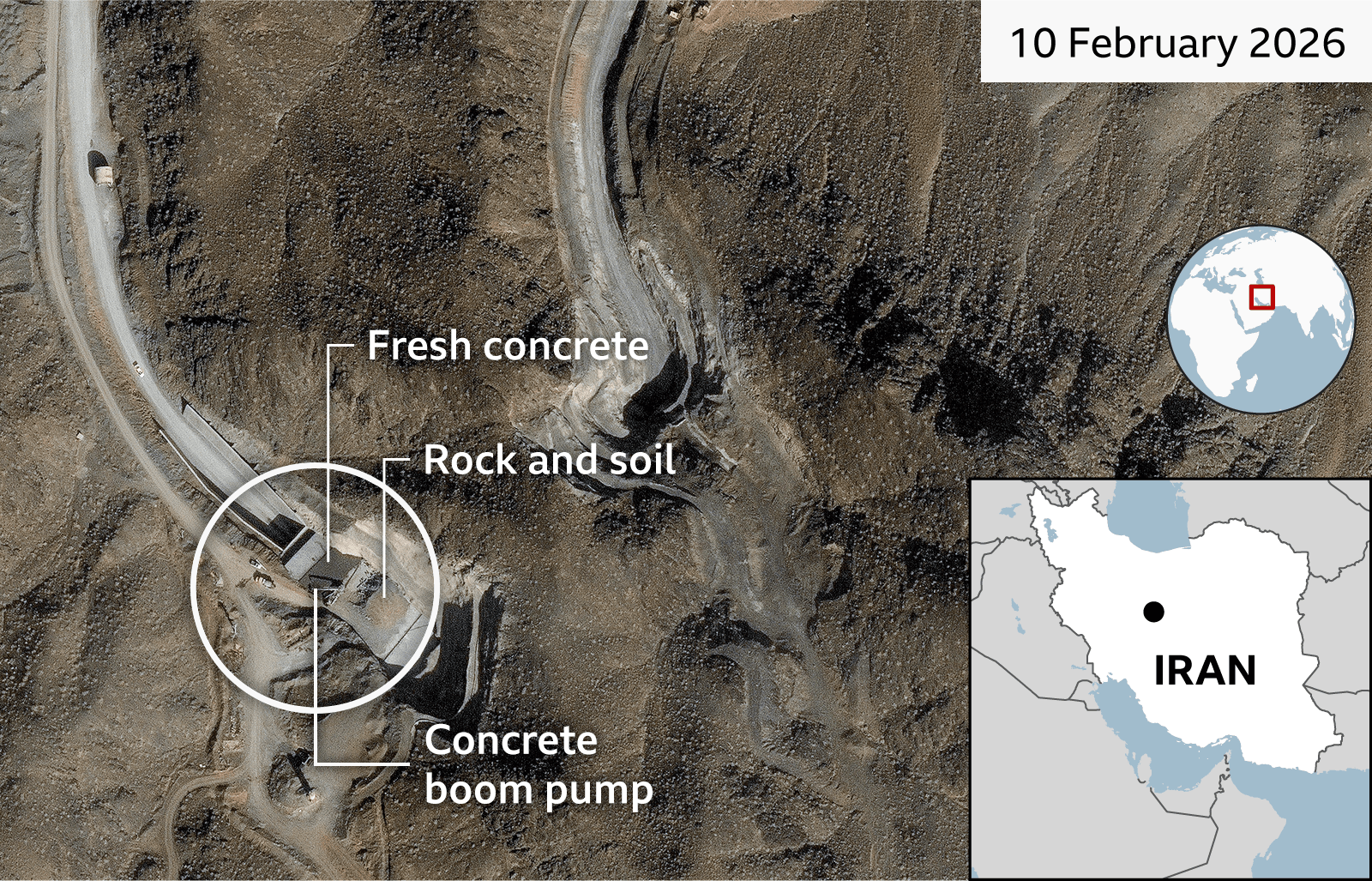
New satellite intelligence exposes a rush by Tehran to harden its underground nuclear facilities against airstrikes, signaling a new phase of entrenched resistance.
Iran is aggressively fortifying a massive underground tunnel complex near its Natanz nuclear site, according to new high-resolution satellite imagery analyzed by Western intelligence. The construction drive at the Kolang-Gaz La Mountain, known colloquially as "Pickaxe Mountain," suggests Tehran is preparing for a potential military confrontation by burying its most sensitive atomic assets deeper beneath the earth than ever before.
The Institute for Science and International Security (ISIS) has identified a surge in activity at the site, with dump trucks, cement mixers, and heavy excavation machinery operating around the clock. The imagery, captured on February 10, 2026, reveals the construction of reinforced concrete "headworks" at tunnel entrances—massive structures designed to shield the facility from bunker-busting munitions. This fortification comes as geopolitical tensions reach a boiling point, with fears of an imminent US or Israeli strike driving the regime’s defensive calculus.
The "Pickaxe Mountain" complex represents a strategic evolution in Iran`s nuclear doctrine. Unlike surface facilities that are vulnerable to sabotage and aerial attack, this deep-burial site is engineered to be impregnable. David Albright, president of the Institute, noted that the modifications are "likely intended to strengthen tunnel portals and improve resistance against potential airstrikes."
Analysts have spotted concrete being poured over the western tunnel extension and earth-moving equipment leveling the ground at the eastern portal. This is not merely maintenance; it is a frantic effort to create a fortress capable of surviving a "decapitation" strike. While the facility is assessed as not yet fully operational, the presence of smaller, closed-roof vehicles suggests that internal outfitting—potentially the installation of advanced centrifuges—may already be underway.
The fortification of Kolang-Gaz La fundamentally alters the military options available to Iran’s adversaries. If Tehran succeeds in moving its enrichment cycle into this "zone of immunity," the window for a conventional military solution to the Iranian nuclear question may close permanently. Western intelligence agencies are now racing to assess whether the facility is intended for uranium enrichment or, more ominously, warhead storage.
For now, the satellite photos tell a clear story: the shovels are digging, the concrete is pouring, and the Islamic Republic is literally cementing its nuclear ambitions into the bedrock of the Zagros Mountains. The world is watching a slow-motion race between the hardening of these tunnels and the patience of the international community.
Keep the conversation in one place—threads here stay linked to the story and in the forums.
Sign in to start a discussion
Start a conversation about this story and keep it linked here.
Other hot threads
E-sports and Gaming Community in Kenya
Active 9 months ago
The Role of Technology in Modern Agriculture (AgriTech)
Active 9 months ago
Popular Recreational Activities Across Counties
Active 9 months ago
Investing in Youth Sports Development Programs
Active 9 months ago



