We're loading the full news article for you. This includes the article content, images, author information, and related articles.
For individuals who prefer controlled coordination—clear boundaries, intentional venues, and disciplined communication—Kilele provides an environment designed around safety-first logistics as standard practice. Request a private brief and structured onboarding pathway via KILELE.APP.
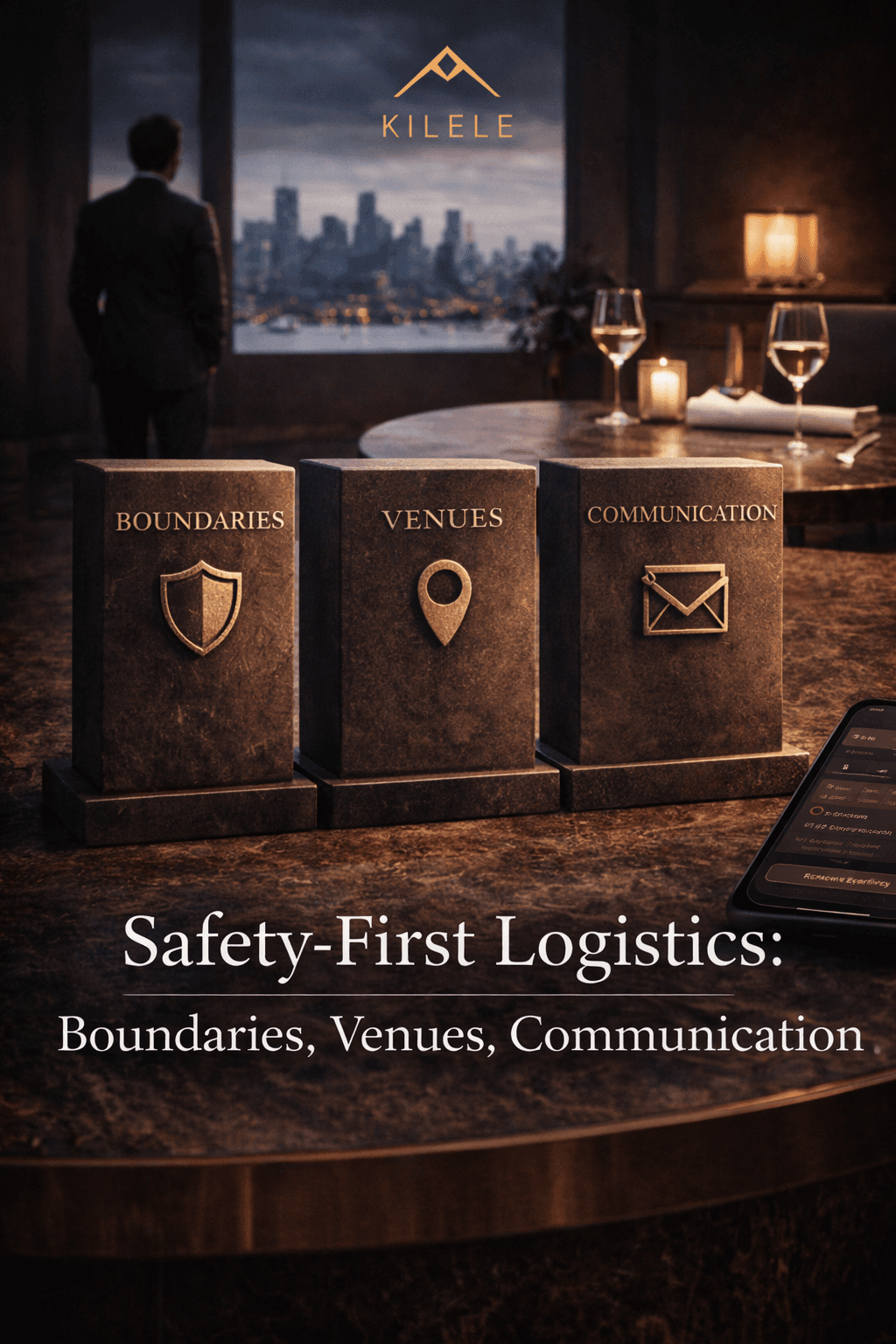
Safety is rarely a single decision. It is an operating method. In high-trust environments, people do not “feel safe” because someone promised discretion; they feel safe because logistics remove ambiguity. Boundaries are explicit. Venues are chosen with intent. Communication follows a disciplined sequence. The system does not rely on personality to prevent risk. It relies on structure. For individuals whose time, reputation, and privacy carry real weight, safety-first logistics is not caution. It is competence.
Control is the standard.
Most social coordination fails for predictable reasons. It begins too quickly, with too little context, inside channels designed for speed rather than governance. Plans are arranged in fragments. Expectations remain implied. Location decisions are made for convenience, not for risk containment. Communication becomes reactive—multiple threads, unclear confirmations, inconsistent tone, shifting intent. While the majority experiences this as “normal dating chaos,” the real inefficiency is structural: low-context entry produces high-friction coordination. The result is not just wasted time. It is increased variance—unnecessary exposure, misread intentions, and avoidable negotiation at the worst possible stage: after commitment.
The strategic cost of ignoring logistics is subtle but compounding. Time leaks through back-and-forth clarifications. Reputation exposure increases when details travel through uncontrolled pathways. Misaligned access grows when boundaries are discovered mid-interaction rather than set at entry. Cognitive load rises because the individual becomes the safety system—screening, correcting, and managing uncertainty in real time. Nothing catastrophic needs to happen for this to be a problem. For high-level individuals, unpredictability itself is the cost. It forces attention onto risk management instead of presence and decision-making.
A safety-first logistics model is simple in principle: boundaries first, venue second, communication always. It treats coordination as a controlled process, not a spontaneous negotiation. It assumes that discretion is not a vibe; it is a sequence. This is how private networks operate: fewer variables, clearer protocols, minimal exposure. Kilele aligns with this architecture as a control layer—designed to reduce variance at the point of entry and support predictable coordination inside a governed environment.
Boundaries are the first pillar because they prevent downstream negotiation. A boundary is not a demand; it is an operating constraint. The most effective boundaries are calm, specific, and non-performative. They clarify intent, pacing, and expectations without overexplaining. They also establish what will not happen—without turning the interaction into a debate. In practice, boundaries protect three things: privacy, time, and emotional bandwidth. They ensure that the interaction begins inside a defined lane rather than expanding into ambiguity. High-trust individuals do not “test” boundaries; they respect them or they exit. That is the point of stating them early.
Venue selection is the second pillar because venue is governance in physical form. Many people choose venues for aesthetics or convenience; safety-first coordination chooses venues for control. The objective is not paranoia. It is predictability. A good venue supports clear arrival and departure, low exposure, and a neutral context that prevents escalation. It allows two people to meet without forcing intimacy or extended commitment. It reduces the likelihood of being “stuck” in a situation that requires negotiation to exit. In high-trust circles, the first venue is rarely the most private. It is the most controllable. Privacy is earned through alignment, not assumed through setting.
Communication is the third pillar because communication is where most risk quietly enters. The problem is not messaging itself; it is the absence of protocol. Without structure, communication becomes a pressure channel—too frequent, too ambiguous, too emotional, too fast. A safety-first model uses clean communication: a small number of messages that confirm intent, time, venue, and boundaries. It avoids oversharing, avoids late-night ambiguity, avoids language that invites negotiation around limits. The tone remains composed. The objective is not romance through text. The objective is operational clarity.
These three pillars reduce four categories of risk without dramatization. First, visibility risk decreases when details are shared selectively and venues are chosen to reduce exposure. Second, context risk decreases when boundaries are explicit before plans solidify. Third, coordination risk decreases when confirmation follows a predictable sequence rather than scattered threads. Fourth, reputation risk decreases when discretion is treated as default behavior, not a request. Structured logistics do not eliminate risk. They reduce variance. That reduction is the real benefit.
A controlled scenario makes the difference obvious. Consider an executive visiting a new city for five days. In an unstructured system, coordination often starts with chemistry and ends with friction: vague plans, last-minute changes, unclear expectations, unnecessary disclosure, and a sense of improvisation that pulls attention away from the executive’s actual priorities. Now change the process. Boundaries are stated early and calmly. A neutral venue is selected by design, not impulse. Communication confirms details once, cleanly, then stops. The executive arrives with clarity and leaves with control. The interaction has less noise, less exposure, and fewer moving parts. The outcome is not “more exciting.” It is more predictable. Predictability is the luxury.
Safety-first logistics is also an authority signal. It communicates maturity without requiring explanation. People who can operate inside structured coordination tend to respect it immediately. People who cannot often reveal themselves through pressure, urgency, or boundary-testing. That information is valuable. In discreet environments, the goal is not to persuade everyone into alignment. It is to identify alignment quickly and avoid spending time negotiating it into existence.
This is why private ecosystems rely on process. Public platforms optimize for reach and engagement; private networks optimize for governance and control. When safety and discretion matter, the core question is not “Who is available?” It is “Who can operate within standards?” Kilele is designed for this logic: an access layer that supports verification, conduct expectations, and safety-first coordination so that discretion is embedded into how interactions begin—not patched in later.
Safety-first logistics does not make someone distant. It makes them deliberate. It does not remove warmth. It removes ambiguity. It is the difference between improvisation and operation. Not everyone needs that level of structure. Many people will find it unnecessary. Those who do require it recognize the advantage quickly, because they understand the cost of variance: time leakage, exposure, and cognitive load.
A quiet conclusion remains: safety is not a feeling. It is a system.
Keep the conversation in one place—threads here stay linked to the story and in the forums.
Sign in to start a discussion
Start a conversation about this story and keep it linked here.
Other hot threads
E-sports and Gaming Community in Kenya
Active 9 months ago
The Role of Technology in Modern Agriculture (AgriTech)
Active 9 months ago
Popular Recreational Activities Across Counties
Active 9 months ago
Investing in Youth Sports Development Programs
Active 9 months ago