We're loading the full news article for you. This includes the article content, images, author information, and related articles.
President's conflicting directives on school management have thrown the education sector into disarray, leaving parents and teachers in Nakuru and across the nation grappling with uncertainty just as the school calendar begins.
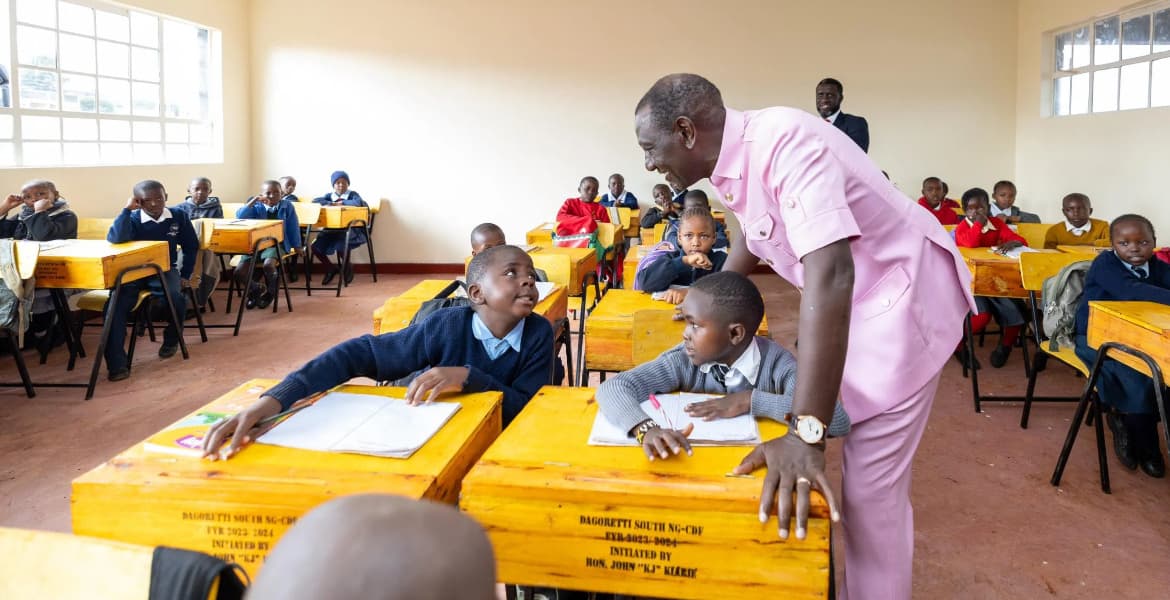
President William Ruto’s abrupt reversal on the management of Junior Schools (JS) has ignited a firestorm of confusion across Kenya’s education landscape, leaving over 23,000 primary school heads, teachers, and parents in a state of anxiety. The policy whiplash threatens the careers of thousands of educators and casts a long shadow over the future of 1.1 million Grade 9 learners set to transition to Senior School in January 2026.
At the heart of the chaos is a direct contradiction. Barely three months after championing a “Comprehensive School” model that places Junior Schools under the authority of primary school head teachers, the President has now pledged autonomy for JS teachers. This U-turn has left parents and educators wondering which policy to follow, creating a vacuum that undermines the stability of the Competency-Based Curriculum (CBC).
In September, President Ruto gave the Ministry of Education a 45-day deadline to finalize the legal framework for Comprehensive Schools, a structure designed to unify Early Childhood Development, Primary, and Junior School under a single principal. The move was initially embraced by the Kenya National Union of Teachers (KNUT) as a way to streamline administration. However, a recent promise to JS teachers to address their push for independence directly undermines this directive, a shift analysts attribute to political pressure from vocal teacher groups.
The Teachers Service Commission (TSC), meanwhile, appears to be proceeding with the comprehensive model. The TSC has proposed a structure with one principal overseeing two deputies—one for primary and one for junior school—and has directed headteachers to appoint acting deputies for the JS sections. This administrative move, occurring amidst the President's conflicting signals, has only deepened the confusion. Teachers in Nakuru have taken to the streets, arguing the comprehensive model is an “illegal entity” that undermines their qualifications and career progression.
This policy paralysis directly impacts the financial stability of Kenyan families. The government's model for Junior School within primary institutions includes a capitation grant of KES 15,000 per learner annually to facilitate free learning. This is intended to ease the burden on parents already struggling with the high cost of living. However, the reality on the ground is different, with many public schools still levying extra charges.
The alternative, an autonomous Junior School, hints at a different financial picture. In Nakuru, teachers argue that financial autonomy is necessary to stop the diversion of JS capitation funds to primary school needs. For comparison, private junior schools, which operate autonomously, have fee structures that can range from KES 70,000 to over KES 159,000 per term for boarders, illustrating the potential costs that could fall to parents without heavy government subsidies. The policy uncertainty leaves parents in a precarious position, unable to plan for future education costs.
The frustration is palpable across the country. In Kisumu, the Kenya Union of Post Primary Education Teachers (KUPPET) has threatened legal action to compel the government to grant JS full autonomy, citing mistreatment of teachers under primary school heads. A senior union leader, speaking anonymously, noted the sector is in “flux,” warning that the uncertainty threatens the careers of thousands of school heads.
The core of the teachers' grievances includes:
Cornelius Oduor of the Kenya Human Rights Commission warned that the constant “flip-flopping” on policy creates damaging uncertainty for both teachers and parents and accused the Head of State of “politicking with a crucial sector.” As the January 2026 transition looms, the lack of a clear, legally-backed structure leaves the foundational years of the CBC on shaky ground. A head teacher and official with the Kenya Primary Schools Headteachers Association (KEPSHA) accused the President of inconsistent communication, asking, “One day, we are told we will have a new structure; the next day, it's about autonomy. Which one is it?”
Keep the conversation in one place—threads here stay linked to the story and in the forums.
Sign in to start a discussion
Start a conversation about this story and keep it linked here.
Other hot threads
E-sports and Gaming Community in Kenya
Active 9 months ago
The Role of Technology in Modern Agriculture (AgriTech)
Active 9 months ago
Popular Recreational Activities Across Counties
Active 9 months ago
Investing in Youth Sports Development Programs
Active 9 months ago



