We're loading the full news article for you. This includes the article content, images, author information, and related articles.
President challenges cement makers to end reliance on foreign clinker, arguing Kenya has abundant raw materials to fuel its own construction boom and create thousands of jobs.
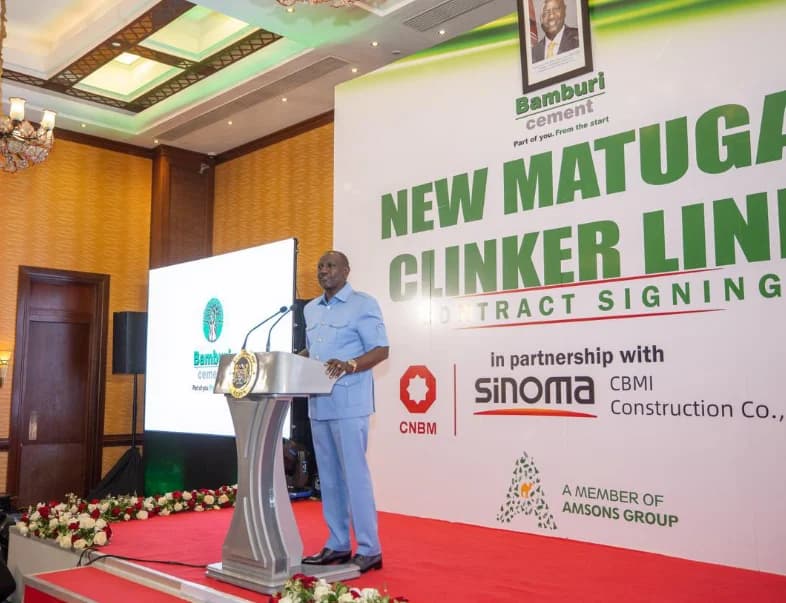
President William Ruto has issued a stark challenge to Kenya's cement industry, questioning the logic of spending billions of shillings to import basic raw materials he bluntly described as “stones.” His remarks, delivered at a high-profile contract signing in Nairobi, signal a hardening stance in his administration's push for local manufacturing.
The core of the issue is clinker, a critical component for cement production, which many Kenyan firms import despite the country sitting on vast deposits of limestone, the primary ingredient. “Somebody needs to explain to me why we need to import stones,” President Ruto stated, emphasizing the economic paradox. “How can we spend our money to import stones from other countries when we have our own stones?”
This presidential directive is not just rhetoric; it is the cornerstone of the government's 'Buy Kenya, Build Kenya' policy aimed at saving precious foreign exchange and creating local employment. The push for self-sufficiency is seen as essential for stabilizing the construction sector, a key driver of the economy and central to the government's ambitious Affordable Housing Programme.
For years, Kenya has been spending significant amounts on foreign clinker and gypsum. In 2023, the country imported gypsum worth $4.41 million (approx. KES 573 million), primarily from Thailand and Oman. Clinker imports have also been a major drain on foreign currency reserves, with the country spending billions annually. This reliance, the President argued, leaves the local market vulnerable to global price shocks and supply chain disruptions.
To counter this, the government has implemented protective measures, including an Export and Investment Promotion Levy on imported clinker, to make the local product more competitive. This policy has already had a dramatic effect, with government data showing clinker imports plummeted by over 90% in the past year.
The President's comments were made as he witnessed the signing of a landmark deal between Bamburi Cement and SINOMA-CBMI for the construction of a new $250 million (approx. KES 32 billion) clinker plant in Kwale County. This single project is expected to create over 10,000 jobs and significantly boost Kenya's domestic production capacity, reducing the need for imports.
This investment is one of several major projects underway, including a KSh45 billion plant in West Pokot commissioned in 2024, which are set to make Kenya a regional leader in cement production. The administration sees these developments as foundational to its economic transformation agenda. “Projects such as the Bamburi clinker line are therefore not isolated investments; they are foundational catalysts of our national transformation,” the President noted.
While the push for local production has been lauded by large-scale manufacturers, some smaller cement grinders who rely on imported clinker have previously raised concerns about potential shortages and price hikes. However, the government remains firm, insisting that harnessing Kenya's own natural resources is the only sustainable path forward. As President Ruto concluded, “We cannot import what we can produce in Kenya.”
Keep the conversation in one place—threads here stay linked to the story and in the forums.
Sign in to start a discussion
Start a conversation about this story and keep it linked here.
Other hot threads
E-sports and Gaming Community in Kenya
Active 10 months ago
The Role of Technology in Modern Agriculture (AgriTech)
Active 10 months ago
Popular Recreational Activities Across Counties
Active 10 months ago
Investing in Youth Sports Development Programs
Active 10 months ago



