We're loading the full news article for you. This includes the article content, images, author information, and related articles.
Secretary of State Marco Rubio told the Munich Security Conference that the US destiny is "intertwined" with Europe, attempting to heal rifts caused by trade disputes and Greenland tensions.
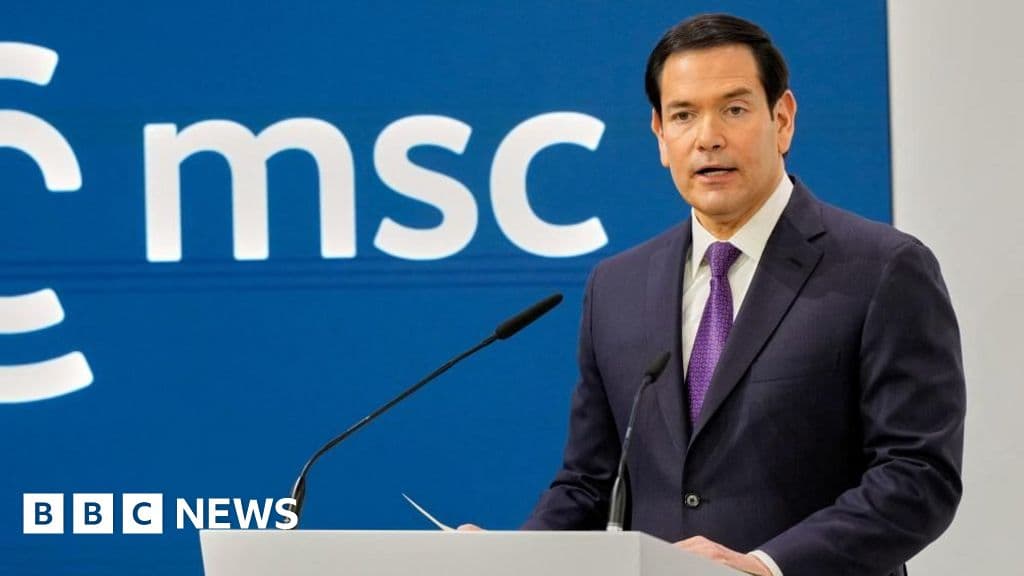
In a rhetorical pivot that stunned the Munich Security Conference, U.S. Secretary of State Marco Rubio declared that the United States does not seek to divorce itself from the Old World, offering a fragile olive branch to allies rattled by months of transatlantic turbulence.
The ghost of JD Vance’s combative 2025 speech still haunts the Hotel Bayerischer Hof, but today, Marco Rubio came to exorcise it. Standing before the assembled defense elite of the Western world, the Trump administration’s top diplomat delivered a message that was equal parts reassurance and admonition. The United States, he insisted, is not abandoning the ship of the Atlantic alliance—it just wants Europe to help row.
“We do not seek to separate, but to revitalize an old friendship and renew the greatest civilization in human history,” Rubio proclaimed, his tone markedly softer than the isolationist rhetoric that has characterized recent Washington dispatches. “For us Americans, our home may be in the Western Hemisphere, but we will always be a child of Europe.”
The speech was a calculated calibration. Europe has been on edge, particularly following Danish Prime Minister Mette Frederiksen’s alarming warnings about U.S. designs on Greenland. Rubio’s task was to soothe these anxieties without walking back President Trump’s "America First" doctrine. He threaded this needle by framing the tensions not as a breakup, but as a "family reckoning."
He admitted that the U.S. and Europe had "made mistakes together" in the post-Cold War era, specifically citing a "dogmatic vision of free and unfettered trade" that he claimed hollowed out industrial bases on both sides of the Atlantic. This was a clear signal: the protectionism is here to stay, but it can be a shared fortress rather than a trade war.
Despite the poetic overtures, Rubio did not spare the rod. He launched a targeted critique of European domestic policies, listing three areas where he believes the continent has lost its way:
Yet, the reception was surprisingly warm. European Commission President Ursula von der Leyen, often a target of Trumpist ire, described the speech as "very reassuring." This reaction betrays Europe’s current desperation: in a world of Russian aggression and Chinese ascension, a critical America is still preferable to an absent one.
Rubio’s comments come at a moment of extreme fragility. The war in Ukraine drags on, with Keir Starmer warning earlier in the day that "the solidity of peace is softening." By reaffirming the "civilizational bond," Rubio was attempting to shore up the psychological defenses of the West. He spoke of a "new century of prosperity" charted together, a vision that seemingly contradicts the transactional nature of his boss’s foreign policy.
Is this a genuine pivot, or a "good cop" routine played while the White House prepares its next tariff salvo? The skepticism in the room was palpable, but so was the relief. For now, the marriage stands.
"We want allies who can defend themselves so that no adversary will ever be tempted to test our collective strength," Rubio concluded, leaving the hall with a standing ovation that felt more like a collective exhale.
Keep the conversation in one place—threads here stay linked to the story and in the forums.
Other hot threads
E-sports and Gaming Community in Kenya
Active 9 months ago
The Role of Technology in Modern Agriculture (AgriTech)
Active 9 months ago
Popular Recreational Activities Across Counties
Active 9 months ago
Investing in Youth Sports Development Programs
Active 9 months ago