We're loading the full news article for you. This includes the article content, images, author information, and related articles.
With the national tree count at 1 billion against a 3 billion target, the Environment CS deploys 15,000 NYS officers and 17 new mass-production sites in a frantic push to green Kenya.
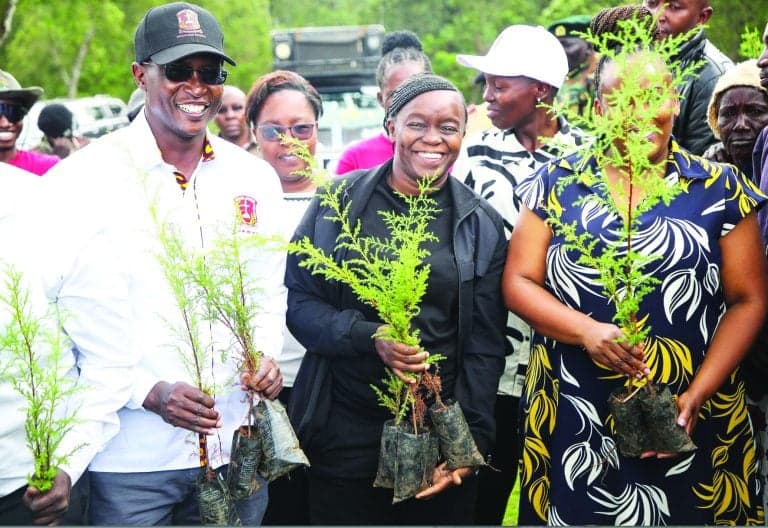
Environment Cabinet Secretary Deborah Barasa has admitted the government is racing against the clock to salvage its flagship 15-billion-tree pledge, revealing a massive strategic pivot to industrial-scale seedling production just days before the world descends on Nairobi for the UN Environment Assembly (UNEA-7).
Speaking during a tour of the Ngong Hills Forest Station and Nairobi Arboretum on Wednesday, Barasa disclosed that while the country has finally surpassed the 1 billion tree mark, it is significantly trailing the interim target of 3 billion trees set for this period. The admission comes as a reality check for the ambitious 2032 deadline, forcing the ministry to abandon business-as-usual approaches in favor of what she termed a "radical acceleration."
To bridge the widening deficit, the CS announced the immediate establishment of 17 "mega nurseries" across the country. Unlike standard community nurseries, these industrial hubs are designed to produce a staggering 25 million seedlings each per year. This centralized approach aims to flood the market with high-quality, drought-resistant seedlings that have often been in short supply during rainy seasons.
"We are calling on all stakeholders to ensure we achieve this target. It is achievable if everyone is working together," Barasa emphasized, noting that the current pace of planting by individuals and schools, while commendable, is mathematically insufficient to hit the 15 billion goal.
Complementing these mega-sites, the government will upgrade 300 existing nurseries to churn out at least 2 million seedlings annually. This shift signals a move from sporadic, ceremonial planting to a continuous, factory-like production line of biological assets.
In a move that intertwines environmental restoration with youth employment—a critical issue for the Kenyan economy—Barasa confirmed the enlistment of 15,000 National Youth Service (NYS) officers. These servicemen and women will not just be planting; they are tasked with the technical management of these nurseries, ensuring seedling survival rates improve from the dismal figures often seen in volunteer drives.
For the timber industry, the days of free riding are over. The CS issued a directive to sawmillers and the Timber Manufacturers Association to adopt specific forest blocks for restoration. "They should adopt forest areas, support schools to grow trees, and engage in ecosystem restoration," she asserted. This "polluter pays" principle effectively mandates that those who profit from felling trees must now directly fund their replacement.
The mathematics of the 15 billion campaign has always been daunting. To reach the 2032 finish line, Kenya needs to plant approximately 1.5 billion trees annually. The current figure of just over 1 billion cumulative trees since 2022 highlights the scale of the challenge.
Barasa insisted that accountability will be non-negotiable. The Jazamiti app, a digital platform designed to track planting in real-time, will be the primary tool for verification. "We need to have strong monitoring and evaluation tools using digital technologies to ensure there is no strain in the forest," she noted, warning that funding will be tied to verifiable data rather than estimates.
The timing of this overhaul is no coincidence. Next week, Nairobi hosts the seventh session of the United Nations Environment Assembly (UNEA-7), placing Kenya's environmental record under the global microscope. With the world watching, the government is keen to demonstrate that its 15 billion tree pledge is a concrete policy with budget and infrastructure behind it, not just a diplomatic talking point.
"We are looking at various ecosystems and restoring them... look at the flooding that occurred in Mai Mahiu," Barasa reminded the press, linking the abstract billions of trees to the visceral reality of climate disasters that have cost Kenyan lives and livelihoods. "These climate changes are what is calling us into action."
Keep the conversation in one place—threads here stay linked to the story and in the forums.
Sign in to start a discussion
Start a conversation about this story and keep it linked here.
Other hot threads
E-sports and Gaming Community in Kenya
Active 10 months ago
The Role of Technology in Modern Agriculture (AgriTech)
Active 10 months ago
Popular Recreational Activities Across Counties
Active 10 months ago
Investing in Youth Sports Development Programs
Active 10 months ago
Key figures and persons of interest featured in this article