We're loading the full news article for you. This includes the article content, images, author information, and related articles.
**In a rare televised exchange, the Russian leader defended repressive laws and offered a chilling glimpse into his vision for the nation, raising questions about future global stability and the direct impact on Kenyan households.**
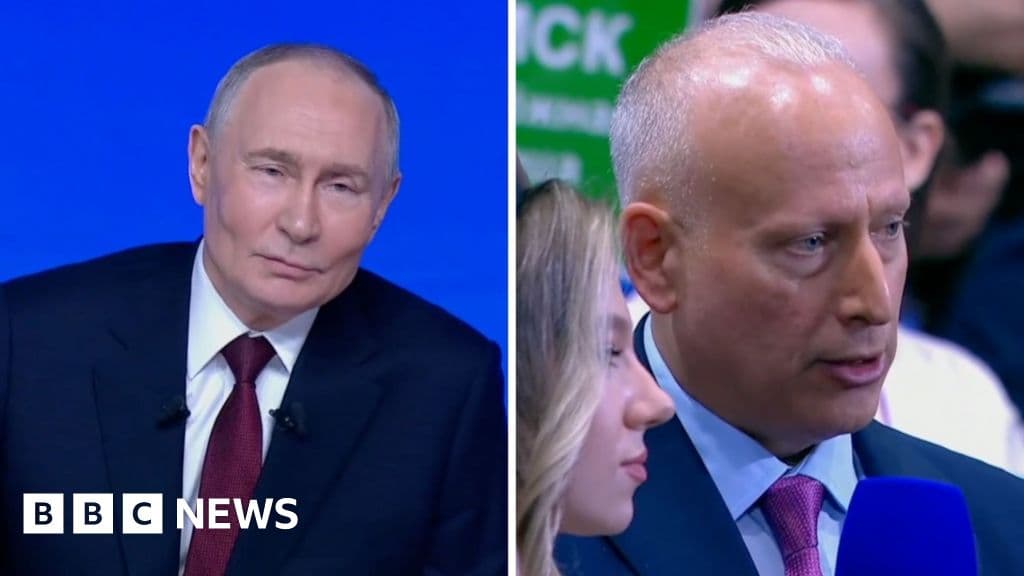
President Vladimir Putin, in a marathon televised press conference Friday, offered a defiant defense of his government's tightening grip on Russian society when challenged by a Western journalist on the country's future. The exchange provides a stark look into the Kremlin's mindset, with significant implications for a global order that directly influences the price of unga and fuel at home in Kenya.
The core of the confrontation came when BBC correspondent Steve Rosenberg asked Putin to clarify his vision for Russia. He questioned whether the future would involve more repressive laws, a continued hunt for enemies, and new “special military operations” — the Kremlin's term for its full-scale war in Ukraine.
Putin deflected the broader points, choosing instead to defend Russia's controversial "foreign agent" law. He asserted that the legislation merely requires individuals and organizations to declare foreign funding, a claim disputed by human rights groups and independent media. Critics note the law has been used to stifle dissent and target anyone deemed to be under undefined "foreign influence."
Russia's "foreign agent" legislation, first introduced in 2012 and progressively widened, now applies to any individual or group that receives any form of foreign support and engages in vaguely defined "political activities." This has been used to label hundreds of critics, journalists, and activists, effectively branding them as spies or traitors and subjecting them to intense scrutiny and legal peril. Contrary to Putin's claim that the law does not involve prison time, Article 330.1 of the Russian Criminal Code allows for jail sentences for non-compliance, a reality faced by several public figures.
This crackdown on internal opposition occurs as Russia's foreign policy continues to create economic shockwaves felt acutely in Kenya. The war in Ukraine, which Putin showed little sign of compromising on, has severely disrupted global supply chains for critical commodities.
The conflict's impact is not an abstract foreign affair; it lands directly on the budgets of Kenyan families.
During the press conference, Putin stated there would be no new wars if Russia's interests were respected by the West, a conditional promise that does little to ease global tensions. He claimed Russia was "ready and willing to end the conflict by peaceful means" but only if its "root causes"—a term widely seen as demanding acceptance of its territorial annexations—were addressed.
As the Kremlin continues to project an image of strength and defiance on the world stage, the consequences of its actions—both in tightening its grip at home and pursuing conflict abroad—reverberate globally. For Kenyans, this translates into continued uncertainty and pressure on the cost of living, linking the politics of Moscow directly to the price of daily bread in Nairobi.
Keep the conversation in one place—threads here stay linked to the story and in the forums.
Sign in to start a discussion
Start a conversation about this story and keep it linked here.
Other hot threads
E-sports and Gaming Community in Kenya
Active 9 months ago
The Role of Technology in Modern Agriculture (AgriTech)
Active 9 months ago
Popular Recreational Activities Across Counties
Active 9 months ago
Investing in Youth Sports Development Programs
Active 9 months ago



