We're loading the full news article for you. This includes the article content, images, author information, and related articles.
Fresh forensic analysis of victims' garments suggests the legendary eruption of Mount Vesuvius occurred in a cooler autumn, not the height of summer, challenging centuries of historical consensus.
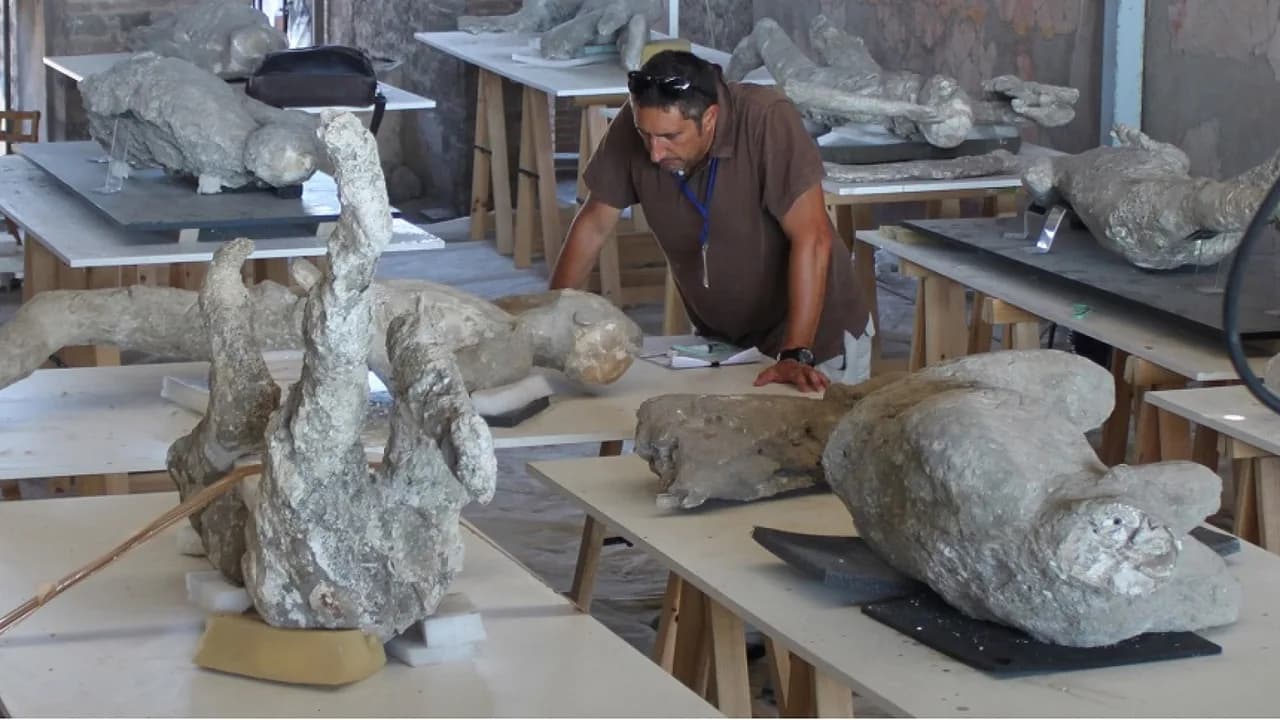
A long-held belief about one of history's most famous disasters is being questioned, not by ancient texts, but by the very clothes on the victims' backs. The silent figures of Pompeii, frozen in time, are offering new clues that could rewrite a pivotal date in the Roman Empire.
New research from Spanish archaeologists argues that the victims of Pompeii were wearing heavy wool, a strange choice for a sweltering Italian August. This forensic finding fuels a growing debate that shifts the catastrophic eruption of Mount Vesuvius from summer to autumn of 79 CE, revealing how modern science can unlock ancient secrets.
The ÁTROPOS research group from the University of Valencia led the study, analyzing 14 plaster casts of those who perished. Their findings, presented at an international congress, noted that several victims wore double layers—a tunic and a cloak—made of a heavy, thick-weave wool. "The clothing worn by the victims suggests not only the possibility of a colder-than-usual climate, but also a day with a harmful environment from which they needed to protect themselves," explained Llorenç Alapont, a University of Valencia archaeologist who headed the research.
For centuries, the eruption date was fixed to August 24th, based on letters from Pliny the Younger, who witnessed the event. However, the original copies of his letters are lost, and transcriptions over the centuries could have introduced errors. This new clothing analysis is the latest in a series of discoveries that point to a later date.
Other evidence challenging the August timeline includes:
The debate is more than academic. Pinpointing the correct season offers a more accurate reconstruction of the final days of Pompeii and Herculaneum. While a Roman disaster nearly two millennia ago may seem distant to the daily life of a Kenyan, the process is a powerful reminder. It shows how technology and critical re-examination of evidence can challenge long-held assumptions and bring us closer to the truth—a principle vital to understanding our own history and present.
While some scholars maintain the traditional August date, citing that wool was a common, all-purpose fabric, the accumulation of counter-evidence is becoming harder to ignore. The most accredited date among many researchers is now leaning towards October 24-25 of 79 CE. The debate underscores a crucial reality: history is not a static set of facts, but a dynamic story constantly being refined, with Pompeii's victims still speaking to us across the millennia.
Keep the conversation in one place—threads here stay linked to the story and in the forums.
Sign in to start a discussion
Start a conversation about this story and keep it linked here.
Other hot threads
E-sports and Gaming Community in Kenya
Active 9 months ago
The Role of Technology in Modern Agriculture (AgriTech)
Active 9 months ago
Popular Recreational Activities Across Counties
Active 9 months ago
Investing in Youth Sports Development Programs
Active 9 months ago



