We're loading the full news article for you. This includes the article content, images, author information, and related articles.
Nigeria and Angola have signed a bilateral visa-exemption agreement that removes visa requirements for holders of diplomatic and official/service passports travelling between the two countries on official business
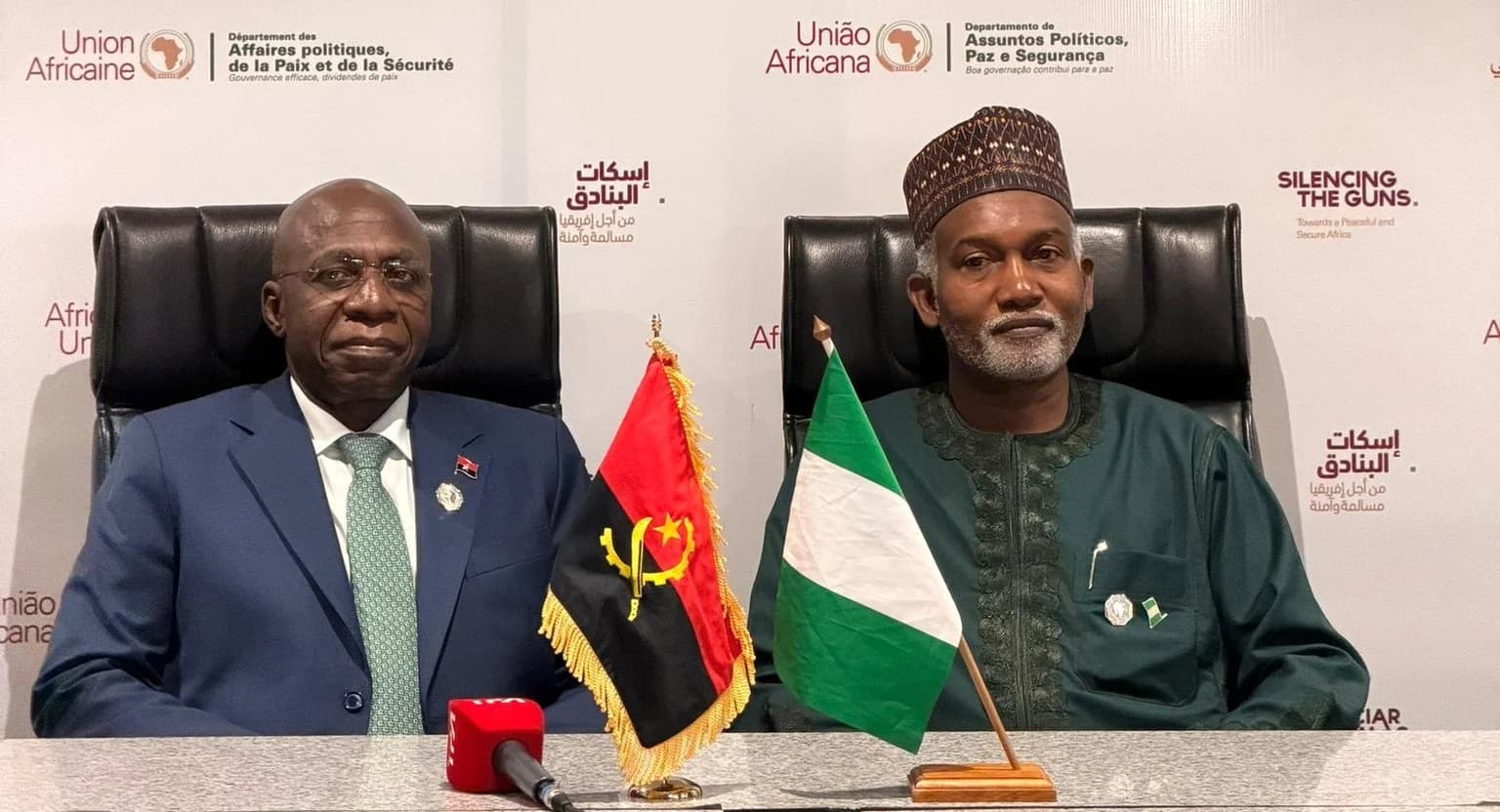
ADDIS ABABA — February 16, 2026: Nigeria and Angola have signed a bilateral visa-exemption agreement that removes visa requirements for holders of diplomatic and official/service passports travelling between the two countries on official business—an incremental but strategically meaningful move aimed at tightening state cooperation and reducing administrative friction.
Nigeria’s Foreign Affairs Minister Yusuf Maitama Tuggar framed the deal as overdue and explicitly positioned it as a practical accelerator for government-to-government work: the “visa exemption arrangement will facilitate smoother official exchanges, deepen institutional cooperation, and create broader opportunities for joint initiatives, dialogue and partnership.”
Multiple contemporaneous reports place the signing on Sunday, February 15, 2026, on the margins of the African Union summit in Addis Ababa, Ethiopia, with Angola represented by Foreign Minister Téte António.
Crucially, the arrangement applies to diplomatic and official/service passports—not ordinary passports—meaning it is designed to ease official missions, not general tourism or mass business travel.
Visa waivers for official passport holders can look symbolic, but they typically target a very specific bottleneck: the pace of statecraft.
1) Faster crisis and security coordination
When diplomatic clearances slow down, so does response time—whether on maritime cooperation, consular issues, intelligence exchanges, or multilateral positioning. Removing visas for senior officials reduces the transaction cost of convening quickly, including on short notice.
2) Higher bandwidth for trade and investment diplomacy
Nigeria and Angola are two of Africa’s major oil producers. Easier movement for economic officials often translates into more frequent technical delegations, renegotiations, and follow-through—especially where energy, refining, logistics, and financing require repeated, in-person government engagement. (The public reporting on the agreement frames this as enabling broader joint initiatives and institutional cooperation.)
3) Institutional “plumbing” for deeper agreements
In most bilateral relationships, the first wins are administrative: travel, protocols, and diplomatic conveniences. Those changes are often prerequisites for heavier instruments—mutual legal assistance, investment protections, double taxation conversations, security MoUs—because they enable more frequent working-level contact.
Tuggar also invoked Nigeria’s historical ties to Angola, including Nigeria’s role during Angola’s liberation-era diplomacy—a reminder that this agreement is being framed as a renewal of older political solidarity, not just a bureaucratic tweak.
This deal should not be confused with continental free-movement arrangements.
It does not create visa-free access for ordinary Nigerian or Angolan passport holders.
It does not substitute for the AU’s broader Free Movement of Persons Protocol, adopted in 2018, which targets progressive rights of entry, residence and establishment across Africa.
Continental free-movement remains uneven and slow-moving, which is why bilateral carve-outs like this one often advance sooner than Africa-wide frameworks.
Public reports so far focus on intent and symbolism. The impact will depend on implementation details that are typically clarified after signing:
Entry conditions: length of stay permitted per visit; whether it is strictly “official travel” and how that is evidenced.
Operational readiness: whether airlines, border posts, and diplomatic missions update guidance quickly (delays here can blunt the benefit).
Reciprocity and scope: whether it covers multiple-entry travel; whether it extends to certain categories of senior staff travelling with principals.
In the near term, expect a modest but immediate uptick in official visits, joint commissions, and working delegations—the kinds of engagements that often stall when visas and schedules collide. Over the medium term, the waiver becomes more consequential if it is followed by sector-specific cooperation (energy, investment facilitation, security coordination, and multilateral alignment within the AU and AfCFTA environment).
The most important signal is what comes next: a visa waiver for officials is often the first visible output of a relationship that intends to move from cordial statements to measurable coordination. Whether that happens will be evident in the next cycle of joint initiatives and signed instruments—especially those requiring repeated, technical face-to-face work.
Keep the conversation in one place—threads here stay linked to the story and in the forums.
Sign in to start a discussion
Start a conversation about this story and keep it linked here.
Other hot threads
E-sports and Gaming Community in Kenya
Active 9 months ago
The Role of Technology in Modern Agriculture (AgriTech)
Active 9 months ago
Popular Recreational Activities Across Counties
Active 9 months ago
Investing in Youth Sports Development Programs
Active 9 months ago