We're loading the full news article for you. This includes the article content, images, author information, and related articles.
NASA has rolled the Space Launch System back to Pad 39B, aiming for an April launch to send astronauts around the Moon for the first time in decades.
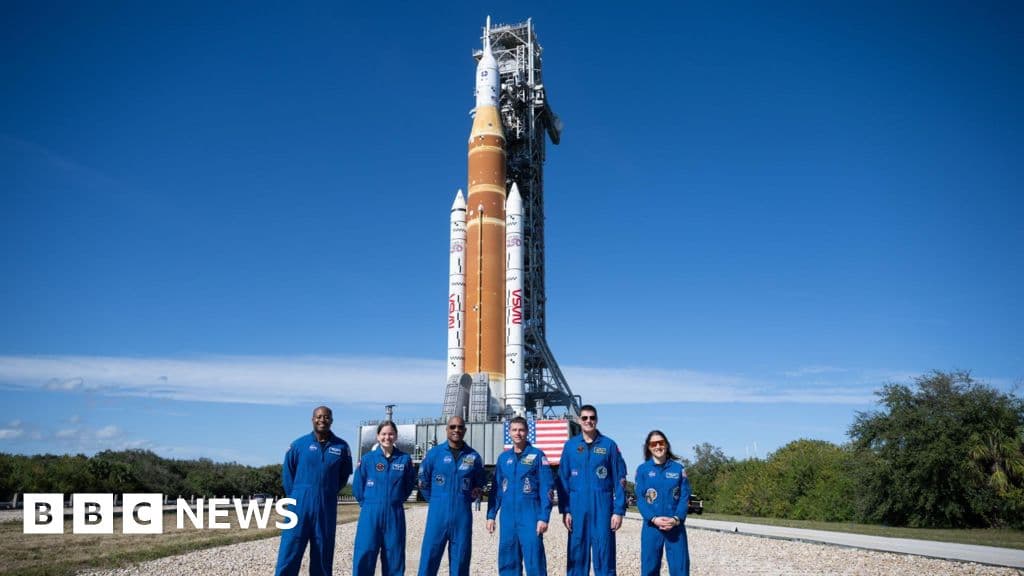
Under the cover of a Florida night, the most powerful rocket ever built by the United States once again crawled toward the launchpad. The 98-meter Space Launch System (SLS), a monument to modern engineering and immense federal expenditure, is traversing the four-mile path from the Vehicle Assembly Building to Pad 39B. This movement, however, is not a victory lap it is a critical recovery effort.
For NASA and its international partners, this rollout represents the culmination of intense remedial work following a grounding in March. With the clock ticking on a narrow launch window in early April, the stakes for the Artemis program—and for the future of human lunar exploration—have never been higher. At the heart of this challenge lies a complex helium system that engineers must prove is stable enough to propel astronauts into the deep void of space.
The journey to the pad is a study in calculated fragility. Standing taller than Big Ben’s clock tower, the SLS and its Orion spacecraft, when perched on their mobile launcher, represent a 5,000-tonne engineering marvel. They are transported by Crawler-Transporter-2, a legacy machine first constructed in 1965 to support the Apollo missions. This tank-like vehicle, moving at a maximum speed of 1.6 kilometers per hour, serves as the only bridge between the controlled environment of the assembly facility and the volatility of the launchpad.
The snail-like pace is not merely a technical limitation it is a necessity. Like carrying a fragile, priceless artifact, the slow, rhythmic movement minimizes structural stress on the rocket’s internal systems. Any sudden jolt or vibration could compromise the sensitive instrumentation housed within the fairing. Engineers and ground controllers observe this migration with heightened scrutiny, as every meter gained brings the mission closer to its launch threshold while simultaneously posing risks to the stability of the vehicle.
The decision to return the rocket to the Vehicle Assembly Building in March was driven by a malfunctioning helium system. Helium is critical in the SLS, primarily used to purge engines and pressurize propellant tanks. In a liquid-fueled rocket, these systems are essentially the circulatory system a leak or a pressure failure can result in catastrophic engine shutdown or, in the worst-case scenario, vehicle destruction during ascent.
NASA engineers have spent the intervening weeks meticulously replacing components and conducting pressure tests to ensure the integrity of these systems. The current rollout is a testament to the fact that space exploration remains an unforgiving discipline where a single mechanical failure can delay multi-billion dollar missions by months. Once locked into position at the pad, the vehicle will undergo a series of final system checks—a "wet dress rehearsal" of sorts—that will push the software and hardware to their limits without the presence of actual fuel.
While the focus is currently on the Florida coast, the implications of a successful Artemis mission extend far beyond North America. Space exploration is no longer a localized endeavor it is an increasingly crowded global stage. Nations such as China, India, and the European Union have accelerated their own lunar programs, and the successful return of humans to the Moon is widely viewed as the first step in establishing a permanent presence on the lunar surface.
For emerging space powers, the success of Artemis serves as a technical benchmark. In Nairobi, the Kenya Space Agency has been steadily building capacity, particularly in satellite technology for agricultural monitoring and climate change mitigation. While the technological delta between a national satellite program and a crewed Moon rocket is vast, the underlying principles of aerospace logistics, risk management, and international cooperation are shared. African nations are observing these developments with keen interest, recognizing that space-faring capabilities are becoming an essential component of national infrastructure and economic sovereignty.
The scale of the Artemis program cannot be overstated, both in terms of ambition and financial resources. The mission to send astronauts around the Moon is the foundational step for the Artemis program, which aims to eventually land the first woman and the first person of color on the lunar surface.
If the tests at Pad 39B prove successful, the window for an April launch will confirm that NASA has resolved the helium-related instability. However, spaceflight is a domain where plans are subject to constant revision by the physical realities of the universe. Should the upcoming tests reveal lingering issues, the program faces the risk of further, indefinite delays, a prospect that would surely frustrate both the scientific community and the political stakeholders funding the venture.
As the crawler arrives at its destination, the engineering teams prepare for the final, high-pressure tasks. The world watches, waiting to see if this slow, deliberate journey will conclude in a historic ascent or yet another pause in the long, arduous road back to the Moon.
Keep the conversation in one place—threads here stay linked to the story and in the forums.
Sign in to start a discussion
Start a conversation about this story and keep it linked here.
Other hot threads
E-sports and Gaming Community in Kenya
Active 10 months ago
The Role of Technology in Modern Agriculture (AgriTech)
Active 10 months ago
Popular Recreational Activities Across Counties
Active 10 months ago
Investing in Youth Sports Development Programs
Active 10 months ago



