We're loading the full news article for you. This includes the article content, images, author information, and related articles.
Dr. Monica Juma has challenged new diplomats to transition beyond traditional roles, prioritizing economic advocacy and regional security to safeguard interests.
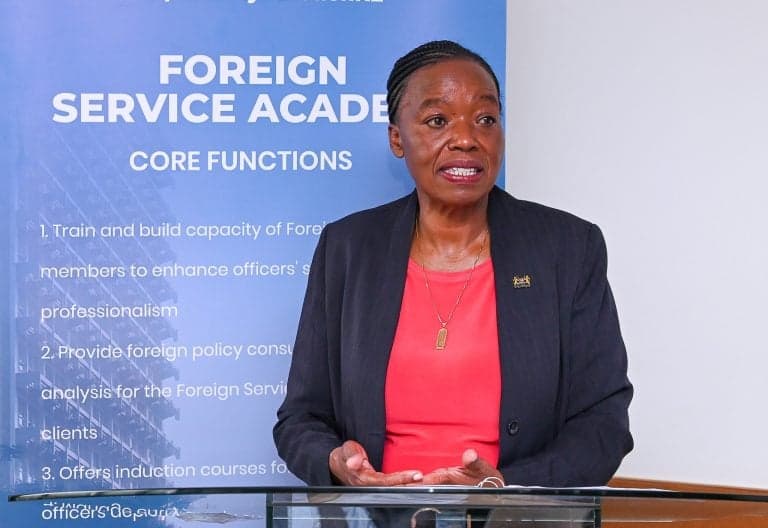
The shifting currents of global geopolitics demand a new breed of envoy, one capable of transcending traditional diplomatic ceremonial roles to become an active architect of economic and security policy. Dr. Monica Juma, the outgoing National Security Advisor, has issued a stark directive to a new cohort of foreign service officers preparing for their overseas postings: the priority is not merely representation, but the rigorous protection of Kenya’s strategic national interests.
For the diplomats, the stakes could not be higher. As Kenya positions itself as a pivotal regional hub within the African Continental Free Trade Area and a primary interlocutor for security initiatives in the Horn of Africa and the Great Lakes region, the personnel deployed to foreign capitals serve as the country’s frontline defense. Their effectiveness—or failure—directly correlates to the nation’s ability to attract foreign direct investment, secure favorable trade terms, and maintain critical security partnerships in an increasingly volatile global landscape.
The guidance provided by Dr. Juma underscores a significant pivot in Kenya’s diplomatic doctrine. Historically, foreign service roles were often viewed through the lens of political representation and consular support. However, the current economic climate, characterized by fluctuating global commodity prices and the urgent need for foreign exchange inflows, has necessitated a move toward what the Ministry of Foreign Affairs now describes as aggressive economic diplomacy.
This mandate requires diplomats to move beyond protocol and act as dealmakers. They must identify investment opportunities, facilitate market access for Kenyan exports, and engage with the Kenyan diaspora as a significant source of capital. For a nation managing a complex public debt profile, the ability of foreign missions to convert diplomatic goodwill into tangible economic partnerships is not merely an institutional goal it is a financial necessity.
The transition necessitates a shift in the skill sets required of officers. The modern diplomat must be proficient in:
Dr. Juma’s tenure as National Security Advisor was marked by a focus on integrating foreign policy with national security mandates. The outgoing advisor has frequently highlighted that Kenya’s internal peace is inextricably linked to regional stability. Diplomats are now being tasked with monitoring and preempting threats that originate beyond the borders, ranging from transnational organized crime and terrorism to climate-induced migration.
In the DRC and Somalia, Kenya has historically played a mediator role. Diplomats on the ground are the primary conduits of information that allow the state to manage these relationships effectively. Failure to accurately report on political shifts or security escalations in these host nations can leave Nairobi vulnerable to strategic surprises. Therefore, the directive to protect national interests is inherently a directive to maintain vigilant, actionable intelligence gathering and diplomatic communication.
Kenya is not unique in this shift. Across the globe, middle-power nations are redesigning their foreign service structures to survive in a multipolar world where traditional allies are increasingly distracted by domestic or larger geopolitical conflicts. From Turkey to Indonesia, states are demanding that their envoys act as extensions of their national trade ministries and intelligence agencies.
For the Kenyan officer, this mandate places an immense burden of responsibility. They must navigate a global environment where the cost of borrowing remains high and the competition for foreign investment is fierce. A single diplomatic miscalculation—be it an improperly handled trade delegation or a failure to anticipate a shift in a host nation’s foreign policy—can result in the loss of millions of dollars in potential revenue or the erosion of long-standing security alliances.
The upcoming postings represent a generational transition within the Foreign Service. These officers are expected to embody a new, harder-edged professionalism. They are no longer expected to be merely observers they are expected to be architects of the state’s foreign agenda. As the country approaches a new fiscal year, the pressure on these envoys to deliver results—measured in trade volume, investment commitments, and security cooperation—will define the success of the administration’s foreign policy framework.
The instructions left by Dr. Juma serve as a final strategic imprint on a diplomatic corps that is now tasked with navigating a world that offers no room for error. The true test of these officers will be their ability to translate high-level policy directives into meaningful outcomes for the citizens in Nairobi, Mombasa, and beyond. In an era of intense global competition, the diplomatic service is the first line of defense for the Kenyan economy and its sovereign integrity.
Keep the conversation in one place—threads here stay linked to the story and in the forums.
Sign in to start a discussion
Start a conversation about this story and keep it linked here.
Other hot threads
E-sports and Gaming Community in Kenya
Active 9 months ago
The Role of Technology in Modern Agriculture (AgriTech)
Active 9 months ago
Popular Recreational Activities Across Counties
Active 9 months ago
Investing in Youth Sports Development Programs
Active 9 months ago



